In this era of linking transportation and housing to find solutions to energy-related problems, it is heartening that the link was reflected in the wish list of solar/low carbon-emission houses produced for the 2011 Solar Decathlon that just took place in Washington, DC. For any of you not in the know, the Solar Decathlon is a finalist competition of 20 college and university teams from across the country and around the world. The teams are from all types of schools along the collegiate spectrum, this year including an impressive entry from a small liberal arts school (my husband's alma mater) in New England to giant state universities (one of which my sister works for and another 10 minutes from my house). Many of the homes are designed for specific regions and affordability is one component of the competition.
This year, two homes were designed as possible units in multi-family buildings. The City University of New York (CCNY) (my dad's alma mater) entrant was a house that could sit atop an apartment building, surrounded by a rooftop farm or other similar units. I have to admit I used to love spending time on the roof of my building when I was growing up. It is an oasis-in-the-city idea. It also made gorgeous use of light green recycled glass in the kitchen and bathroom. Team Tidewater from Virginia's Old Dominion University and Hampton University, produced a lovely house, the most formally decorated and architecturally detailed in the competition, designed as a unit for a small apartment building in a walkable old small city.
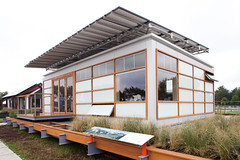
[CCNY house.]
I was happy to see that these schools thought about the energy use of their occupants beyond their front doors to where people travel in their daily lives.
Accessibility: Garden State and Beyond
New Jersey was not far behind in this respect. Its design assumed that homes are usually placed close enough together that privacy is desired and that floor-to-ceiling windows in every room do not provide that. (Disclosure: I had a private tour of the New Jersey house from my cousin, an architecture student, who was on the team.)
Another plus from Team New Jersey that reflected larger societal trends was its complete accessibility, even in the bathroom, for wheelchair users, so that a person in a wheelchair can do more than visit for a few hours, but can actually visit over night or live in the house. Other teams with equal accessibility were Florida International, Maryland, Illinois, Tennessee, and Appalachian State. Indeed, Florida International's design included grab bars throughout the bathroom.
[Bathroom of Appalachian State's house.]
Affordability
We can all have a dream house with enough money, but providing housing that meets societal and personal needs at an affordable price is a challenge. Affordability was well displayed in Team Belgium's entry. The home was made from a house kit the students designed that will enable do-it-yourself building. It is compact, livable and flexible for multiple uses. It also features a design element missing in the 2009 Solar Decathlon, two bedrooms, so that a family could live there.
A few other teams also featured two bedrooms, including Middlebury College (an impressive entrant with a green indoor vegetable wall in the kitchen) and Appalachian State (also beautiful with tin wall in bathroom and outdoor shed storage spaces). Florida International's design also seemed amenable to family use for long-term living.
Something heartening beyond the creativity and commitment of the students was the attention of many teams to universal design, cost concerns, and options (such as solar technology) that are available now. That a few teams actually placed their homes in specific types of walkable - and transit-friendly - locations was a big plus, and one that I hope extends beyond the competition.
[Middlebury's green wall in kitchen.]
Showing posts with label Universal Design. Show all posts
Tuesday, October 4, 2011
Thursday, June 10, 2010
Who Needs Sounds of the Road
American Council of the Blind
ACB has been pushing hard to resolve the dilemma of hybrid vehicles and the safety of people who are visually impaired. Hybrids are quieter than their conventional counterparts and in some circumstances fail to supply noises that are sufficiently loud to enable visually-impaired people to navigate streets. ACB supports passage of, the Pedestrian Safety Enhancement Act (H.R. 734, S. 841). This Act would require a Department of Transportation study and establishment of a motor vehicle safety standard for alerting blind and other pedestrians of motor vehicle operation. Both bills have been in committee since early 2009.
Now a National Highway Traffic Safety Report, Quieter Cars and the Safety of Blind Pedestrians: Phase I, posted on ACB’s website, studies the circumstances in which there is a difference between noise levels, whether those differentials impact safety, and the merits of possible countermeasures. Basically, noise levels differ at speeds up to 20 miles per hour. Two approaches for counter measures are discussed, (1) configuring hybrids so that they emit more noise and (2) producing devices that can be carried that warn people who are visually impaired that a quiet vehicle is nearby.
The report wisely observes what is true in many circumstances, that universal design measures that assist people with disabilities also help others. The boys and girls who play soccer and street hockey in the middle of the road or who ride bikes without paying too much attention to their surroundings need vehicle noise almost as much as someone who is blind and they are probably less likely to carry a personal noise emitter. The sound must also be recognizable as vehicular noise, the report noted, discussing the disadvantages of personal device sounds.
ACB has been pushing hard to resolve the dilemma of hybrid vehicles and the safety of people who are visually impaired. Hybrids are quieter than their conventional counterparts and in some circumstances fail to supply noises that are sufficiently loud to enable visually-impaired people to navigate streets. ACB supports passage of, the Pedestrian Safety Enhancement Act (H.R. 734, S. 841). This Act would require a Department of Transportation study and establishment of a motor vehicle safety standard for alerting blind and other pedestrians of motor vehicle operation. Both bills have been in committee since early 2009.
Now a National Highway Traffic Safety Report, Quieter Cars and the Safety of Blind Pedestrians: Phase I, posted on ACB’s website, studies the circumstances in which there is a difference between noise levels, whether those differentials impact safety, and the merits of possible countermeasures. Basically, noise levels differ at speeds up to 20 miles per hour. Two approaches for counter measures are discussed, (1) configuring hybrids so that they emit more noise and (2) producing devices that can be carried that warn people who are visually impaired that a quiet vehicle is nearby.
At present, only countermeasures that cause quiet vehicles to emit additional sound come close to meeting the requirements of blind pedestrians. Within this class of countermeasures, there is a fundamental distinction between systems that emit synthetic engine noise at all times when the vehicle is operating at low speeds, and those that emit noise only when triggered by a transmitter carried by blind pedestrians. The former eliminate the need for blind pedestrians to carry special transmitters, and also warn other pedestrians, cyclists and animals of the approach of quiet vehicles, while the latter minimize community noise impact.
The report wisely observes what is true in many circumstances, that universal design measures that assist people with disabilities also help others. The boys and girls who play soccer and street hockey in the middle of the road or who ride bikes without paying too much attention to their surroundings need vehicle noise almost as much as someone who is blind and they are probably less likely to carry a personal noise emitter. The sound must also be recognizable as vehicular noise, the report noted, discussing the disadvantages of personal device sounds.
Subscribe to:
Posts (Atom)


