Transportation Camp - Why Go?
Why get out of bed early on a Saturday morning in the middle of the winter - decidedly not summer camp weather - to leave your partner (if you have one), children (if you have them), pets (if you have them) and absolve yourself of all adult responsibility and the comforts of routine and loved ones to spend an entire day in windowless rooms - also not camp like - to discuss all aspects of transportation with 300 people, many of whom describe themselves as transportation geeks? Why attend an unconference, an event where there are no keynote speakers, predetermined sessions, experts, bios or daises?
Why? Because you will have fun - yes, it's camp - with people excited about walkable streets, better transit, open data, paratransit, bikesharing, bus rapid transit plans, and social media use by, for and perhaps with some hostility to transit. Indeed, upon arrival (without trunk, duffel bags, parents, or junk food), one does not even know what is on the program. But like any returning camper, one knows and sees friends, some from previous stays at camp and some from other venues - in this case twitter, normal conferences, and actual work. (Apologies to any twitter friends not recognized from those tiny twitter photos.)
Indeed, as Transportation Camp is an unconference, the campers suggest what will be discussed and offer their own expertise as speakers or as bunch of nerds interested in talking about something. Some come bearing presentations, cameras, tablets, and laptops; others admit they are concerned citizens without a resume and curious. Some come alone and others with lots of colleagues.
[Attendees reading session ideas posted on colorful, large post-its.]
And what actually happens at the camp social?
Not that anyone was flirting in the social hall or hanging out by the big tree at the lake (wait, that's actual camp), but one sees lots of connections being made, as if data, social media, transit, biking, walking soul mates are finding each other. I saw colleagues and friends from Ithaca, Iowa, Portland, and Boston, and met people from practically my own backyard interested in some of the same hometown (though inside the Beltway) issues. I think half of the
San Francisco DOT attended camp in Arlington. There were also a bunch of
mobility management professionals, some there to promote ideas, some
seeking ideas, and all wanting to share.
In terms of quality, sessions vary from amazing to "I should have chosen something else," with my own experience much more toward the former. As there are only four sessions over the course of the day and about 10 offerings during each time slot, there is often heard the cheerful complaint of an embarrassment of rich choices. If cloning were possible, ...
[Possible offerings displayed. Yes, this photo is intentionally gigantic so that some of the post-its can be read.]
One could easily have spent the entire day immersed in a virtual "track" of data sharing, open source, apps and other things that normal people (translation: someone like me) know little or nothing about. Instead, I chose a variety of different topics - (1) Transit social media engagement (with both the rider and the transit agency perspectives discussed), (2) universal design advocacy and planning for streets and transportation to suit all users (particularly people with disabilities), (3) sharing big ideas, and (4) bus rapid transit (BRT) plans and politics in the DC area.
Rural Roads Meet the Jetsons, Sort of?
What were some big ideas? Cost-effective personal rapid transit for rural areas; walkable streets - with access to transit - in suburban and rural areas; pre-purchased annual transportation with a menu of transportation choices (to replace one or more privately-owned vehicles). There were a ton more; that's just the tiniest of samples.
At the BRT session, a gentleman from Ireland supplied this DC-area crowd with a list of cities around the world with bus systems worthy of comparison.* Another gentleman, originally from suburban Maryland, talked about his BRT planning experiences in Brazil. Montgomery County's Rapid Transit Vehicle (RTV) plan was discussed in detail, including the role of the planning and transportation departments, which, by the way, report to different entities (the former reporting to the county council and the latter to the county executive). Other DC-area BRT activity described included Arlington, Howard and Prince William counties, with some of those more akin to express commuter services.
One Person's Mobility Experiences
The universal design session was led by a person who travels in a wheelchair and the session was very much informed by the her experiences, in terms of using the pedestrian network and transit, as well as advocacy and maintaining relationships with political leaders and other types of advocacy groups. She mentioned biking groups as one example of stakeholders that can be useful for people with disabilities in pushing for universal design and multi-modal streets. A controversy arose during the session about expertise of planners versus advocacy of residents and which deserves more weight, though most of the session was conducted in the spirit of building relationships with various stakeholders rather than a zero-sum game of right and wrong.
The social media session I attended (and there were quite a few offered) concentrated on twitter - from the perspective of the complaining rider and the transit agency. Effective engagement strategies were discussed rather than mere whining about service. At the center of the session was discussion about building relationships with staff at the transit agency and how to do that. Sometimes those tweeting interactions become actual relationships.
Tell your parents to sign you up for camp next year, or sign up yourself. Next camp is coming up soon in Atlanta - in February - another decidedly un-camp-like time of year. If we have camp in July, my porch is open for a front row seat at the Takoma Park July Fourth Parade. I'll even make bug juice.
*Cities with bus networks mentioned were Almere (Netherlands), Melbourne, Helsinki, Gothenburg (Sweden), and Nantes (France).
Showing posts with label Accessibility. Show all posts
Thursday, January 17, 2013
Wednesday, December 7, 2011
What it Takes to Walk - When You Cannot See
American Council for the Blind
ACB releases an updated Pedestrian Safety Handbook, a publication that informs the visually impaired and blind communities "about contemporary approaches to assuring safe paths of travel for blind pedestrians and effective ways to advocate for accommodations like accessible pedestrian signals, tactile warnings at the edges of curb ramps, and mechanisms for routing travelers safely through problematic intersections." This is a valuable resource for two reasons. First, this handbook is an excellent guide to the ADA and how it is implemented in states and localities. Step-by-step advice is given about how to work within the ADA's requirements and when and how to advocate for accessible pedestrian sidewalk and intersection features. Its value is not limited to those who are visually impaired.
Second, the handbook provides detailed information for people who are blind and visually impaired about navigating streets and intersections and what improvements are currently available. Considering how much we who are sighted rely on visual cues, this resource aims to supply those types of details via senses other than sight. For example, cues are described and possibilities explained for what happens at the end of the building line. Airflow changes and a curb is the most frequent, but not the only, possibility of what is in close proximity.
Monday, November 28, 2011
Legislative Push to Improve Transportation for People with Disabilities
National Council on Independent Living
NCIL published a new position paper on transportation that starts out with the observation that 80 percent of federal transportation funding goes to highways, which discriminates against people with disabilities, along with the unfulfilled promise of the ADA for transit service accessible to all and the lack in rural areas of transportation options and accessible streets for people with disabilities.
NCIL declares 11 goals that it is seeking via the next transportation authorization bill. The following list is edited, but quotes from the position paper.
ABLE Act
NCIL and other disability rights organizations, particularly those representing people with cognitive disabilities, are advocating for the ABLE Act, which stands for Achieving a Better Life Experience Act. Modeled on the qualified tuition program, the Act would amend the tax code to encourage saving for "disability-related expenses on behalf of designated beneficiaries with disabilities that will supplement, but not supplant, benefits provided through private insurance, the Medicaid program under title XIX of the Social Security Act, the supplemental security income program under title XVI of such Act, the beneficiary's employment, and other sources." These expenses include housing, transportation, education, employment supports, health and wellness, and assistive technology, among others, including spending on public transit or modifying personal vehicles.
NCIL published a new position paper on transportation that starts out with the observation that 80 percent of federal transportation funding goes to highways, which discriminates against people with disabilities, along with the unfulfilled promise of the ADA for transit service accessible to all and the lack in rural areas of transportation options and accessible streets for people with disabilities.
NCIL declares 11 goals that it is seeking via the next transportation authorization bill. The following list is edited, but quotes from the position paper.
1. Address the continued discrimination against individuals with disabilities by ensuring through legislation that all public transportation is accessible to and for individuals with disabilities. According to the Rural Transportation Institute, a recent study indicates that only 7 states require public transportation to be wheel-chair accessible under Section 5310. ...
2. Provide major new investments in public transportation and complete street designs ... . The lack of transportation and pedestrian safety and right of way options in many communities is a major barrier to employment of individuals with disabilities. Individuals with disabilities heavily rely on public transportation and the expansions of transportation and complete street options will significantly improve the mobility of individuals with disabilities. ...
3. Include the creation of innovative, creative, universally designed, and accessible and energy efficient vehicles in any future Economic Stimulus, Climate Change, or Surface Transportation Reauthorization Legislation. ... Legislation should maximize the development of federal incentives to increase local and state transit investment. All community and public transportation systems should be able to decide locally when and how to best deploy federal and local investment for either operating or capital uses.
4. Require states to establish an advisory committee to the state Department of Transportation including at least 51% of persons with disabilities and senior citizens, for all types of transportation services. An advisory committee should also be created in counties and/or areas where there are no transportation services, in order to help establish a transportation system to meet the needs of that county. ...
5. Develop a federal standard that requires all taxi fleets to be wheelchair accessible/universally designed that can be adopted by the U.S. Access Board. At a minimum private transportation services such as taxis, limousines and/or shuttle services, must have 10-20% (with a minimum of at least one accessible vehicle) wheelchair accessible/universally designed vehicles.
6. Make all train cars, stations, and any mechanism used to assist with boarding, doorways and vestibules accessible. According to the Amtrak staff at The Piedmont in Charlotte, North Carolina, there are no accessible cars for wheelchair users. As a result, one may be able to get to his or her destination on a car that is accessible but may not be able to travel home because the car on the return train may not be accessible. ... Also, all stations must maximize accessibility improvements including stations not designated as key stations.
7. Create legislation that requires support for mobility management and coordination programs and voucher programs among public transportation providers, other human services agencies providing transportation services, and volunteer driver and aide programs ... by establishing a dedicated funding source for these services. The mobility needs of individuals with disabilities in rural communities are significant. New initiatives to address their unique needs, such as the need for accessible transportation services to transport individuals between the various Municipalities, must be included in any transportation reauthorization.
8. Expand Section 5310 [rural general purpose], the Job Access and Reverse Commute program and the New Freedom program that serves a critical need in the disability community. ... The program should be strengthened by improved oversight and transparency to help nonprofit partners understand how to access the program and assist policy makers understand how the program is being used.
9. Produce all information by transportation authorities for the purpose of informing the general public of their function and schedule of operations in an accessible format upon request. Such formats must address the needs and requests of the patron requesting such an alternative format like large print (18 size font), braille, and computer disk (digital format). In addition, transportation websites must meet the requirements set forth under Section 508 of the Rehabilitation Act.
10. Establish a federal standard that requires all commercial airline carriers, as well as small air carriers, to provide personnel with adequate training in safe methods of transfer for passengers with mobility disabilities onto both small and large aircraft. ...
11. Allow service animals including psychiatric service dogs & emotional support animals (ESA) to follow their user.
ABLE Act
NCIL and other disability rights organizations, particularly those representing people with cognitive disabilities, are advocating for the ABLE Act, which stands for Achieving a Better Life Experience Act. Modeled on the qualified tuition program, the Act would amend the tax code to encourage saving for "disability-related expenses on behalf of designated beneficiaries with disabilities that will supplement, but not supplant, benefits provided through private insurance, the Medicaid program under title XIX of the Social Security Act, the supplemental security income program under title XVI of such Act, the beneficiary's employment, and other sources." These expenses include housing, transportation, education, employment supports, health and wellness, and assistive technology, among others, including spending on public transit or modifying personal vehicles.
Friday, November 4, 2011
Smart Growth Community Assistance and Walkability News
Environmental Protection Agency
EPA has school siting guidelines that include access to transit and biking, as well as walkability.
More EPA Technical Assistance Opportunities
Through an EPA grant to the Project for Public Spaces under the Building Blocks for Sustainable Communities Program, Livability Solutions will be offering free technical assistance workshops to six to 12 communities around the country. This technical assistance will take the form of one- to two-day workshops utilizing livability tools such as a Community Image Survey (CIS) public engagement tool, a Walk Audit workshop, a Safe Routes to School workshop or a Design Mini-Charrette, among other community-focused analyses and exercises. Selected communities will also be linked to a network of other communities with similar goals and challenges. Each community team will be led by Livability Solutions coalition members.
The application deadline is Nov. 22, 2011. Visit the Livability Solutions technical assistance page for details and the application.
A webinar next week will cover four technical assistance programs under the Building Blocks for Sustainable Communities Program program.
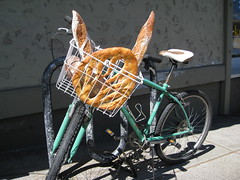
[Bicycle promoting the goods from a bakery in Hood River, Oregon.]
Streets for All Walkers and Wheelchair Users
Access Board
Three weeks left for public comment on Accessibility Guidelines for Public Rights-of-Way. The US Access Board posted the proposed guidelines on its website these are available for public comment through November 23, 2011.
The guidelines will cover sidewalks, street crossings, medians and traffic islands, overpasses, underpasses and bridges, on-street parking, transit stops, toilet facilities, signs, and street furniture. They will apply to permanent as well as temporary facilities, such as temporary routes around work zones and portable toilets.
Issues related to particular disabilities and pedestrian safety are noted.
Please note that a public hearing will be held in Washington, DC on Nov. 9 at the Access Board Meeting Room, 1331 F Street, NW, Suite 800.
[Buses on Central Park South on a June morning.]
Template for Multi-Modal Street Networks
National Complete Streets Coalition
The coalition is recommending the Model Design Manual for Living Streets. Offered as a street-design template, the manual:
EPA has school siting guidelines that include access to transit and biking, as well as walkability.
Connecting a school to a network of sidewalks, bike paths and other infrastructure encourages physical activity by making walking or biking safe and enjoyable. It is also important to provide walking and biking routes that do not bring children close to large roads, highways and other major pollution sources (for both health and safety concerns). Site size, location and design all play a role in determining whether walking or biking will be an option for students. Locations that provide access for students and staff via public transit will also reduce vehicle use as well as potentially promote increased physical activity in getting to the transit stops from both home and school.
More EPA Technical Assistance Opportunities
Through an EPA grant to the Project for Public Spaces under the Building Blocks for Sustainable Communities Program, Livability Solutions will be offering free technical assistance workshops to six to 12 communities around the country. This technical assistance will take the form of one- to two-day workshops utilizing livability tools such as a Community Image Survey (CIS) public engagement tool, a Walk Audit workshop, a Safe Routes to School workshop or a Design Mini-Charrette, among other community-focused analyses and exercises. Selected communities will also be linked to a network of other communities with similar goals and challenges. Each community team will be led by Livability Solutions coalition members.
The application deadline is Nov. 22, 2011. Visit the Livability Solutions technical assistance page for details and the application.
A webinar next week will cover four technical assistance programs under the Building Blocks for Sustainable Communities Program program.
[Bicycle promoting the goods from a bakery in Hood River, Oregon.]
Streets for All Walkers and Wheelchair Users
Access Board
Three weeks left for public comment on Accessibility Guidelines for Public Rights-of-Way. The US Access Board posted the proposed guidelines on its website these are available for public comment through November 23, 2011.
The guidelines will cover sidewalks, street crossings, medians and traffic islands, overpasses, underpasses and bridges, on-street parking, transit stops, toilet facilities, signs, and street furniture. They will apply to permanent as well as temporary facilities, such as temporary routes around work zones and portable toilets.
Issues related to particular disabilities and pedestrian safety are noted.
Wheelchair users usually have a lower eye height above the street than most adult pedestrians, and may be hidden from motorist view behind parked vehicles, plantings, or other visual obstacles. People may have vision, hearing, cognitive, or other considerations that must be considered within the public right-of-way.Please be aware that certain public comments will be allowed regarding the Access Board's Advance NPRM (notice of public rulemaking) for Shared Use Paths, announced on on March 28, 2011. Although comments were due June 27, 2011, these guidelines are in initial development stages. The proposed guidelines will consider differences between public right-of-way guidelines and recreational trail guidelines. More information is available in the FHWA's Pedestrian Forum newsletter.
Please note that a public hearing will be held in Washington, DC on Nov. 9 at the Access Board Meeting Room, 1331 F Street, NW, Suite 800.
[Buses on Central Park South on a June morning.]
Template for Multi-Modal Street Networks
National Complete Streets Coalition
The coalition is recommending the Model Design Manual for Living Streets. Offered as a street-design template, the manual:
focuses on all users and all modes, seeking to achieve balanced street design that accommodates cars while ensuring that pedestrians, cyclists and transit users can travel safely and comfortably. This manual also incorporates features to make streets lively, beautiful, economically vibrant as well as environmentally sustainable.For more information about walkability best practices and places, visit the Pedestrian and Bicycle Information Center's walkinginfo.org website, which also houses information about the Walk-Friendly Communities Program. More walkability news and resources are available from America Walks and the Federal Highway Administration's pedestrian resources website.
Tuesday, May 3, 2011
Reauthorization and Other Perspectives on the Future of Mobility Choices
National Conference of State Legislatures
NCSL, in partnership with the National Governors Association (NGA), the National Association of Counties (NACo) and the National League of Cities (NLC), issues a statement of principles for moving forward with transportation reauthorization legislation. "'State and local governments are responsible for 97 percent of the nation’s interconnected surface transportation systems and contribute nearly 75 percent of the annual cost to operate and maintain those systems,' said NGA Executive Director Dan Crippen."
Among others, the principles include:
1. "[T]he continuation of the “user pays” principle to guide transportation funding" with opposition to federally mandated prescriptions of sub-federal authority over demand-side strategies.
2. Stable funding for "reliable, long-term funding certainty" so that state and local governments can execute long-term, multi-year projects.
3. "[M]aximum federal surface transportation program and funding flexibility given our diversity of geography, population, and priorities" and opposition to earmarks.
4. Streamlining of processes to reduce project approval and completion time.
5. "[S]trong federal role in funding transportation solutions for metropolitan and non-metropolitan areas across the country" to address connectivity and congestion issues.
6. Clear, "outcome-oriented performance measures."
National Governors Association
NGA provides a new page on its website entitled "Redesigning State Government," with information about how different states are coping with lean fiscal conditions.
Paralyzed Veterans of America
PVA celebrates accessible design and mobility with its 2011 Accessible City Award going to sixth, seventh and eighth graders from St. Thomas More School in Baton Rouge, LA.
The Current State of Rural Transit
For a realistic snapshot of rural transportation generally - including transit, intercity service and human services transportation - read Rethinking Federal Investments in Rural Transportation: Rural Considerations Regarding Reauthorization of the Surface Transportation Act, produced by the Rural Policy Research Institute (RUPRI). In a nutshell, the report states:
NCSL, in partnership with the National Governors Association (NGA), the National Association of Counties (NACo) and the National League of Cities (NLC), issues a statement of principles for moving forward with transportation reauthorization legislation. "'State and local governments are responsible for 97 percent of the nation’s interconnected surface transportation systems and contribute nearly 75 percent of the annual cost to operate and maintain those systems,' said NGA Executive Director Dan Crippen."
Among others, the principles include:
1. "[T]he continuation of the “user pays” principle to guide transportation funding" with opposition to federally mandated prescriptions of sub-federal authority over demand-side strategies.
2. Stable funding for "reliable, long-term funding certainty" so that state and local governments can execute long-term, multi-year projects.
3. "[M]aximum federal surface transportation program and funding flexibility given our diversity of geography, population, and priorities" and opposition to earmarks.
4. Streamlining of processes to reduce project approval and completion time.
5. "[S]trong federal role in funding transportation solutions for metropolitan and non-metropolitan areas across the country" to address connectivity and congestion issues.
6. Clear, "outcome-oriented performance measures."
National Governors Association
NGA provides a new page on its website entitled "Redesigning State Government," with information about how different states are coping with lean fiscal conditions.
Paralyzed Veterans of America
PVA celebrates accessible design and mobility with its 2011 Accessible City Award going to sixth, seventh and eighth graders from St. Thomas More School in Baton Rouge, LA.
The team took a comprehensive approach to accessibility: the blind had chips embedded on the side of their heads that allowed them to perceive figures so they would not bump into things. An integrative transportation system provided easy transitioning for people in wheelchairs and also sensed when passengers were waiting to board, stopping for them without being summoned.What impressed the judges was the universality of the team's approach. Their concept of accessibility included people in wheelchairs and strollers, as well as those with physical and sensory challenges. What impresses me is the promise of technological advances and design innovations for making transportation more accessible to wider range of individuals.
The Current State of Rural Transit
For a realistic snapshot of rural transportation generally - including transit, intercity service and human services transportation - read Rethinking Federal Investments in Rural Transportation: Rural Considerations Regarding Reauthorization of the Surface Transportation Act, produced by the Rural Policy Research Institute (RUPRI). In a nutshell, the report states:
There are about 1,200 systems operating in half of rural counties nationwide, but they tend to be local in nature, and generally not connected to regional and national passenger systems. Thirty-eight percent of rural residents live in areas with no public transit. There are also 3,700 systems specifically for the elderly and people with disabilities, and others operated by human services agencies.Add to the many logistical challenges the reality that many rural areas do not have access to professional staff or sufficient staff to handle their transportation and mobility challenges. Though only one piece of the economic development puzzle, transportation is described as a threshold item for local and regional economic success. The report supports local planning to increase transportation options and suggests that "[t]ransportation funding and planning should be measured against outcomes rather than uniform standards." Helpful charts are provided that categorize the challenges for different types of rural areas.
Thursday, March 17, 2011
Praise for Transit and Improving the Experience for People with Disabilities
Always a good day when you read about people and organizations you personally know. Today it is the American Public Transportation Association. I read many of Secretary LaHood's blog posts on the Fastlane. (Yes, I skip stuff related to airlines and anything on the water except for taxis and ferries.) Today, I find the Secretary praising APTA for its mission to "strengthen and improve public transportation,":
People with Disabilities Invited to Rate Service
Speaking of public transit service, a former colleague, Judy Shanley, pointed me to a survey on the website of the Center for Inclusive Design and Environmental Access that requests people with disabilities to share their public transit experiences. Of course, I can never stop with the one recommended feature and explored the website further. There is information about and links to resources involving rural aging in place, naturally occurring retirement communities (NORCS), and universal design for housing.
Easter Seals Project ACTION points out that IDEA also has published a wheelchair users mobility report that includes new data on wheeled mobility devices people with disabilities use, including data about ease of use and navigating spaces. The report recommends that standards be revised to reflect body size and functional abilities of current wheelchair users.
Great Minds Think Alike
Two national parters, Easter Seals Project ACTION and the Taxi, Limousine and Paratransit Association pointed me to the big news that the Department of Energy (DOE) is loaning $50 million to develop a "six-passenger MV-1, a purpose-built wheelchair accessible vehicle that will run on compressed natural gas." According to DOE,
Easter Seals Proejct ACTION
Webinar series - The Cutting Edge of Wayfinding Technology - Apr. 4 and 11 at 2 ET. The webinars will cover wayfinding technologies that help customers with disabilities navigate transit systems. The two sessions will discuss new technologies that are either available to the public or currently being researched. Visit ESPA's homepage for information about the organization's many events about accessibility, transportation, and improving transportation options for people with disabilities.
a goal this Department deeply believes in. This Administration has made transportation a priority--and affirmed that commitment, not just with words, but also with actions. President Obama’s 2012 budget proposal invests $129 billion in transportation. We’re talking about a 127% increase in support aimed at improving safety, service, and reliability.After reviewing the proposed budget's transit priorities, Secretary LaHood spoke generally about the contributions of public transit, saying that "[p]ublic transportation connects Americans," takes them to airports, downtowns, jobs, essential services, education and shopping, while relieving congestion.
Every day in our cities and towns, transit workers are planning, building, maintaining, repairing and operating these vital systems. Here at DOT, we think that’s incredibly important.The Secretary quoted from his speech at the APTA Legislative Conference.
People with Disabilities Invited to Rate Service
Speaking of public transit service, a former colleague, Judy Shanley, pointed me to a survey on the website of the Center for Inclusive Design and Environmental Access that requests people with disabilities to share their public transit experiences. Of course, I can never stop with the one recommended feature and explored the website further. There is information about and links to resources involving rural aging in place, naturally occurring retirement communities (NORCS), and universal design for housing.
Easter Seals Project ACTION points out that IDEA also has published a wheelchair users mobility report that includes new data on wheeled mobility devices people with disabilities use, including data about ease of use and navigating spaces. The report recommends that standards be revised to reflect body size and functional abilities of current wheelchair users.
Great Minds Think Alike
Two national parters, Easter Seals Project ACTION and the Taxi, Limousine and Paratransit Association pointed me to the big news that the Department of Energy (DOE) is loaning $50 million to develop a "six-passenger MV-1, a purpose-built wheelchair accessible vehicle that will run on compressed natural gas." According to DOE,
[The] MV-1 is the only factory-built light-duty vehicle to date that meets or exceeds the guidelines of the Americans with Disabilities Act. The vehicle features a deployable access ramp with a 1,200-pound weight capacity, a 36-inch entryway and an interior that accommodates up to six occupants with the optional jump seat, including one or two wheelchair passengers and the driver.Getting to and Navigating Transit
Easter Seals Proejct ACTION
Webinar series - The Cutting Edge of Wayfinding Technology - Apr. 4 and 11 at 2 ET. The webinars will cover wayfinding technologies that help customers with disabilities navigate transit systems. The two sessions will discuss new technologies that are either available to the public or currently being researched. Visit ESPA's homepage for information about the organization's many events about accessibility, transportation, and improving transportation options for people with disabilities.
Thursday, November 18, 2010
Resources: Accessibility and Health Reform
The Association of Programs for Rural Independent Living (APRIL) has posted an outpatient accessibility form and guidebook, the Outpatient Health Care Usability Profile V4, for health care facilities. The form is a self-assessment that quickly generates a picture of accessibility for any type of building and could be used beyond the health care field. It covers accessibility to bathrooms, elevators, hallways, ramps to the building entrance, among others. However, the guidebook only discusses federal requirements; state and local regulations may be more stringent. Transportation to the facility - an assessment of whether transit, taxi service or other services are available - is not mentioned, but could be added.
For information about ADA paratransit eligibility, the National Transit Institute has a course on this topic and Easter Seals Project ACTION has an upcoming series of distance learning classes about ADA paratransit.
Health Care Reform
The Children’s Health Fund has posted a link to the video of the Kaiser Family Foundation's event last week, What Does the Election Mean for Health Reform and Other Health Issues?
For information on what states must accomplish and are doing to fulfill the mandates of the new health care law, the National Governors' Association (NGA) has created a website, the Health Reform Implementation Resource Center, a product of the State Consortium on Health Care Reform Implementation (State Consortium), which provides information and technical assistance to states about requirements, offers options and best practices and synthesizes feedback to federal agencies on issues that affect state implementation. The website has resources on aspects of the health reform law that are likely to have the biggest effect on states – the Medicaid expansion, the establishment of health insurance exchanges, insurance regulations, and delivery system initiatives, along with important governance, coordination and timing issues for states are available from NGA and on each of the Consortium members' websites.
The four consortium organizations are: National Governors Association (NGA), including the NGA Center for Best Practices, National Association of Insurance Commissioners (NAIC), National Association of State Medicaid Directors (NASMD), and National Academy for State Health Policy (NASHP).
Health care guidance for individuals is available from AARP. It's health reform fact sheets offer information about a wide range of changes and implications for consumers, particularly older adults.
Thursday, September 2, 2010
Facts & Assistance for Helping People with Disabilities
Today's American Public Human Services Association (APHSA) newsletter, Working for Tomorrow, reports "[p]eople with disabilities are much more likely than people without disabilities to consider inadequate transportation to be a problem (34 percent vs. 16 percent, respectively)— a gap of 18 percentage points." The newsletter also gives details of upcoming changes to Medicaid.
Contact Nanette Relave (202-682-0100 x241; nrelave@aphsa.org) for subscription information.
Making Service Truly Accessible
The American Bus Association and Easter Seals Project ACTION are jointly featuring the Motorcoach Operator’s ADA Pocket Guide in a two-part webinar, Using the Motorcoach Operator’s ADA Pocket Guide, starting Sept. 22. Staff from Jefferson Bus Lines will explain how their company has made its service accessible for people with disabilities.
Wednesday, August 25, 2010
Spontaneity = Accessibility 2.0
Spontaneity is becoming the new buzzword for people with disabilities, a kind of Accessibility 2.0. I have heard Mary Leary, Senior Director of Easter Seals Project ACTION, use the term before and she employs it now as the guest writer on the Disability Blog. She writes about the next 20 years of the Americans with Disabilities Act (ADA). What Ms. Leary is seeking for people with disabilities is "a world of spontaneous living" and she is working with the inter-agency Partnership for Sustainable Communities and its livability program to help her vision become a reality.
Making Lemonade in Hard Times
If these were normal times, I would agree not only with Ms. Leary's vision, but also with the prospect of it becoming a reality. These are hard times, so my skepticism is tempted to take over. Metro Magazine's article about paratransit providers discusses strategies for dealing with lean budgets and the growing demand for paratransit service. Unfortunately, one of the strategies for already lean operations is cutting service.
People are working hard locally to make sure that others do not lose the transit service they already have. Two examples struck me today as demonstrating the challenges of financial hardships for transit systems and what individuals can do to retain the spontaneity that existing service provides them.
Local Stories
A rural New Hampshire woman who uses a walker convinced bus buddies to help her persuade local authorities to retain her bus service. However, an article in the Union Leader explains the dilemmas that transit systems are confronting, especially on routes with low ridership and very little help from the fare box.
I cannot resist a good Brooklyn story, especially one about a neighborhood I have lived in. The B71 (B for Brooklyn) transported people through Park Slope, Prospect Heights and Carroll Gardens before it was discontinued and budget cuts prompted driver layoffs. Now, according to a Wall Street Journal piece (likely written by a Slope resident, perhaps a Paul Auster neighbor), a new service is starting that will feature laid off drivers, TLC (New York's Taxi and Limousine Commission)-approved van service on discontinued routes ($1 fare, initially) and driver pay equal to their old jobs. In true Brooklyn fashion, the union that represents the new service's drivers is also involved in litigation to shut it down.
This interagency effort joins programs and policy areas in transportation, housing and the environment to create a synergistic approach to increase access and mobility. Accessible transportation is more than just getting to doctor’s appointments, the grocery store, to work or to school. It is also about seeing friends and family, going to a park, going out to dinner, enjoying the fireworks on the 4th of July or traveling across the country.
Making Lemonade in Hard Times
If these were normal times, I would agree not only with Ms. Leary's vision, but also with the prospect of it becoming a reality. These are hard times, so my skepticism is tempted to take over. Metro Magazine's article about paratransit providers discusses strategies for dealing with lean budgets and the growing demand for paratransit service. Unfortunately, one of the strategies for already lean operations is cutting service.
People are working hard locally to make sure that others do not lose the transit service they already have. Two examples struck me today as demonstrating the challenges of financial hardships for transit systems and what individuals can do to retain the spontaneity that existing service provides them.
Local Stories
A rural New Hampshire woman who uses a walker convinced bus buddies to help her persuade local authorities to retain her bus service. However, an article in the Union Leader explains the dilemmas that transit systems are confronting, especially on routes with low ridership and very little help from the fare box.
I cannot resist a good Brooklyn story, especially one about a neighborhood I have lived in. The B71 (B for Brooklyn) transported people through Park Slope, Prospect Heights and Carroll Gardens before it was discontinued and budget cuts prompted driver layoffs. Now, according to a Wall Street Journal piece (likely written by a Slope resident, perhaps a Paul Auster neighbor), a new service is starting that will feature laid off drivers, TLC (New York's Taxi and Limousine Commission)-approved van service on discontinued routes ($1 fare, initially) and driver pay equal to their old jobs. In true Brooklyn fashion, the union that represents the new service's drivers is also involved in litigation to shut it down.
Monday, August 23, 2010
ADA Guidance for Getting Around
The Department of Justice has issued a fact sheet that highlights the Department of Justice's ADA design standards. Specific to transportation, there is guidance about service animals - specifically, dogs trained to perform certain tasks. Those animals that provide solely emotional support, do not, for ADA purposes, constitute service animals. There are nuances to the rule, so careful reading is recommended.
Another area where transportation is affected is use of wheelchairs and mobility devices. Wheelchairs are permitted wherever pedestrians are allowed. However, Segways, "which are often used by individuals with disabilities as their mobility device of choice," are Justice's prime focus in this guidance. To ban "power-driven mobility devices," the rule requires a "covered entity [to] demonstrate that such use would fundamentally alter its programs, services, or activities, create a direct threat, or create a safety hazard."
Burden of Proof
Note that the fact sheet clearly places the burden of proof on the covered entity to prove that the "power-driven mobility device" falls within the threat, safety or other allowances for banning the devices from certain places. The user of the device is not required to show anything to trigger the right to use a particular device.
Topic Guides
Easter Seals Project ACTION is featuring the ADA Topic Guides in its newsletter. The topic guides are very detailed instructions about what the ADA requires in terms of paratransit eligibility, equipment maintenance, no shows and other operational issues. The Disability Rights Education and Defense Fund and TranSystem Corporation prepared the topic guides with funding from the Federal Transit Administration (FTA).
Though not transportation-related, the Department of Justice released a guide to providing accessible medical care for people with disabilities. Access To Medical Care For Individuals With Mobility Disabilities provides straight-forward and simple advice about what accessibility means and details related to medical offices, such as transfer techniques and accessible exam tables.
Monday, July 26, 2010
Livability for Everyone: Celebrating the ADA Anniversary
Happy 20th Anniversary of the Americans with Disabilities Act!
The top ten cities for wheelchair users were named today by the Christopher & Dana Reeve Foundation. The cities were rated on the basis of climate, employment of people with disabilities, Medicaid spending and eligibility, and age of the cities (with the assumption that older cities are less accessible). Due to the difficulty of judging actual accessibility of transit systems and streets, the Foundation mentioned these factors in its announcement of the top 10, but did not assess transit and street design in making its selections.
Rated number one is Seattle, with Denver, New Orleans, Lubbock, Fort Worth, and and small Arlington, Va. also in the top 10. If these are considered the most livable cities for people with physical disabilities, specifically for wheelchair users, then I assume, rightly or wrongly, that the other measures used for rating the cities are in some ways proxies for transit and mobility options other than cars. For example, the employment rate for people with disabilities assumes that most of those employees are getting to a workplace outside the home. As much as an accessible home is a necessity, so is the freedom to navigate streets and travel to places outside our own four walls.
Progress on Next 20 Years of Paratransit
For those interested in improving transit, streets and other mobility options for people with disabilities, Easter Seals Project ACTION (ESPA) is hosting a National Paratransit Online Dialogue to address calls for programs to decrease service or provide innovative options in a time of tight budgets. This dialogue will provide an opportunity for providers and stakeholders to share experiences, paratransit practices, challenges, and recommendations. ESPA is defining paratransit for the purpose of this dialogue to include ADA complementary service and a range of traditional and beyond-ADA demand response services for people with disabilities, older adults, customers of community programs, and/or the general public. Paratransit services are typically door-to-door or curb-to-curb reservation-based services.
Wednesday, July 21, 2010
Some Great Websites
From time to time, it's good to point out places to go, virtual places that is, that are good for finding particular types of resources, what I consider my reliable sources. Unlike great chefs who do not want their secrets to be widely known (perhaps except when their cookbooks come out), I feel like it's part of my job to share information.
Going Regional
National Association of Regional Councils (NARC)
NARC is a great resource for all types of funding information for regional councils, such as livability, transportation, economic development, air quality, and emergency preparedness. Legislation is also well covered from the perspective of regional planning organizations.
By the way, NARC has an upcoming conference in Austin, Texas in late September. Here's NARC's blurb.
Federal Partnership
Initiative for Sustainable Communities and States
(ISCS)
ISCS compiles the news and resources of the federal interagency sustainability partnership in one place. There is information about funding, policy, and examples for states and localities.
FTA Site A Treasure Trove of ADA Resources
Federal Transit Administration (FTA)
FTA has a multitude of resources related to the intersection of transit and the ADA. These include regulations, legal guidance, details about equitment and paratransit eligibility, and so much more. A new page has topic guides* on selected ADA topics. These offer way more details than a simple fact sheet. They are comprehensive and contain beautiful footnotes, something I really like because I enjoy (yes, enjoy) reading about the foundation for statements and background information about the text.
* As my own little footnote, the topic guide link above is to the FTA introduction page instead of the topic guide home page so that one may easily navigate back to the other FTA resources.
Going Regional
National Association of Regional Councils (NARC)
NARC is a great resource for all types of funding information for regional councils, such as livability, transportation, economic development, air quality, and emergency preparedness. Legislation is also well covered from the perspective of regional planning organizations.
By the way, NARC has an upcoming conference in Austin, Texas in late September. Here's NARC's blurb.
Regional councils of all sizes have core cities and towns that are facing issues of growth, infrastructure, security and safety. This Forum will be a discussion on recent trends and opportunities in metropolitan policy for regions, and will address related federal, state, and local issues. Regions and partners will come together to discuss recent federal action on livability, transportation, climate change and other issues.
Federal Partnership
Initiative for Sustainable Communities and States
(ISCS)
ISCS compiles the news and resources of the federal interagency sustainability partnership in one place. There is information about funding, policy, and examples for states and localities.
FTA Site A Treasure Trove of ADA Resources
Federal Transit Administration (FTA)
FTA has a multitude of resources related to the intersection of transit and the ADA. These include regulations, legal guidance, details about equitment and paratransit eligibility, and so much more. A new page has topic guides* on selected ADA topics. These offer way more details than a simple fact sheet. They are comprehensive and contain beautiful footnotes, something I really like because I enjoy (yes, enjoy) reading about the foundation for statements and background information about the text.
* As my own little footnote, the topic guide link above is to the FTA introduction page instead of the topic guide home page so that one may easily navigate back to the other FTA resources.
Thursday, June 24, 2010
Resources and Events to Make Livability and Accessibility Happen
I admit to being early on the smart growth bandwagon and happy to see the concept morph into the more-inclusive livability/sustainability collaboration that is the inter-agency Partnership for Sustainable Communities, among the Department of Transportation (DOT), the Department of Housing and Urban Development (HUD), and the Environmental Protection Agency (EPA). From what I hear, the Department of Energy (DOE) and the Department of Agriculture (USDA) are also coordinating with the partnership at various levels.
The current manual of funding sources among the partnership agencies is Leveraging the Partnership: DOT, HUD, and EPA Programs for Sustainable Communities. Many of the sources can be used for transit and other mobility options, including designing a street scape that improves access to buses, vanpool meeting areas, trains and biking facilities.
Since our transportation technical assistance (TA) centers have been involved with livability since before the term was invented, many of us are educating our constituencies about livability resources that will bring and enhance transit service and transportation options to communities across the country.
Upcoming Livability-Related Events among the TA Centers
National Conference of State Legislatures (NCSL): Livability 101 Pre-conference on July 25, 2010, right before the Legislative Summit in Louisville, Ky. The Transportation Committee will be concentrating as well on high-speed rail, the link between transportation and health, biking and rural road safety.
Easter Seals Project ACTION (ESPA): Forming Partnerships with Transit for human service providers, disability community advocates and private transportation providers – online from Aug. 2 to Sept. 10, 2010.
American Association of State Highway and Transportation Officials (AASHTO), American Public Transportation Association (APTA), and Community Transportation Association of America (CTAA): State Public Transit Partnerships Conference on Aug. 3-6, 2010 in Seattle will have a livability session.
Access and Universal Design
Livability encompasses availability of transportation options beyond the automobile. To include everyone in the benefits of livable community initiatives raises issues of universal design, rural access and specialized transportation. The following resources and events address those issues and their links to economic development, equitable access for transportation-challenged populations, and costs.
Easter Seals Project ACTION (ESPA) continues to assist the transit community to make people with disabilities welcome. A handy Transit Operator’s Pocket Guide informs drivers of their ADA responsibilities and etiquette for interacting with people with disabilities.
ESPA: Excellence in Service for Paratransit Managers - online from July 19 to Sept. 24, 2010.
Taxi, Limousine, and Paratransit Association (TLPA) releases Assessing the Full Cost of Implementing An Accessible Taxicab Program. The report discusses how the taxi industry works in terms of the practical obstacles and costs of providing accessibility where the additional costs fall on mostly small businesses and independent contractors.
Rural Accessibility
For rural transportation and economic development resources, the National Association of Development Organizations (NADO) has a Rural Transportation Clearinghouse. Among the resources available are descriptions of how rural planning organizations operate in different states.
National Rural Public and Intercity Bus Transportation Conference on October 24-27, 2010, in Burlington, Vt. Conference sessions will include accessibility, rural transit policy and planning, alternative fuels, regional systems, networks and coalitions, and tribal transportation.
ADA Takes the Ferry
Finally, with a picture of the Staten Island Ferry, the Secretary of Transportation blogged on June 17 about extending ADA protection to maritime vessels, including public ferry service. Secretary LaHood "encourage[s] everyone to visit www.regulations.gov and get their two cents in on the important questions" outstanding about this ADA extension.
Thursday, June 10, 2010
Who Needs Sounds of the Road
American Council of the Blind
ACB has been pushing hard to resolve the dilemma of hybrid vehicles and the safety of people who are visually impaired. Hybrids are quieter than their conventional counterparts and in some circumstances fail to supply noises that are sufficiently loud to enable visually-impaired people to navigate streets. ACB supports passage of, the Pedestrian Safety Enhancement Act (H.R. 734, S. 841). This Act would require a Department of Transportation study and establishment of a motor vehicle safety standard for alerting blind and other pedestrians of motor vehicle operation. Both bills have been in committee since early 2009.
Now a National Highway Traffic Safety Report, Quieter Cars and the Safety of Blind Pedestrians: Phase I, posted on ACB’s website, studies the circumstances in which there is a difference between noise levels, whether those differentials impact safety, and the merits of possible countermeasures. Basically, noise levels differ at speeds up to 20 miles per hour. Two approaches for counter measures are discussed, (1) configuring hybrids so that they emit more noise and (2) producing devices that can be carried that warn people who are visually impaired that a quiet vehicle is nearby.
The report wisely observes what is true in many circumstances, that universal design measures that assist people with disabilities also help others. The boys and girls who play soccer and street hockey in the middle of the road or who ride bikes without paying too much attention to their surroundings need vehicle noise almost as much as someone who is blind and they are probably less likely to carry a personal noise emitter. The sound must also be recognizable as vehicular noise, the report noted, discussing the disadvantages of personal device sounds.
ACB has been pushing hard to resolve the dilemma of hybrid vehicles and the safety of people who are visually impaired. Hybrids are quieter than their conventional counterparts and in some circumstances fail to supply noises that are sufficiently loud to enable visually-impaired people to navigate streets. ACB supports passage of, the Pedestrian Safety Enhancement Act (H.R. 734, S. 841). This Act would require a Department of Transportation study and establishment of a motor vehicle safety standard for alerting blind and other pedestrians of motor vehicle operation. Both bills have been in committee since early 2009.
Now a National Highway Traffic Safety Report, Quieter Cars and the Safety of Blind Pedestrians: Phase I, posted on ACB’s website, studies the circumstances in which there is a difference between noise levels, whether those differentials impact safety, and the merits of possible countermeasures. Basically, noise levels differ at speeds up to 20 miles per hour. Two approaches for counter measures are discussed, (1) configuring hybrids so that they emit more noise and (2) producing devices that can be carried that warn people who are visually impaired that a quiet vehicle is nearby.
At present, only countermeasures that cause quiet vehicles to emit additional sound come close to meeting the requirements of blind pedestrians. Within this class of countermeasures, there is a fundamental distinction between systems that emit synthetic engine noise at all times when the vehicle is operating at low speeds, and those that emit noise only when triggered by a transmitter carried by blind pedestrians. The former eliminate the need for blind pedestrians to carry special transmitters, and also warn other pedestrians, cyclists and animals of the approach of quiet vehicles, while the latter minimize community noise impact.
The report wisely observes what is true in many circumstances, that universal design measures that assist people with disabilities also help others. The boys and girls who play soccer and street hockey in the middle of the road or who ride bikes without paying too much attention to their surroundings need vehicle noise almost as much as someone who is blind and they are probably less likely to carry a personal noise emitter. The sound must also be recognizable as vehicular noise, the report noted, discussing the disadvantages of personal device sounds.
Subscribe to:
Posts (Atom)