Transportation Camp - Why Go?
Why get out of bed early on a Saturday morning in the middle of the winter - decidedly not summer camp weather - to leave your partner (if you have one), children (if you have them), pets (if you have them) and absolve yourself of all adult responsibility and the comforts of routine and loved ones to spend an entire day in windowless rooms - also not camp like - to discuss all aspects of transportation with 300 people, many of whom describe themselves as transportation geeks? Why attend an unconference, an event where there are no keynote speakers, predetermined sessions, experts, bios or daises?
Why? Because you will have fun - yes, it's camp - with people excited about walkable streets, better transit, open data, paratransit, bikesharing, bus rapid transit plans, and social media use by, for and perhaps with some hostility to transit. Indeed, upon arrival (without trunk, duffel bags, parents, or junk food), one does not even know what is on the program. But like any returning camper, one knows and sees friends, some from previous stays at camp and some from other venues - in this case twitter, normal conferences, and actual work. (Apologies to any twitter friends not recognized from those tiny twitter photos.)
Indeed, as Transportation Camp is an unconference, the campers suggest what will be discussed and offer their own expertise as speakers or as bunch of nerds interested in talking about something. Some come bearing presentations, cameras, tablets, and laptops; others admit they are concerned citizens without a resume and curious. Some come alone and others with lots of colleagues.
[Attendees reading session ideas posted on colorful, large post-its.]
And what actually happens at the camp social?
Not that anyone was flirting in the social hall or hanging out by the big tree at the lake (wait, that's actual camp), but one sees lots of connections being made, as if data, social media, transit, biking, walking soul mates are finding each other. I saw colleagues and friends from Ithaca, Iowa, Portland, and Boston, and met people from practically my own backyard interested in some of the same hometown (though inside the Beltway) issues. I think half of the
San Francisco DOT attended camp in Arlington. There were also a bunch of
mobility management professionals, some there to promote ideas, some
seeking ideas, and all wanting to share.
In terms of quality, sessions vary from amazing to "I should have chosen something else," with my own experience much more toward the former. As there are only four sessions over the course of the day and about 10 offerings during each time slot, there is often heard the cheerful complaint of an embarrassment of rich choices. If cloning were possible, ...
[Possible offerings displayed. Yes, this photo is intentionally gigantic so that some of the post-its can be read.]
One could easily have spent the entire day immersed in a virtual "track" of data sharing, open source, apps and other things that normal people (translation: someone like me) know little or nothing about. Instead, I chose a variety of different topics - (1) Transit social media engagement (with both the rider and the transit agency perspectives discussed), (2) universal design advocacy and planning for streets and transportation to suit all users (particularly people with disabilities), (3) sharing big ideas, and (4) bus rapid transit (BRT) plans and politics in the DC area.
Rural Roads Meet the Jetsons, Sort of?
What were some big ideas? Cost-effective personal rapid transit for rural areas; walkable streets - with access to transit - in suburban and rural areas; pre-purchased annual transportation with a menu of transportation choices (to replace one or more privately-owned vehicles). There were a ton more; that's just the tiniest of samples.
At the BRT session, a gentleman from Ireland supplied this DC-area crowd with a list of cities around the world with bus systems worthy of comparison.* Another gentleman, originally from suburban Maryland, talked about his BRT planning experiences in Brazil. Montgomery County's Rapid Transit Vehicle (RTV) plan was discussed in detail, including the role of the planning and transportation departments, which, by the way, report to different entities (the former reporting to the county council and the latter to the county executive). Other DC-area BRT activity described included Arlington, Howard and Prince William counties, with some of those more akin to express commuter services.
One Person's Mobility Experiences
The universal design session was led by a person who travels in a wheelchair and the session was very much informed by the her experiences, in terms of using the pedestrian network and transit, as well as advocacy and maintaining relationships with political leaders and other types of advocacy groups. She mentioned biking groups as one example of stakeholders that can be useful for people with disabilities in pushing for universal design and multi-modal streets. A controversy arose during the session about expertise of planners versus advocacy of residents and which deserves more weight, though most of the session was conducted in the spirit of building relationships with various stakeholders rather than a zero-sum game of right and wrong.
The social media session I attended (and there were quite a few offered) concentrated on twitter - from the perspective of the complaining rider and the transit agency. Effective engagement strategies were discussed rather than mere whining about service. At the center of the session was discussion about building relationships with staff at the transit agency and how to do that. Sometimes those tweeting interactions become actual relationships.
Tell your parents to sign you up for camp next year, or sign up yourself. Next camp is coming up soon in Atlanta - in February - another decidedly un-camp-like time of year. If we have camp in July, my porch is open for a front row seat at the Takoma Park July Fourth Parade. I'll even make bug juice.
*Cities with bus networks mentioned were Almere (Netherlands), Melbourne, Helsinki, Gothenburg (Sweden), and Nantes (France).
Showing posts with label Livability. Show all posts
Thursday, January 17, 2013
Thursday, April 19, 2012
Social Equity and Mobility Management
The Victoria Transport Policy Institute (VTPI) issues two reports that surprised me in terms of making the case for a wholistic view of mobility options in terms of environmental benefits, how people choose travel options, and how different populations - particularly transportation-challenged individuals - bear the impacts of funding decisions and how they advocate for their positions.
In New Social Equity Agenda For Sustainable Transportation VTPI takes aim at conventional transportation/social equity/environmental justice analysis. Comparing discrimination in the South prior to the civil rights movement, the report notes progress, but argues "[t]ransport system discrimination has changed: it results less from race or ethnicity and more from disability and poverty." The report criticizes the proxy use of race for poverty and age for disability status as well as a lack of funding for those who walk, bike or take transit.
Among VTPI's points are:
Mobility Management's Wholistic Perspective for Environmental Decisionmaking
Skipping completely the mobility benefits to transportation-challenged populations and focusing instead on a wide range of factors that affect travel-mode choices of the general population (basically, for those who have choices), the VTPI report Comprehensive Evaluation of Transport Energy Conservation and Emission Reduction Policies finds that mobility management is a more effective method of reducing emissions and saving money than just making vehicles cleaner and more efficient. Included in VTPI's analysis is parking, congestion costs and other factors that contribute to mode selection.
At the heart of the argument is a reluctance to accept that everyone prefers to travel by car all of the time; in essence, VTPI posits that mobility management examines the primacy of auto travel as a reflection of lack of choice rather than preference.
FTA Celebrates Earth Day
The Federal Transit Administration (FTA) observes the environmental holiday with a new Earth Day web page devoted to its environmental accomplishments, efforts and even bragging about the fact that almost 90 percent of its own employees travel by transit to get to work each day (I am guessing that among the other 13 percent there are quite a few bikers and some walkers).
Pages linked to the site tout the environmental, health and safety benefits of transit. From fewer transportation accidents in places with higher transit mode share to transit riders' far greater walking in comparison to the general population, the new website demonstrates the outsize contribution of public transportation.
On a personal note, I will be doing a nice amount of traveling in the next few months. Will be sampling transit and streets wherever I go. Hope to be taking many pictures along the way of buses, trains, streets and people.
In New Social Equity Agenda For Sustainable Transportation VTPI takes aim at conventional transportation/social equity/environmental justice analysis. Comparing discrimination in the South prior to the civil rights movement, the report notes progress, but argues "[t]ransport system discrimination has changed: it results less from race or ethnicity and more from disability and poverty." The report criticizes the proxy use of race for poverty and age for disability status as well as a lack of funding for those who walk, bike or take transit.
Among VTPI's points are:
A major portion of total transport funding is dedicated to roads and parking facilities, and cannot be used for other modes even where demand exists and they are cost effective investments.The report urges those who represent communities of low-income and people with disabilities to shift their perspective.
...
Non-drivers as a group receive less than their fair share of transport funding which is unfair (horizontally inequitable).
...
Wider roads and higher motor vehicle traffic volumes and speeds impose delay, risk, discomfort and pollution on other road users, particularly pedestrians and cyclists.
Since physically, economically and socially disadvantaged people tend to rely heavily on walking, cycling and public transit (or described differently, people who drive less than average tend to be disadvantaged compared with high-annual-mileage motorists), these impacts tend to be regressive (vertically inequitable).
These policies tend to cause automobile-dependency: transport systems and land use patterns which favor automobile access. This provides inferior access for non-drivers, and transport costs on lower-income households (Agrawal 2011).
Environmental justice advocates tend to treat public transit funding as a zero-sum game, which pits interests groups against each other. For example, they sometimes criticize rail transit because it diverts resources from basic bus service. Yet, rail transit funds are often shifted from highway accounts or generated by special new taxes. Cities with high quality rail transit systems tend to have more total public transit, including more bus transit service per capita, than cities that lack rail transit (Litman 2004), and rail transit tends to increase the social status and build political support for alternative modes and supportive land use policies. It is therefore wrong to assume that rail transit investments necessarily harm disadvantaged people. Although it may seem so in the short run, over the long run, rail transit development can be an effective way to create more multi-modal transport systems and accessible land use development.
Mobility Management's Wholistic Perspective for Environmental Decisionmaking
Skipping completely the mobility benefits to transportation-challenged populations and focusing instead on a wide range of factors that affect travel-mode choices of the general population (basically, for those who have choices), the VTPI report Comprehensive Evaluation of Transport Energy Conservation and Emission Reduction Policies finds that mobility management is a more effective method of reducing emissions and saving money than just making vehicles cleaner and more efficient. Included in VTPI's analysis is parking, congestion costs and other factors that contribute to mode selection.
At the heart of the argument is a reluctance to accept that everyone prefers to travel by car all of the time; in essence, VTPI posits that mobility management examines the primacy of auto travel as a reflection of lack of choice rather than preference.
FTA Celebrates Earth Day
The Federal Transit Administration (FTA) observes the environmental holiday with a new Earth Day web page devoted to its environmental accomplishments, efforts and even bragging about the fact that almost 90 percent of its own employees travel by transit to get to work each day (I am guessing that among the other 13 percent there are quite a few bikers and some walkers).
Pages linked to the site tout the environmental, health and safety benefits of transit. From fewer transportation accidents in places with higher transit mode share to transit riders' far greater walking in comparison to the general population, the new website demonstrates the outsize contribution of public transportation.
On a personal note, I will be doing a nice amount of traveling in the next few months. Will be sampling transit and streets wherever I go. Hope to be taking many pictures along the way of buses, trains, streets and people.
Monday, January 23, 2012
Transportation Camp
A camp that does not require or supply duffel bags, trunks, bunks, tents, swim instruction, or counselors, Transportation Camp is an unconference - no pre-planned sessions or experts - with transit, alternative mode, planner and data, self-described geeks gathering for a day of exchanging ideas and learning.
I met friends from the worlds of transit technical assistance, mobility management, and the Federal Transit Administration (FTA). I also ran into people whom I had not met before, but have been in contact with through twitter and blogs. Two surprises were meeting TransitWire (Susan Bregman, who started the blog/twitter service as a Transit Cooperative Research Program (TCRP) project) (I felt like I was meeting a transit celebrity) and someone from Austria who knows all about mobility management in the European Union and pointed me to performance measures developed in Sweden. There were even a couple of people from my neighborhood who are involved in local transit and alternative mode issues.
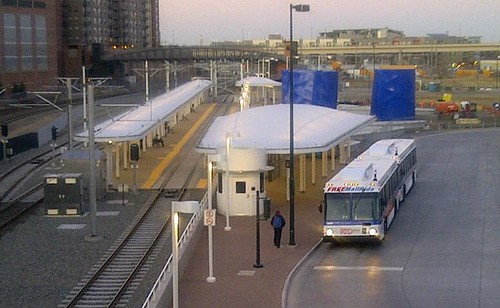
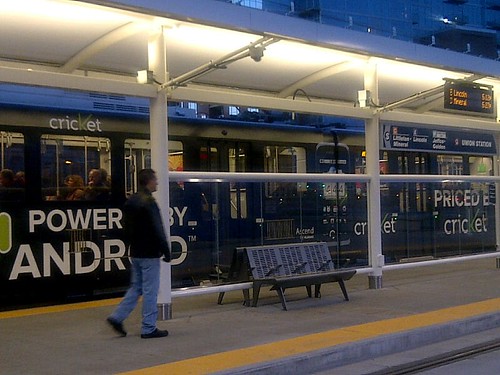
[Multi-modal in Denver at the under-construction hub at Union Station.]
Designing Your Own Unconference
Because there were so many sessions, maybe 10 at a time, everyone's experience was different. I attended a mix of sessions on topics I know something about and others about which I acknowledge total ignorance. So, on the ignorant side, I went to a demonstration of an open trip planner that provides route information for walkers, bikers, wheelchair users and transit riders. Incredibly impressive, especially for bikers because the program allows for input of preferences, but not on a real-time level. For example, for wheelchair users, the program has data about accessible streets and transit entrances and exits, but it does not collect or transmit data that an elevator just went out of service at a particular station. I do not doubt, however, that the techie folks will get there.
I also went to Greening the Suburbs, which connected two DC-exurban planners from far outside different circumference points on the Beltway, to discuss common issues of residents who drove til they qualified for a mortgage and others who want a country-like lifestyle. The question is not preference as the idea of green is popular (where would we be without Kermit?), but how to make green convenient, particularly in relation to travel habits, as that is a prime consideration of people with long commutes and no infrastructure to walk or bike to a convenience or grocery store even if it is only a few blocks away. Arlington's decades-long effort to be a green city/suburb and Houston's decentralized employment nodes were examples discussed. A Houston native said that high energy prices would soon green the suburbs whatever the preferences of their residents, while another decried the huge expenditures to support the expense and costs of the auto-centric lifestyle.
[A Portland tech-savvy bus stop with wait times, seating and protection from precipitation.]
I also went to a session in which a rural Virginia transit employee asked for ideas about promoting and improving transit, particularly for young professionals. Though, like many sessions, conversation veered off course at times, he walked away with suggestions about how to engage transit leadership, market transit and make low-cost improvements that will attract riders.
For a wonderful synopsis of the energy and connections made at Transportation Camp, read today's TransitWire.
I met friends from the worlds of transit technical assistance, mobility management, and the Federal Transit Administration (FTA). I also ran into people whom I had not met before, but have been in contact with through twitter and blogs. Two surprises were meeting TransitWire (Susan Bregman, who started the blog/twitter service as a Transit Cooperative Research Program (TCRP) project) (I felt like I was meeting a transit celebrity) and someone from Austria who knows all about mobility management in the European Union and pointed me to performance measures developed in Sweden. There were even a couple of people from my neighborhood who are involved in local transit and alternative mode issues.
[Multi-modal in Denver at the under-construction hub at Union Station.]
Designing Your Own Unconference
Because there were so many sessions, maybe 10 at a time, everyone's experience was different. I attended a mix of sessions on topics I know something about and others about which I acknowledge total ignorance. So, on the ignorant side, I went to a demonstration of an open trip planner that provides route information for walkers, bikers, wheelchair users and transit riders. Incredibly impressive, especially for bikers because the program allows for input of preferences, but not on a real-time level. For example, for wheelchair users, the program has data about accessible streets and transit entrances and exits, but it does not collect or transmit data that an elevator just went out of service at a particular station. I do not doubt, however, that the techie folks will get there.
I also went to Greening the Suburbs, which connected two DC-exurban planners from far outside different circumference points on the Beltway, to discuss common issues of residents who drove til they qualified for a mortgage and others who want a country-like lifestyle. The question is not preference as the idea of green is popular (where would we be without Kermit?), but how to make green convenient, particularly in relation to travel habits, as that is a prime consideration of people with long commutes and no infrastructure to walk or bike to a convenience or grocery store even if it is only a few blocks away. Arlington's decades-long effort to be a green city/suburb and Houston's decentralized employment nodes were examples discussed. A Houston native said that high energy prices would soon green the suburbs whatever the preferences of their residents, while another decried the huge expenditures to support the expense and costs of the auto-centric lifestyle.
[A Portland tech-savvy bus stop with wait times, seating and protection from precipitation.]
I also went to a session in which a rural Virginia transit employee asked for ideas about promoting and improving transit, particularly for young professionals. Though, like many sessions, conversation veered off course at times, he walked away with suggestions about how to engage transit leadership, market transit and make low-cost improvements that will attract riders.
For a wonderful synopsis of the energy and connections made at Transportation Camp, read today's TransitWire.
Tuesday, December 20, 2011
What Livability Means: Rural Areas and State Policies
Last year, 32,885 people were killed on the nation's roads, according to Secretary of Transportation Ray LaHood in a recent blog post. Rural roads witness a far greater rate of accidents, injuries and deaths than urban roads. The Secretary's words are chilling.
Technical Assistance
Local coordination stories are featured in today's NRC Technical Assistance News about how communities are growing or reconsidering transit and transportation services. Stories come from York, Pa., Corpus Christi, Tx., and Portland, Or.
From our technical assistance network, an offering that national organizations and state and local stakeholders may be interested in is the National Transit Institute webinar on Jan. 12, 2012, Public Transportation Systems as the Foundation for Economic Growth (RRD 102), which examines the experiences of four cities outside the U.S., Istanbul, Cairo, Johannesburg, and Cape Town, through the eyes of staff from much-smaller American transit systems and cities who participated in the Transit Cooperative Research Program (TCRP) international study mission.
[A light rail area of Denver's upcoming new Union Station multi-modal hub.]
What Is Rural Smart Growth?
Federal Interagency Partnership for Sustainable Communities
Supporting Sustainable Rural Communities is a partnership report that presents brief case studies and explanations of benefits of livability for rural communities. The report seeks to make the practical case for livability outside its usual metropolitan area or urban contexts. Walking, biking, transit and economic development are part of the usual cast of livability characters discussed by the federal partner agencies, the Department of Transportation, the Environmental Protection Agency, and the Department of Housing and Urban Development, in collaboration with the Department of Agriculture. A list of staff contacts at each agency appears in Appendix B.
The agencies are promoting community self-determination in rural areas, espousing particular strategies for economic vitality that also support transportation-challenged populations, historic downtowns and rural landscapes and agriculture. In an agency-cross-cultural exchange, the report explains the relevant programs of each agency to rural areas. Performance measures are suggested for each type of goal - whether environmental, housing, land use, transportation, economic. Case studies are from many sparsely populated places, especially from the Plains to the West Coast. My favorite transit-focused case studies are the Opportunity Link in Montana, the Tennessee Intercity Bus Program, and the Downeast Transportation and Island Explorer transit service in Maine, which grew out of a meals-on-wheels program.
State Legislation and Livability
AARP
I attended the recent AARP Public Policy Institute forum on aging in place and read the report connected with the event. Aging in Place: A State Survey of Livability Policies and Practices was a joint venture with the National Conference of State Legislatures. It presents case studies about transit, human services transportation, pedestrian safety, volunteer driver programs, transit-oriented development, and housing-related issues. There is an appendix with a summary of state laws and programs. AARP and NCSL "offer state legislators and officials concrete examples of state laws, policies and programs that foster aging in place."
The report gives many state legislative examples and points out which ones are mandatory and which do not actually require changes. One concrete example given of the dollars-and-cents ramifications of sprawl and exclusively auto-centric communities versus more compact and mixed-use development concerns emergency service delivery in Charlotte, N.C.
Variety of State Action
The report discusses what is necessary in terms of transportation and pedestrian-friendly street networks for people to age in place and the movement at the state legislative level on related policies. From Virginia's complete streets legislation to Utah's transit-oriented development, the report contains many examples of programs and laws that are the starting blocks for communities to be hospitable to a wider range of transportation modes. An example of progress is Montana, a very sparsely-populated state.
Idaho Smart Growth
Idaho Smart Growth releases a citizen's guide that could easily function as a template for other states and communities. Language is plain for laypeople. It defines livability concepts and walks through jurisdictional responsibilities and steps for becoming involved in planning and community participation in land use, transportation, and public health decisions. Included is information specific to Idaho and local organizations, but most of the guide and resources listed are relevant nationally.
[D]river distraction continues to be a significant safety problem. For example, in a survey we're releasing ..., more than three-quarters of the drivers told us they answer calls on all, some, or most trips when they're behind the wheel. They also said there are very few driving situations when they would not use the phone or text, and that they rarely consider traffic situations when deciding to use their phone. That behavior poses a safety threat to everyone on the road.We owe our rural neighbors mobility options beyond the single-occupancy vehicle. To bring options to people in every type of community involves partnerships and an eye on the prize of what type of transportation options a community needs, or, given the realities of funding scarcity, what kind of transportation service a community or region desperately needs. This blog addresses the "how" of options that are available and what national organizations, government at every level, and other partners are doing to make getting from here to there (channeling Dr. Seuss) easier.
Technical Assistance
Local coordination stories are featured in today's NRC Technical Assistance News about how communities are growing or reconsidering transit and transportation services. Stories come from York, Pa., Corpus Christi, Tx., and Portland, Or.
From our technical assistance network, an offering that national organizations and state and local stakeholders may be interested in is the National Transit Institute webinar on Jan. 12, 2012, Public Transportation Systems as the Foundation for Economic Growth (RRD 102), which examines the experiences of four cities outside the U.S., Istanbul, Cairo, Johannesburg, and Cape Town, through the eyes of staff from much-smaller American transit systems and cities who participated in the Transit Cooperative Research Program (TCRP) international study mission.
[A light rail area of Denver's upcoming new Union Station multi-modal hub.]
What Is Rural Smart Growth?
Federal Interagency Partnership for Sustainable Communities
Supporting Sustainable Rural Communities is a partnership report that presents brief case studies and explanations of benefits of livability for rural communities. The report seeks to make the practical case for livability outside its usual metropolitan area or urban contexts. Walking, biking, transit and economic development are part of the usual cast of livability characters discussed by the federal partner agencies, the Department of Transportation, the Environmental Protection Agency, and the Department of Housing and Urban Development, in collaboration with the Department of Agriculture. A list of staff contacts at each agency appears in Appendix B.
The agencies are promoting community self-determination in rural areas, espousing particular strategies for economic vitality that also support transportation-challenged populations, historic downtowns and rural landscapes and agriculture. In an agency-cross-cultural exchange, the report explains the relevant programs of each agency to rural areas. Performance measures are suggested for each type of goal - whether environmental, housing, land use, transportation, economic. Case studies are from many sparsely populated places, especially from the Plains to the West Coast. My favorite transit-focused case studies are the Opportunity Link in Montana, the Tennessee Intercity Bus Program, and the Downeast Transportation and Island Explorer transit service in Maine, which grew out of a meals-on-wheels program.
State Legislation and Livability
AARP
I attended the recent AARP Public Policy Institute forum on aging in place and read the report connected with the event. Aging in Place: A State Survey of Livability Policies and Practices was a joint venture with the National Conference of State Legislatures. It presents case studies about transit, human services transportation, pedestrian safety, volunteer driver programs, transit-oriented development, and housing-related issues. There is an appendix with a summary of state laws and programs. AARP and NCSL "offer state legislators and officials concrete examples of state laws, policies and programs that foster aging in place."
The report gives many state legislative examples and points out which ones are mandatory and which do not actually require changes. One concrete example given of the dollars-and-cents ramifications of sprawl and exclusively auto-centric communities versus more compact and mixed-use development concerns emergency service delivery in Charlotte, N.C.
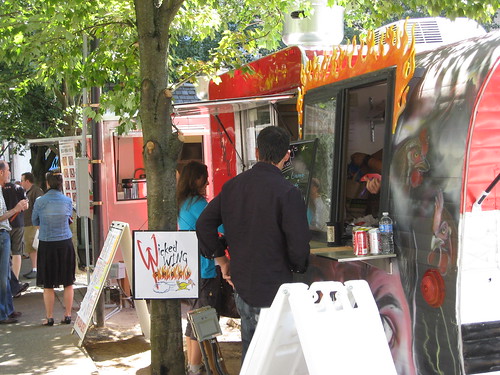
Connectivity also reduces the cost of providing emergency services. In Charlotte,[Portland's round-the-block food cart destinations are a wonderful example of a transit-oriented, mixed-use, neighborhood's potential offerings.]
the most efficient fire station—in a connected 19th-century neighborhood—served 26,930 households in 14.1 square miles with a per capita life cycle cost of $159 per year. In contrast, the least efficient station—in a sprawling community built in the 1980s and 1990s—served only 5,779 households in 8 square miles at a per capita life cycle cost of $740 per year.
Variety of State Action
The report discusses what is necessary in terms of transportation and pedestrian-friendly street networks for people to age in place and the movement at the state legislative level on related policies. From Virginia's complete streets legislation to Utah's transit-oriented development, the report contains many examples of programs and laws that are the starting blocks for communities to be hospitable to a wider range of transportation modes. An example of progress is Montana, a very sparsely-populated state.
Three years ago, the state had nine rural transportation systems; today, there are almost 40. To achieve this, the state went to city and county governments and several county Councils on Aging (each of which already operated some type of bus service) and offered to help them devise and pay for a coordinated plan. “We went to these Councils on Aging and said, ‘You’re already running a senior bus service; if you open your doors to everyone, print a schedule and follow the FTA guidelines, we will help you pull it all together and receive FTA funding,’” said [Audrey] Allums. The localities have provided matching funds by using Title III-B Older Americans Act money, property taxes, donations and other local government money.What Is a Citizen to Do?
Idaho Smart Growth
Idaho Smart Growth releases a citizen's guide that could easily function as a template for other states and communities. Language is plain for laypeople. It defines livability concepts and walks through jurisdictional responsibilities and steps for becoming involved in planning and community participation in land use, transportation, and public health decisions. Included is information specific to Idaho and local organizations, but most of the guide and resources listed are relevant nationally.
Tuesday, December 6, 2011
Local Success Stories
In the NRC Technical Assistance News
State coordinating council profiles
Mobility management grants
Livability briefs
Online dialogue about senior transportation
I&R training
FTA procurement facts
[Details high up inside Chicago's Union Station.]
Planning Assistance
National Association of Regional Councils
NARC's newsletter welcomes communities to apply for the American Planning Association's Community Planning Assistance Team (CPAT) program. Communities facing a range of challenges including, but not limited to, social equity and affordability, economic development, sustainability, consensus building, and urban design are well-suited for assistance through the program. Demonstrated need for assistance is an important qualification. The deadline for applications is Dec. 13, 2011.
Transit Partnerships
American Bus Association
The ABA celebrates the new bus deck at Union Station in Washington, D.C., making the station truly multi-modal, with intercity bus and train services as well as local transit and bikeshare. The Union Station parking garage now accommodates Megabus, Bolt Bus, Washington Deluxe, DC2NY and tour bus parking.
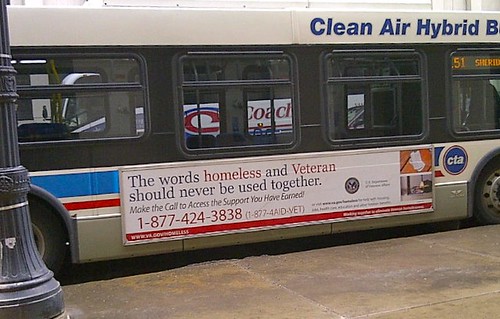
[Chicago Transit Authority bus outside Union Station.]
American Public Transportation Association
APTA awards six Local Transit Coalition Grants, which "support grassroots coalitions and their advocacy efforts to achieve public transportation goals on the state and local levels." These include education and advocacy campaigns. The current winners are:
* Arizona Transit Association (AzTA), Gilbert, AZ, which will use the grant award to support a first-ever statewide poll of voter preferences for public transit in Arizona.
* Community Transportation Association of Idaho (CTAI), Boise, ID, which is working with Idaho Smart Growth and community leaders to place the question of local option tax authority on the November 2012 ballot.
* Friends of Transit for Kalamazoo, Kalamazoo, MI, which will support grassroots advocacy efforts to secure local funding for public transportation services in Kalamazoo County and to increase public transportation funding in the state and federal budgets.
* Transit Alliance, Denver, CO, which will continue its educational efforts on the benefits of public transit in the Denver metropolitan region. The group is working with other regional stakeholders to identify ways to solidify long-term leadership and advocacy for the region’s livability.
* Transit Now Nashville (TNN), Madison, TN, which is partnering with the Metro Nashville Public Health Department to develop a pilot educational program focused on incorporating public transportation as a component of a healthy lifestyle.
* Washtenaw Partners for Transit (P4T), Ypsilanti, MI, which advocates for reliable funding to implement the 30-year Ann Arbor Transportation Authority Transit Master Plan.
Smart Growth Achievement Awards
Environmental Protection Agency
Last week at EPA, the agency celebrated this year's Smart Growth Achievement Awards. Terms like mixed-use, transit-oriented and walkable figured prominently. While none of the projects was a transit project, some provided access to transit and sought to engineer transit-oriented living. Two stand out from a transit perspective.
* LEED-platinum residential project in downtown Albuquerque, N.M., which is affordable and placed near transit, intercity transportation, restaurants and shopping. The site was previously a bus holding facility.
* Plan El Paso that envisions three mixed-use, transit-oriented neighborhoods that will make possible responsible environmental stewardship and reduced car usage. Bus rapid transit service has already started.
[View of California coast.]
Big Partnerships in a Big State
From the newsletter of the National Complete Streets Coalition:
State coordinating council profiles
Mobility management grants
Livability briefs
Online dialogue about senior transportation
I&R training
FTA procurement facts
[Details high up inside Chicago's Union Station.]
Planning Assistance
National Association of Regional Councils
NARC's newsletter welcomes communities to apply for the American Planning Association's Community Planning Assistance Team (CPAT) program. Communities facing a range of challenges including, but not limited to, social equity and affordability, economic development, sustainability, consensus building, and urban design are well-suited for assistance through the program. Demonstrated need for assistance is an important qualification. The deadline for applications is Dec. 13, 2011.
Transit Partnerships
American Bus Association
The ABA celebrates the new bus deck at Union Station in Washington, D.C., making the station truly multi-modal, with intercity bus and train services as well as local transit and bikeshare. The Union Station parking garage now accommodates Megabus, Bolt Bus, Washington Deluxe, DC2NY and tour bus parking.
[Chicago Transit Authority bus outside Union Station.]
American Public Transportation Association
APTA awards six Local Transit Coalition Grants, which "support grassroots coalitions and their advocacy efforts to achieve public transportation goals on the state and local levels." These include education and advocacy campaigns. The current winners are:
* Arizona Transit Association (AzTA), Gilbert, AZ, which will use the grant award to support a first-ever statewide poll of voter preferences for public transit in Arizona.
* Community Transportation Association of Idaho (CTAI), Boise, ID, which is working with Idaho Smart Growth and community leaders to place the question of local option tax authority on the November 2012 ballot.
* Friends of Transit for Kalamazoo, Kalamazoo, MI, which will support grassroots advocacy efforts to secure local funding for public transportation services in Kalamazoo County and to increase public transportation funding in the state and federal budgets.
* Transit Alliance, Denver, CO, which will continue its educational efforts on the benefits of public transit in the Denver metropolitan region. The group is working with other regional stakeholders to identify ways to solidify long-term leadership and advocacy for the region’s livability.
* Transit Now Nashville (TNN), Madison, TN, which is partnering with the Metro Nashville Public Health Department to develop a pilot educational program focused on incorporating public transportation as a component of a healthy lifestyle.
* Washtenaw Partners for Transit (P4T), Ypsilanti, MI, which advocates for reliable funding to implement the 30-year Ann Arbor Transportation Authority Transit Master Plan.
Smart Growth Achievement Awards
Environmental Protection Agency
Last week at EPA, the agency celebrated this year's Smart Growth Achievement Awards. Terms like mixed-use, transit-oriented and walkable figured prominently. While none of the projects was a transit project, some provided access to transit and sought to engineer transit-oriented living. Two stand out from a transit perspective.
* LEED-platinum residential project in downtown Albuquerque, N.M., which is affordable and placed near transit, intercity transportation, restaurants and shopping. The site was previously a bus holding facility.
* Plan El Paso that envisions three mixed-use, transit-oriented neighborhoods that will make possible responsible environmental stewardship and reduced car usage. Bus rapid transit service has already started.
[View of California coast.]
Big Partnerships in a Big State
From the newsletter of the National Complete Streets Coalition:
Though most everything else is bigger in Texas, AARP Texas isn't convinced mobility options for the state's aging population are the right size. Volunteers have begun conducting pedestrian safety audits across the state, including in El Paso, Dallas, Houston, Beaumont, Sherman, San Angelo, Austin, San Antonio, and McAllen. This information will be used to make the case for more Complete Streets solutions, including a renewed push for a state law when the legislature meets again in 2013. A bi-partisan group of legislators put forward a Complete Streets bill this year, but it failed to reach the floor in either chamber.
Tuesday, November 29, 2011
Events and Local Coordination Stories
Centers for Disease Control and Prevention
Webinar - Tackling the Question: Will Complete Streets Cost Too Much? - Dec. 1, 2011. Communities Putting Prevention to Work Webinar series presentation about implementing Complete Streets policies and strategies for responding to the cost concern, including examples and resources. The webinar will provide information both about the low cost of many complete streets treatments, as well as ways to talk to transportation professionals about the added value and community support that result from complete streets implementation.
National Association of Regional Councils
Annual conference - Feb. 12-14, 2012, Washington, DC. The conference will focus on the Administration's priorities, Congressional activities, critical policy issues and pending federal legislation that will impact regions. Environmental and transportation policy, livability and the effect of the current U.S. fiscal situation will be addressed.
[View of mid-renovation Union Station area in Denver at dusk.]
Coordination Stories
The Rio Grande Valley in Texas is realistically appraising its coordination and connectivity challenges via its coordinated transportation plan. "The public transit coordination plan was completed this month to comply with Federal Transit Administration rules requiring similar plans to be in place for access to its funding streams, but the study also provided an overview of how well the Valley’s providers have implemented existing coordination efforts." An article in the Brownsville Herald, Study: Valley's Transit Providers Must Connect Services, also explains the plan for further coordination to enable commuting from one city to another in the area. Other transportation services on the horizon are medical and shopping trips and routes with consistent schedules "throughout the day in the Valley’s urbanized areas."
Binghamton, a city in Upstate New York is using its half million dollar Community Challenge Grant, the only one awarded in the state, to engage the community to envision what type of community it should be in the future and follow up on that vision by writing it into its zoning code. A brief television news piece explains.
Webinar - Tackling the Question: Will Complete Streets Cost Too Much? - Dec. 1, 2011. Communities Putting Prevention to Work Webinar series presentation about implementing Complete Streets policies and strategies for responding to the cost concern, including examples and resources. The webinar will provide information both about the low cost of many complete streets treatments, as well as ways to talk to transportation professionals about the added value and community support that result from complete streets implementation.
National Association of Regional Councils
Annual conference - Feb. 12-14, 2012, Washington, DC. The conference will focus on the Administration's priorities, Congressional activities, critical policy issues and pending federal legislation that will impact regions. Environmental and transportation policy, livability and the effect of the current U.S. fiscal situation will be addressed.
[View of mid-renovation Union Station area in Denver at dusk.]
Coordination Stories
The Rio Grande Valley in Texas is realistically appraising its coordination and connectivity challenges via its coordinated transportation plan. "The public transit coordination plan was completed this month to comply with Federal Transit Administration rules requiring similar plans to be in place for access to its funding streams, but the study also provided an overview of how well the Valley’s providers have implemented existing coordination efforts." An article in the Brownsville Herald, Study: Valley's Transit Providers Must Connect Services, also explains the plan for further coordination to enable commuting from one city to another in the area. Other transportation services on the horizon are medical and shopping trips and routes with consistent schedules "throughout the day in the Valley’s urbanized areas."
Binghamton, a city in Upstate New York is using its half million dollar Community Challenge Grant, the only one awarded in the state, to engage the community to envision what type of community it should be in the future and follow up on that vision by writing it into its zoning code. A brief television news piece explains.
Wednesday, November 2, 2011
Events, Proposals Sought: Transit, Aging & Sustainability
Environmental Protection Agency
Webinar - Building Blocks for Sustainable Communities - Nov. 9. The webinar will describe the Building Blocks for Sustainable Communities Program and how it can help communities achieve the kind of development they are seeking. Discussed will be EPA’s direct technical assistance and each of the four grantee’s programs to provide free technical assistance. The webinar will also cover important deadlines and the application process.
National Center on Senior Transportation
Webinar - Successful Collaboration Between Aging and Transit: The Experience of Kent County, Michigan - Nov. 15, 2011. Sponsored by the Administration on Aging and NCST, the webinar will cover a successful collaboration between aging and transit that uses person-centered mobility management as a tool to assist older adults in identifying the right mobility option to meet their needs. Featured will be the experience of Ridelink, a transportation system for seniors in Kent County, Michigan.
NCST is a technical assistance center administered by Easter Seals Inc., in partnership with the National Association of Area Agencies on Aging.
[Fort Collins - First Colorado snow of the 2011-2012 season.]
National Transit Institute
Webinar - Public Transportation Systems as the Foundation for Economic Growth - Jan. 12, 2012. The International Transit Studies Program (ITSP) of the Transit Cooperative Research Program (TCRP) conducted a study mission of four cities where large investments in public transit are being made. The webinar will focus on how public transit investments drive economic growth in Istanbul, Cairo, Johannesburg, and Cape Town, and will discuss how population growth, congestion, urban sprawl, and inequalities in society are leading to unique patterns of transit expansion. Transit professionals who were members of the study team will present their observations and analysis.
Seeking Proposals (Non-matrimonial)
National Council on Independent Living
NCIL is requesting proposals for its 2012 conference, which will take place in Washington, DC on June 11-14, 2012. NCIL seeks workshops about transportation, social media, best practices, and the work of centers for independent living in hard times, among others. The deadline for submitting proposals is Dec. 2, 2011.
Webinar - Building Blocks for Sustainable Communities - Nov. 9. The webinar will describe the Building Blocks for Sustainable Communities Program and how it can help communities achieve the kind of development they are seeking. Discussed will be EPA’s direct technical assistance and each of the four grantee’s programs to provide free technical assistance. The webinar will also cover important deadlines and the application process.
National Center on Senior Transportation
Webinar - Successful Collaboration Between Aging and Transit: The Experience of Kent County, Michigan - Nov. 15, 2011. Sponsored by the Administration on Aging and NCST, the webinar will cover a successful collaboration between aging and transit that uses person-centered mobility management as a tool to assist older adults in identifying the right mobility option to meet their needs. Featured will be the experience of Ridelink, a transportation system for seniors in Kent County, Michigan.
NCST is a technical assistance center administered by Easter Seals Inc., in partnership with the National Association of Area Agencies on Aging.
[Fort Collins - First Colorado snow of the 2011-2012 season.]
National Transit Institute
Webinar - Public Transportation Systems as the Foundation for Economic Growth - Jan. 12, 2012. The International Transit Studies Program (ITSP) of the Transit Cooperative Research Program (TCRP) conducted a study mission of four cities where large investments in public transit are being made. The webinar will focus on how public transit investments drive economic growth in Istanbul, Cairo, Johannesburg, and Cape Town, and will discuss how population growth, congestion, urban sprawl, and inequalities in society are leading to unique patterns of transit expansion. Transit professionals who were members of the study team will present their observations and analysis.
Seeking Proposals (Non-matrimonial)
National Council on Independent Living
NCIL is requesting proposals for its 2012 conference, which will take place in Washington, DC on June 11-14, 2012. NCIL seeks workshops about transportation, social media, best practices, and the work of centers for independent living in hard times, among others. The deadline for submitting proposals is Dec. 2, 2011.
Tuesday, October 4, 2011
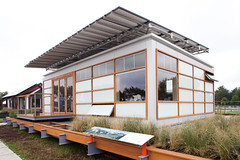
Solar Decathlon Reflects Transportation, Accessibility Thinking Among College Students
In this era of linking transportation and housing to find solutions to energy-related problems, it is heartening that the link was reflected in the wish list of solar/low carbon-emission houses produced for the 2011 Solar Decathlon that just took place in Washington, DC. For any of you not in the know, the Solar Decathlon is a finalist competition of 20 college and university teams from across the country and around the world. The teams are from all types of schools along the collegiate spectrum, this year including an impressive entry from a small liberal arts school (my husband's alma mater) in New England to giant state universities (one of which my sister works for and another 10 minutes from my house). Many of the homes are designed for specific regions and affordability is one component of the competition.
This year, two homes were designed as possible units in multi-family buildings. The City University of New York (CCNY) (my dad's alma mater) entrant was a house that could sit atop an apartment building, surrounded by a rooftop farm or other similar units. I have to admit I used to love spending time on the roof of my building when I was growing up. It is an oasis-in-the-city idea. It also made gorgeous use of light green recycled glass in the kitchen and bathroom. Team Tidewater from Virginia's Old Dominion University and Hampton University, produced a lovely house, the most formally decorated and architecturally detailed in the competition, designed as a unit for a small apartment building in a walkable old small city.
[CCNY house.]
I was happy to see that these schools thought about the energy use of their occupants beyond their front doors to where people travel in their daily lives.
Accessibility: Garden State and Beyond
New Jersey was not far behind in this respect. Its design assumed that homes are usually placed close enough together that privacy is desired and that floor-to-ceiling windows in every room do not provide that. (Disclosure: I had a private tour of the New Jersey house from my cousin, an architecture student, who was on the team.)
Another plus from Team New Jersey that reflected larger societal trends was its complete accessibility, even in the bathroom, for wheelchair users, so that a person in a wheelchair can do more than visit for a few hours, but can actually visit over night or live in the house. Other teams with equal accessibility were Florida International, Maryland, Illinois, Tennessee, and Appalachian State. Indeed, Florida International's design included grab bars throughout the bathroom.
[Bathroom of Appalachian State's house.]
Affordability
We can all have a dream house with enough money, but providing housing that meets societal and personal needs at an affordable price is a challenge. Affordability was well displayed in Team Belgium's entry. The home was made from a house kit the students designed that will enable do-it-yourself building. It is compact, livable and flexible for multiple uses. It also features a design element missing in the 2009 Solar Decathlon, two bedrooms, so that a family could live there.
A few other teams also featured two bedrooms, including Middlebury College (an impressive entrant with a green indoor vegetable wall in the kitchen) and Appalachian State (also beautiful with tin wall in bathroom and outdoor shed storage spaces). Florida International's design also seemed amenable to family use for long-term living.
Something heartening beyond the creativity and commitment of the students was the attention of many teams to universal design, cost concerns, and options (such as solar technology) that are available now. That a few teams actually placed their homes in specific types of walkable - and transit-friendly - locations was a big plus, and one that I hope extends beyond the competition.
[Middlebury's green wall in kitchen.]
This year, two homes were designed as possible units in multi-family buildings. The City University of New York (CCNY) (my dad's alma mater) entrant was a house that could sit atop an apartment building, surrounded by a rooftop farm or other similar units. I have to admit I used to love spending time on the roof of my building when I was growing up. It is an oasis-in-the-city idea. It also made gorgeous use of light green recycled glass in the kitchen and bathroom. Team Tidewater from Virginia's Old Dominion University and Hampton University, produced a lovely house, the most formally decorated and architecturally detailed in the competition, designed as a unit for a small apartment building in a walkable old small city.
[CCNY house.]
I was happy to see that these schools thought about the energy use of their occupants beyond their front doors to where people travel in their daily lives.
Accessibility: Garden State and Beyond
New Jersey was not far behind in this respect. Its design assumed that homes are usually placed close enough together that privacy is desired and that floor-to-ceiling windows in every room do not provide that. (Disclosure: I had a private tour of the New Jersey house from my cousin, an architecture student, who was on the team.)
Another plus from Team New Jersey that reflected larger societal trends was its complete accessibility, even in the bathroom, for wheelchair users, so that a person in a wheelchair can do more than visit for a few hours, but can actually visit over night or live in the house. Other teams with equal accessibility were Florida International, Maryland, Illinois, Tennessee, and Appalachian State. Indeed, Florida International's design included grab bars throughout the bathroom.
[Bathroom of Appalachian State's house.]
Affordability
We can all have a dream house with enough money, but providing housing that meets societal and personal needs at an affordable price is a challenge. Affordability was well displayed in Team Belgium's entry. The home was made from a house kit the students designed that will enable do-it-yourself building. It is compact, livable and flexible for multiple uses. It also features a design element missing in the 2009 Solar Decathlon, two bedrooms, so that a family could live there.
A few other teams also featured two bedrooms, including Middlebury College (an impressive entrant with a green indoor vegetable wall in the kitchen) and Appalachian State (also beautiful with tin wall in bathroom and outdoor shed storage spaces). Florida International's design also seemed amenable to family use for long-term living.
Something heartening beyond the creativity and commitment of the students was the attention of many teams to universal design, cost concerns, and options (such as solar technology) that are available now. That a few teams actually placed their homes in specific types of walkable - and transit-friendly - locations was a big plus, and one that I hope extends beyond the competition.
[Middlebury's green wall in kitchen.]
Wednesday, April 6, 2011
Getting out of Cars
American Association of State Highway and Transportation Officials
AASHTO reports record-breaking Amtrak ridership, 8 percent overall over last year, with some lines having increases over 30 percent.
Virginia's Newport News line to Washington grew 43% year over year, while the Lynchburg-to-Washington route was up 40%.
"Virginia is very proud of the success of this train," Virginia Department of Rail and Public Transportation Director Thelma Drake said in a statement. "This success shows that there is demand for intercity passenger rail service in Virginia, and by serving major population centers, we are able to remove thousands of cars from the highways."
What Will Get People out of Their Cars?
This is a question I will pose in terms of urban areas right now due to a recent report, Tech for Transit: Designing a Future System, which synthesizes the recommendations of 18 people who went on one-week car-free diets in Boston and San Fransisco. The report is useful in determining what will reduce car usage in places that already have convenient and multiple alternatives to the automobile, such as transit, bike sharing, carsharing, taxis and walkable streets. It also provides food for thought for investment options in places that do not have all of those alternatives.
For the participants, the benefit of a car was not ownership, but autonomy. The benefits of being car free were feeling a part of a community and feeling that one was contributing to the environment. Now, from the recommendations, it seems like a particular type of person was included in the study. The primary recommendations is all-tech, all personally available, and easily accessible.
The participants want to see all information - transit, car sharing, taxis, bike sharing, etc - available in one place so that they can make cost, route and time decisions. The preference was for apps. Signage and telephone information were not even mentioned, as if they were so quaintly 20th century. They want mobility options and easy ways to make last-minute determinations about the options to select. The change in habits that participants noticed was adjustment to shopping routines. While they could see going car free, there was also the opinion that reducing car usage does not have to be all or nothing.
Creativity for Transit
Danville, Va., a city in the central part of the state, is offering two sites for "new creative bus stop shelters." According to the WLS10 business news article:
the Young Professionals Committee of the Danville Pittsylvania County Chamber of Commerce "would like 'creative and aesthetically pleasing' bus stop shelters not only to increase ridership, but also to serve as focal points for the city’s central business district, according to a news release. So, the young professionals are sponsoring a design competition with $1,000, $500, and $250 prizes to be awarded for first, second and third places.
Wednesday, March 9, 2011
American Public Transportation Association (APTA)
APTA reports rising savings for using public transit (and walking or biking) instead of owning a car. Currently, the national average stands at "$9,904 annually and $825 per month based on the March 4, 2011 average national gas price ($3.47 per gallon-reported by AAA) and the national unreserved monthly parking rate." The savings are more impressive in the nation's largest - and most transit-rich cities - with savings of over $14,000 in New York and over $10,000 in Denver. Prices in metropolitan areas and other regions are not assessed; suburban and rural equivalents of the savings rates are not available.
In this same vein, the APTA savings report is featured in a CBS News story about the financial rationale for using transit, on the one hand, and, on the other, the revenue squeeze on transit that has prompted systems to reduce service and/or increase fares.
Public Participation: Not Necessarily Boring
If you are looking to promote public participation in transit promotion, planning and advocacy, view this creative video from Detroit, which uses legos and music to discuss the street configuration for the planned Woodward Ave. line.
Thanks to Chris Zeilinger, Director of the National Resource Center for Human Service Transportation Coordination (NRC) for finding the video material.
The Utah Transit Authority is promoting and using twitter to hear from its customer base about their preferences for service hours and routes. Although the transit system is also employing traditional public hearings and now old-fashioned email as well, management has respect for the thoughtful, quality 140-character (and fewer) tweets they have received.
Livability Goes Local
National Association of Counties (NACo)
From NACo's newsletter:
APTA reports rising savings for using public transit (and walking or biking) instead of owning a car. Currently, the national average stands at "$9,904 annually and $825 per month based on the March 4, 2011 average national gas price ($3.47 per gallon-reported by AAA) and the national unreserved monthly parking rate." The savings are more impressive in the nation's largest - and most transit-rich cities - with savings of over $14,000 in New York and over $10,000 in Denver. Prices in metropolitan areas and other regions are not assessed; suburban and rural equivalents of the savings rates are not available.
In this same vein, the APTA savings report is featured in a CBS News story about the financial rationale for using transit, on the one hand, and, on the other, the revenue squeeze on transit that has prompted systems to reduce service and/or increase fares.
Public Participation: Not Necessarily Boring
If you are looking to promote public participation in transit promotion, planning and advocacy, view this creative video from Detroit, which uses legos and music to discuss the street configuration for the planned Woodward Ave. line.
Thanks to Chris Zeilinger, Director of the National Resource Center for Human Service Transportation Coordination (NRC) for finding the video material.
The Utah Transit Authority is promoting and using twitter to hear from its customer base about their preferences for service hours and routes. Although the transit system is also employing traditional public hearings and now old-fashioned email as well, management has respect for the thoughtful, quality 140-character (and fewer) tweets they have received.
Livability Goes Local
National Association of Counties (NACo)
From NACo's newsletter:
NACo will seek input from members about implementing federal livability goals through a new project led by the National Association of Regional Councils (NARC), with support from U.S. Department of Transportation. The two-year project is intended to assist localities in building the governance, strategies and tools needed to create and implement regional transportation plans that support sustainable development. NARC and NACo will partner to offer listening sessions at upcoming NACo conferences.
Contact: James Davenport • 202.661.8807
Thursday, January 13, 2011
Partnering to Multiply Benefits of Transit
Two publications are being distributed that demonstrate partnering across funding streams and types of public and private works. These partnerships have multiple benefits for communities.
Community Transportation Association of America (CTAA)
CTAA's current issue of Community Transportation Magazine focuses on examples of partnerships for coordination, whether among transit and long-distance systems, in the case of San Francisco's planned new terminal (said to rival Grand Central Station) or a transit hub in Spearfish, S.D., or among human service agencies and public transit, such as in Massachusetts. The issue profiles Cape Cod's employment of technology to assist transit and for rider information and scheduling. The issue also covers Institutes for Coordination, complete streets and ride sharing models.
(As for any station competing with Grand Central, first visit Grand Central at 8:30 on any particular sunny morning with streams of light falling across the station and then tell me whether another facility can rival the beauty of this New York landmark. The answer might be yes, in which case there will be a new place to inspire us all.)
Putting Money into Transit-Oriented Development
Reconnecting America
The latest Reconnecting America TOD publication, 2010 Inventory of TOD Programs, covers federal, state and local funding for TOD. The report does not examine any other type of TOD inducements, such as zoning changes or partnerships with transit. Most of the TOD programs mentioned seek to capitalize on existing transit rather than developing transit and residential or commercial projects in conjunction with one another. Reconnecting America announces that TOD programs are on the rise, with many interested communities seeking advice from existing program personnel.
Community Transportation Association of America (CTAA)
CTAA's current issue of Community Transportation Magazine focuses on examples of partnerships for coordination, whether among transit and long-distance systems, in the case of San Francisco's planned new terminal (said to rival Grand Central Station) or a transit hub in Spearfish, S.D., or among human service agencies and public transit, such as in Massachusetts. The issue profiles Cape Cod's employment of technology to assist transit and for rider information and scheduling. The issue also covers Institutes for Coordination, complete streets and ride sharing models.
(As for any station competing with Grand Central, first visit Grand Central at 8:30 on any particular sunny morning with streams of light falling across the station and then tell me whether another facility can rival the beauty of this New York landmark. The answer might be yes, in which case there will be a new place to inspire us all.)
Putting Money into Transit-Oriented Development
Reconnecting America
The latest Reconnecting America TOD publication, 2010 Inventory of TOD Programs, covers federal, state and local funding for TOD. The report does not examine any other type of TOD inducements, such as zoning changes or partnerships with transit. Most of the TOD programs mentioned seek to capitalize on existing transit rather than developing transit and residential or commercial projects in conjunction with one another. Reconnecting America announces that TOD programs are on the rise, with many interested communities seeking advice from existing program personnel.
Friday, January 7, 2011
Making the Most of Transit
The American Public Transportation Association (APTA) has added a mobility management page to its website. In addition to explaining what mobility management means for APTA's membership of transit agencies across the country, the site has articles that explain the business case for this approach and why partnerships, a customer focus and a reduced emphasis on "rolling stock" are in the interests of communities and transit.
The National Endowment for the Arts published a report on Creative Placemaking, that includes use of art in transit infrastructure. Though the report is not primarily transit oriented, it makes the case to communities, planners, and transit staff that public art enhances the value of all types of public works projects.
Who is the guy standing outside the subway station at Metro Center? It's Abe Lincoln letting people know about Nationals games, where he races a few fellow past presidents.
Resources for Transportation-Challenged Populations
Children’s Health Fund (CHF)
CHF has presentations and publications that discuss transportation as a critical link to health care for people with low incomes. Information about CHF's positions regarding health care legislative issues are also available.
Easter Seals Project ACTION is currently accepting applications for the 2011 Accessible Transportation Coalitions Initiative.
This initiative helps communities ready to tackle accessible transportation challenges and engage local leaders in the process. Ten communities across the United States will be selected to participate in the Accessible Transportation Coalitions Initiative (ATCI), a one-year systems change process designed to improve accessible transportation options for people with disabilities. In order to be considered, the completed application must be submitted on or before January 31, 2011.
ESPA is also conducting an online survey about the connection between hospital discharge planning and access to appropriate transportation options.
The National Endowment for the Arts published a report on Creative Placemaking, that includes use of art in transit infrastructure. Though the report is not primarily transit oriented, it makes the case to communities, planners, and transit staff that public art enhances the value of all types of public works projects.
Who is the guy standing outside the subway station at Metro Center? It's Abe Lincoln letting people know about Nationals games, where he races a few fellow past presidents.
Resources for Transportation-Challenged Populations
Children’s Health Fund (CHF)
CHF has presentations and publications that discuss transportation as a critical link to health care for people with low incomes. Information about CHF's positions regarding health care legislative issues are also available.
Easter Seals Project ACTION is currently accepting applications for the 2011 Accessible Transportation Coalitions Initiative.
This initiative helps communities ready to tackle accessible transportation challenges and engage local leaders in the process. Ten communities across the United States will be selected to participate in the Accessible Transportation Coalitions Initiative (ATCI), a one-year systems change process designed to improve accessible transportation options for people with disabilities. In order to be considered, the completed application must be submitted on or before January 31, 2011.
ESPA is also conducting an online survey about the connection between hospital discharge planning and access to appropriate transportation options.
Tuesday, November 30, 2010
Ideas for a Sustainable, Multi Modal Transportation System
The American Bus Association (ABA) posts a link to a report of the Mobility Choice Coalition, of which ABA is a member. Taking the Wheel: Achieving a Competitive Transportation Sector Through Mobility Choice discusses the history and biases of current transportation infrastructure and policy, with recommendations for a multi-modal future that incorporates the public and private sectors.
Recommendations include:
* Transparent pricing - paying for the road services one uses;
* Fair allocation of costs based on use, savings of oil and damage to roadways;
* Moving authority for decision making to metropolitan level with national performance standards - to encourage more competition among mode choices; and
* Technology upgrades for a more efficient system.
A Menu of Suggestions
Though the report calls for transparent pricing, it includes only transportation costs and not many of the external costs of a car-dependent lifestyle, such as public health consequences. It does call for mileage-based insurance premiums to account for the high rate of injury and death that automobile travel results in and the increasing odds of accidents that come along with increases in mileage. Among the strategies mentioned are congestion pricing, HOT lanes, truck-only lanes, fees to reflect oil's national security costs, telecommuting, high-speed and inter-city rail, transit vouchers for low-income riders, apportioning transit dollars for realizing fuel savings through high-load routes and modes, and changing land-use rules to satisfy demand for mixed-use walkable communities.
The coalition estimates that by 2030, the recommended strategies could save 779 million barrels, "or more than 10 percent of projected on-road oil consumption." The estimates are based on "the Department of Energy’s Annual Energy Outlook (AEO) 2010, and includes all of AEO’s assumptions regarding vehicle miles of travel (VMT) and vehicle fuel efficiency to 2030."
DC's Sustainability Plan
The Department of Transportation for Washington, D.C., the equivalent of a state department of transportation that also has jurisdiction over local roads, releases its Sustainability Plan 2010, which promotes transit, biking and walking and seeks to reduce energy consumption.
In the section about linking land use to transportation, the plan announces that "[t]he program revitalizes major urban corridors by improving transportation options, increasing streetscape attractiveness and attracting businesses and residents to the area. It also provides environmental benefits through smarter and more efficient use of land resources."
In terms of its strong endorsement of a multi-modal approach, the program is progressing with:
The plan also covers economic and social justice impacts. It envisions itself as a tool to spur economic activity and to save on infrastructure costs. It also seeks, without concrete details, to equitably serve low-income communities.
Recommendations include:
* Transparent pricing - paying for the road services one uses;
* Fair allocation of costs based on use, savings of oil and damage to roadways;
* Moving authority for decision making to metropolitan level with national performance standards - to encourage more competition among mode choices; and
* Technology upgrades for a more efficient system.
A Menu of Suggestions
Though the report calls for transparent pricing, it includes only transportation costs and not many of the external costs of a car-dependent lifestyle, such as public health consequences. It does call for mileage-based insurance premiums to account for the high rate of injury and death that automobile travel results in and the increasing odds of accidents that come along with increases in mileage. Among the strategies mentioned are congestion pricing, HOT lanes, truck-only lanes, fees to reflect oil's national security costs, telecommuting, high-speed and inter-city rail, transit vouchers for low-income riders, apportioning transit dollars for realizing fuel savings through high-load routes and modes, and changing land-use rules to satisfy demand for mixed-use walkable communities.
The coalition estimates that by 2030, the recommended strategies could save 779 million barrels, "or more than 10 percent of projected on-road oil consumption." The estimates are based on "the Department of Energy’s Annual Energy Outlook (AEO) 2010, and includes all of AEO’s assumptions regarding vehicle miles of travel (VMT) and vehicle fuel efficiency to 2030."
DC's Sustainability Plan
The Department of Transportation for Washington, D.C., the equivalent of a state department of transportation that also has jurisdiction over local roads, releases its Sustainability Plan 2010, which promotes transit, biking and walking and seeks to reduce energy consumption.
In the section about linking land use to transportation, the plan announces that "[t]he program revitalizes major urban corridors by improving transportation options, increasing streetscape attractiveness and attracting businesses and residents to the area. It also provides environmental benefits through smarter and more efficient use of land resources."
In terms of its strong endorsement of a multi-modal approach, the program is progressing with:
* Expanding and increasing transit services, such as designing and constructing a streetcar system and a water-taxi system.
* Developing multimodal transportation projects that consider roadway, pedestrians, bicyclists and transit improvements.
* Implementing TDM strategies, such as car sharing, carpool, vanpool, transit subsidies and parking management programs.
The plan also covers economic and social justice impacts. It envisions itself as a tool to spur economic activity and to save on infrastructure costs. It also seeks, without concrete details, to equitably serve low-income communities.
Wednesday, September 15, 2010
Rural Transit Gets Attention
The Association of Programs for Rural Independent Living (APRIL), along with YouthBuild USA, Good News Mountaineer Garage (a car ownership program for low-income residents of West Virginia), Redwood Coast Rural Action (a regional network of rural leaders based in northern California), and Sustainable Northwest (a Western U.S. community-oriented, conservation-based non-profit group), is a member of the National Rural Assembly Rural Transportation Policy Group. The group released a statement declaring, "Highway-building alone is not enough to address the economic and mobility needs of small-town and rural America."
The group's position on transportation reauthorization legislation calls for the federal government to be a catalyst to "modernize, strengthen and integrate the transportation systems that connect rural people and places to each other and urban commercial centers, while protecting the landscapes, habitat and livelihoods of rural communities." The National Rural Assembly is also asking for investments in broadband technology.
Billy Altom, executive director of APRIL, stated that "rural residents, especially those with disabilities, need and deserve affordable and accessible transportation. This includes public transit, regional, and inter-modal systems that are in compliance with Americans with Disabilities Act."
Stories of Rural Livability
The Transportation for America blog series on rural livability is now complete, with 12 examples of livability initiatives across the spectrum of small towns, reservations and small cities. A few of the examples are from the archives of technical assistance projects of the Community Transportation Association of America (CTAA). Some are examples of EPA smart growth projects.
The series shows some examples of transit's role in creating livable communities. Others showcase places that have embarked on downtown and pedestrian-friendly projects. The full series is available at http://t4america.org/tag/livability-case-studies/.
One State Goes Totally Smart Growth
The newsletter of the American Association of State Highway and Transportation Officials (AASHTO), announced that New York State recently passed a smart growth bill that is intended to do away with unnecessary sprawl. Enacted as an environmental conservation measure, the law sets forth nine smart growth criteria, including protection of rural agricultural land and improvement of public transportation choices to move beyond automobile dependency.
Though there are no exceptions to the law listed, it only applies to state agencies. It requires state infrastructure agencies to create smart growth advisory committees and mandates state committees to "solicit input from and consult with various representatives of affected communities and organizations within those communities, and shall give consideration to the local and environmental interests affected by the activities of the agency or projects planned, approved or financed through such agency."
I'm a New Yorker; I'm skeptical, watching and waiting to see how this broad legislative action plays out in the real world. There are no enforcement teeth or specific mandates.
The group's position on transportation reauthorization legislation calls for the federal government to be a catalyst to "modernize, strengthen and integrate the transportation systems that connect rural people and places to each other and urban commercial centers, while protecting the landscapes, habitat and livelihoods of rural communities." The National Rural Assembly is also asking for investments in broadband technology.
Billy Altom, executive director of APRIL, stated that "rural residents, especially those with disabilities, need and deserve affordable and accessible transportation. This includes public transit, regional, and inter-modal systems that are in compliance with Americans with Disabilities Act."
Stories of Rural Livability
The Transportation for America blog series on rural livability is now complete, with 12 examples of livability initiatives across the spectrum of small towns, reservations and small cities. A few of the examples are from the archives of technical assistance projects of the Community Transportation Association of America (CTAA). Some are examples of EPA smart growth projects.
The series shows some examples of transit's role in creating livable communities. Others showcase places that have embarked on downtown and pedestrian-friendly projects. The full series is available at http://t4america.org/tag/livability-case-studies/.
One State Goes Totally Smart Growth
The newsletter of the American Association of State Highway and Transportation Officials (AASHTO), announced that New York State recently passed a smart growth bill that is intended to do away with unnecessary sprawl. Enacted as an environmental conservation measure, the law sets forth nine smart growth criteria, including protection of rural agricultural land and improvement of public transportation choices to move beyond automobile dependency.
Though there are no exceptions to the law listed, it only applies to state agencies. It requires state infrastructure agencies to create smart growth advisory committees and mandates state committees to "solicit input from and consult with various representatives of affected communities and organizations within those communities, and shall give consideration to the local and environmental interests affected by the activities of the agency or projects planned, approved or financed through such agency."
I'm a New Yorker; I'm skeptical, watching and waiting to see how this broad legislative action plays out in the real world. There are no enforcement teeth or specific mandates.
Thursday, August 26, 2010
Public Transit: Health Provider
Yes, a bus can take a person to the doctor, to work, to the supermarket, but, according to a study commissioned by the American Public Transportation Association (APTA), just having rail or bus fixed-route transit in your town or neighborhood increases the chances that you are living a healthy lifestyle and reaping its benefits. Evaluating Public Transportation Health Benefits, prepared by the Victoria Transport Policy Institute, shows that it is not so much the bus or the train itself that provides health benefits as the accouterments of places that have invested in transit and the lifestyle of walking to a stop or a station: walkable streets, less car use - whether a trip is part transit or not, fewer car crashes (injuries and fatalities), less pollution, more exercise, and fewer health problems associated with a sedentary lifestyle. What transit does accomplish for health is making possible healthier choices than those mobility options that disproportionately pollute, cause serious injury and death, and make it inconvenient to get in that all-important daily exercise.
APTA's website is filled stories of the benefits of transit. In addition to health, the annual savings average of transit over car use was pegged this year at $9,381, an average far exceeded in many major cities. If you live in Brooklyn, for example, you could save over $13,000 (of course your housing costs would be impossible, so you might want to consider a move carefully).
Planning Sustainable Communities
The Administration intends to encourage more communities to become healthier and more environmentally sustainable through the Department of Housing and Urban Development Sustainable Communities Regional Planning Grants.
The Association of Metropolitan Planning Organizations has posted advice for regions planning to apply for the grants. This includes a good explanation of what federal and other dollars may be used as matching funds. This planning grant program intends to "support metropolitan and multijurisdictional planning efforts that integrate housing, land use, economic and workforce development, transportation and infrastructure investments in a manner that empowers jurisdictions to consider the interdependent challenges of these issues specific to their region."
Another good source of information on this topic is the National Association of Regional Councils (NARC). It has a page devoted to the Sustainable Communities Regional Planning Grants and how to apply.
APTA's website is filled stories of the benefits of transit. In addition to health, the annual savings average of transit over car use was pegged this year at $9,381, an average far exceeded in many major cities. If you live in Brooklyn, for example, you could save over $13,000 (of course your housing costs would be impossible, so you might want to consider a move carefully).
Planning Sustainable Communities
The Administration intends to encourage more communities to become healthier and more environmentally sustainable through the Department of Housing and Urban Development Sustainable Communities Regional Planning Grants.
The Association of Metropolitan Planning Organizations has posted advice for regions planning to apply for the grants. This includes a good explanation of what federal and other dollars may be used as matching funds. This planning grant program intends to "support metropolitan and multijurisdictional planning efforts that integrate housing, land use, economic and workforce development, transportation and infrastructure investments in a manner that empowers jurisdictions to consider the interdependent challenges of these issues specific to their region."
Another good source of information on this topic is the National Association of Regional Councils (NARC). It has a page devoted to the Sustainable Communities Regional Planning Grants and how to apply.
Tuesday, August 3, 2010
HUD Money Available for Community-Based Initiatives
The Department of Housing and Urban Development (HUD) in its Sustainable Communities Regional Planning Grant program has funds available for communities with stakeholder involvement in equity-based projects, such as transportation services and infrastructure. According to a PolicyLink guide to the funding, the applications, due Aug. 23, must address the Administration's livability principles and HUD's priorities.
The goal of the HUD program is to transform low-income areas into "communities of opportunity," which I presume means communities that have more income than they had before. Some of the funding will go to rural communities, with grants of between $100,000 and $1 million.
Community and Regional Partners
One of the key priorities is to fund projects with coordination among equity advocates, community-based organizations representing people of color and/or low-income residents, local government and regional planning organizations. Examples of the type of projects HUD is looking for are given and they include transit and infrastructure improvements. Health equity is another permissible goal for applicants.
The guide includes advice about how to fill out the application.
The goal of the HUD program is to transform low-income areas into "communities of opportunity," which I presume means communities that have more income than they had before. Some of the funding will go to rural communities, with grants of between $100,000 and $1 million.
Community and Regional Partners
One of the key priorities is to fund projects with coordination among equity advocates, community-based organizations representing people of color and/or low-income residents, local government and regional planning organizations. Examples of the type of projects HUD is looking for are given and they include transit and infrastructure improvements. Health equity is another permissible goal for applicants.
The guide includes advice about how to fill out the application.
Friday, July 30, 2010
Coordinating for Vibrant Communites
A bus system alone does not transform a community. And unless there is an accessible sidewalk and perhaps a bench, the bus will not be a solution for even those who live and work close by. However, I have seen plenty of smart growth material that does not even mention transit or long-distance transportation services. (And at least one court has ruled that poor public transit for an employee with a disability requires a reasonable accommodation. Read about the decision and resources in the NRC Technical Assistance News.)
What are the transportation issues that rural areas are paying attention to? Are transit access and connectivity among them?
Transportation Opinions from Rural Areas
Read the Four Corners Rural Transportation Forum report, recently prepared by the National Association of Development Organizations (NADO). The Four Corners rural communities of Arizona, Colorado, New Mexico and Utah are working on coordination of public transit and human services transportation, translating livability and the land-use/transportation connection for rural areas, incorporating transit into long-range transportation planning, and dealing with emerging rural growth areas.
One concern expressed about coordination was the perceived barrier of insurance/liability potential. Developments in rural coordination include establishment of one call services, statewide coordinated planning, and integration of transit and alternative modes into transportation planning. In terms of livability, these states are examining rural connectivity to cities and reinvigoration of downtowns.
A recent Government Accountability Office report, Rural Homelessness: Better Collaboration by HHS and HUD Could Improve Delivery of Services in Rural Areas suggests, though does not explicitly state, that smart growth and livability would greatly help poor and homeless rural populations. They not only have limited housing choices, but they lack transportation to connect to services and jobs. While this is not the only problem, the lack of connectivity over the long distances involved needlessly complicates life for struggling populations.
Smart Growth Geared for Rural America
The following new resources present ideas for coordination in terms of enhancing transit accessibility and use:
Putting Smart Growth to Work in Rural Communities examines different types of rural areas and the specific challenges they confront in loss of farmland, dispersed development, long distances to jobs, and rapid growth as well as long-term declines. This report promotes the benefits of transportation options, walkable main streets and downtowns, reuse of existing land, and preservation of open space.
The parts I found useful concerned redevelopment readiness (including community visioning)and transportation options. One caveat: Though the report provides ideas for economic development and preservation of open spaces, farmland and rural communities, transportation, generally, and mobility options, specifically, (including transit) are given short shrift.
Pedestrian Access to the Bus and the Community
A Blueprint America video (eight minutes) demonstrates the unsafe conditions for pedestrians on many American roads, with particular footage of inadequate bus stop access. The images and interviews are thoughtfully presented, providing a stark comparison between the priority of car travel, on the one hand, and, on the other hand, the lack of official focus on pedestrian safety and transit accessibility.
Federal Highway Administration (FHWA) has webinars and newsletters related to the ins and outs of pedestrian safety. A new webinar series is starting on Aug. 13. The seventh of eight in the series focuses on transit and pedestrians. Previous webinars are archived on the same site.
The National Highway Traffic Safety Administration (NHTSA) has released pedestrian safety materials for people whose first language is not English. Coming soon is a beginner level ESL course for learners who are not advanced, but still need to be educated on pedestrian and bicycle safety. NHSA has additional pedestrian and bike safety materials for Hispanics.
Next Steps for Pedestrian Safety and Mobility
The National Complete Streets Coalition 2010 Progress Report points to the amazing success that the coalition has achieved in helping states, regions and communities institute complete streets policies. Members of the National Consortium on the Coordination of Human Services Transportation have been instrumental to this success, particularly AARP (which has produced amazing livability and safe roads products), the American Council for the Blind, the American Public Transportation Association (APTA), and the National Association of Area Agencies on Aging (N4A), which all serve on the coalition's steering committee.
The coalition is looking forward to implementation, specifically at what elements complete streets policies include, whether these policies result in training, project development processes, design standards, and project selection criteria. The coalition will be analyzing performance measures to see whether they reflect the adopted complete streets policies and whether the outcomes are projects with improved travel for bicyclists, pedestrians, transit, and people with disabilities. The coalition "emphasizes a system-wide look at improvements, rather than measurement of individual projects against a standardized ideal."
As a lifelong pedestrian and transit user, I see safe and welcoming streets from the ground level and without expert eyes. I see the challenges from the perspective of a walker - of nonexistent, broken and inaccessible sidewalks, intersections where laws and signals allow both left and right turns during the same intervals allotted for pedestrians to cross, and streets with pedestrians running across six fast-moving lanes of cars because traffic signals are several blocks or more apart. I will throw out an ideal: places that have no right on red, scramble intersections, and traffic signal and other calming measures at walkable intervals, all to invite users other than cars, whether people are going to a train station, a bus stop or a library.
Watch a Video at Work
And in case we need any more incentives to promote transit and the streets that provide access to it, a new study shows that these symbiotic infrastructure systems lead to weight loss. Read about the Charlotte, N.C. weight-loss experience with light rail. A cute car-free diet video shows two young professional guys giving up their cars for a month in transit-friendly Arlington, Va.
What are the transportation issues that rural areas are paying attention to? Are transit access and connectivity among them?
Transportation Opinions from Rural Areas
Read the Four Corners Rural Transportation Forum report, recently prepared by the National Association of Development Organizations (NADO). The Four Corners rural communities of Arizona, Colorado, New Mexico and Utah are working on coordination of public transit and human services transportation, translating livability and the land-use/transportation connection for rural areas, incorporating transit into long-range transportation planning, and dealing with emerging rural growth areas.
One concern expressed about coordination was the perceived barrier of insurance/liability potential. Developments in rural coordination include establishment of one call services, statewide coordinated planning, and integration of transit and alternative modes into transportation planning. In terms of livability, these states are examining rural connectivity to cities and reinvigoration of downtowns.
A recent Government Accountability Office report, Rural Homelessness: Better Collaboration by HHS and HUD Could Improve Delivery of Services in Rural Areas suggests, though does not explicitly state, that smart growth and livability would greatly help poor and homeless rural populations. They not only have limited housing choices, but they lack transportation to connect to services and jobs. While this is not the only problem, the lack of connectivity over the long distances involved needlessly complicates life for struggling populations.
Smart Growth Geared for Rural America
The following new resources present ideas for coordination in terms of enhancing transit accessibility and use:
Putting Smart Growth to Work in Rural Communities examines different types of rural areas and the specific challenges they confront in loss of farmland, dispersed development, long distances to jobs, and rapid growth as well as long-term declines. This report promotes the benefits of transportation options, walkable main streets and downtowns, reuse of existing land, and preservation of open space.
The parts I found useful concerned redevelopment readiness (including community visioning)and transportation options. One caveat: Though the report provides ideas for economic development and preservation of open spaces, farmland and rural communities, transportation, generally, and mobility options, specifically, (including transit) are given short shrift.
Pedestrian Access to the Bus and the Community
A Blueprint America video (eight minutes) demonstrates the unsafe conditions for pedestrians on many American roads, with particular footage of inadequate bus stop access. The images and interviews are thoughtfully presented, providing a stark comparison between the priority of car travel, on the one hand, and, on the other hand, the lack of official focus on pedestrian safety and transit accessibility.
Federal Highway Administration (FHWA) has webinars and newsletters related to the ins and outs of pedestrian safety. A new webinar series is starting on Aug. 13. The seventh of eight in the series focuses on transit and pedestrians. Previous webinars are archived on the same site.
The National Highway Traffic Safety Administration (NHTSA) has released pedestrian safety materials for people whose first language is not English. Coming soon is a beginner level ESL course for learners who are not advanced, but still need to be educated on pedestrian and bicycle safety. NHSA has additional pedestrian and bike safety materials for Hispanics.
Next Steps for Pedestrian Safety and Mobility
The National Complete Streets Coalition 2010 Progress Report points to the amazing success that the coalition has achieved in helping states, regions and communities institute complete streets policies. Members of the National Consortium on the Coordination of Human Services Transportation have been instrumental to this success, particularly AARP (which has produced amazing livability and safe roads products), the American Council for the Blind, the American Public Transportation Association (APTA), and the National Association of Area Agencies on Aging (N4A), which all serve on the coalition's steering committee.
The coalition is looking forward to implementation, specifically at what elements complete streets policies include, whether these policies result in training, project development processes, design standards, and project selection criteria. The coalition will be analyzing performance measures to see whether they reflect the adopted complete streets policies and whether the outcomes are projects with improved travel for bicyclists, pedestrians, transit, and people with disabilities. The coalition "emphasizes a system-wide look at improvements, rather than measurement of individual projects against a standardized ideal."
As a lifelong pedestrian and transit user, I see safe and welcoming streets from the ground level and without expert eyes. I see the challenges from the perspective of a walker - of nonexistent, broken and inaccessible sidewalks, intersections where laws and signals allow both left and right turns during the same intervals allotted for pedestrians to cross, and streets with pedestrians running across six fast-moving lanes of cars because traffic signals are several blocks or more apart. I will throw out an ideal: places that have no right on red, scramble intersections, and traffic signal and other calming measures at walkable intervals, all to invite users other than cars, whether people are going to a train station, a bus stop or a library.
Watch a Video at Work
And in case we need any more incentives to promote transit and the streets that provide access to it, a new study shows that these symbiotic infrastructure systems lead to weight loss. Read about the Charlotte, N.C. weight-loss experience with light rail. A cute car-free diet video shows two young professional guys giving up their cars for a month in transit-friendly Arlington, Va.
Wednesday, July 21, 2010
Some Great Websites
From time to time, it's good to point out places to go, virtual places that is, that are good for finding particular types of resources, what I consider my reliable sources. Unlike great chefs who do not want their secrets to be widely known (perhaps except when their cookbooks come out), I feel like it's part of my job to share information.
Going Regional
National Association of Regional Councils (NARC)
NARC is a great resource for all types of funding information for regional councils, such as livability, transportation, economic development, air quality, and emergency preparedness. Legislation is also well covered from the perspective of regional planning organizations.
By the way, NARC has an upcoming conference in Austin, Texas in late September. Here's NARC's blurb.
Federal Partnership
Initiative for Sustainable Communities and States
(ISCS)
ISCS compiles the news and resources of the federal interagency sustainability partnership in one place. There is information about funding, policy, and examples for states and localities.
FTA Site A Treasure Trove of ADA Resources
Federal Transit Administration (FTA)
FTA has a multitude of resources related to the intersection of transit and the ADA. These include regulations, legal guidance, details about equitment and paratransit eligibility, and so much more. A new page has topic guides* on selected ADA topics. These offer way more details than a simple fact sheet. They are comprehensive and contain beautiful footnotes, something I really like because I enjoy (yes, enjoy) reading about the foundation for statements and background information about the text.
* As my own little footnote, the topic guide link above is to the FTA introduction page instead of the topic guide home page so that one may easily navigate back to the other FTA resources.
Going Regional
National Association of Regional Councils (NARC)
NARC is a great resource for all types of funding information for regional councils, such as livability, transportation, economic development, air quality, and emergency preparedness. Legislation is also well covered from the perspective of regional planning organizations.
By the way, NARC has an upcoming conference in Austin, Texas in late September. Here's NARC's blurb.
Regional councils of all sizes have core cities and towns that are facing issues of growth, infrastructure, security and safety. This Forum will be a discussion on recent trends and opportunities in metropolitan policy for regions, and will address related federal, state, and local issues. Regions and partners will come together to discuss recent federal action on livability, transportation, climate change and other issues.
Federal Partnership
Initiative for Sustainable Communities and States
(ISCS)
ISCS compiles the news and resources of the federal interagency sustainability partnership in one place. There is information about funding, policy, and examples for states and localities.
FTA Site A Treasure Trove of ADA Resources
Federal Transit Administration (FTA)
FTA has a multitude of resources related to the intersection of transit and the ADA. These include regulations, legal guidance, details about equitment and paratransit eligibility, and so much more. A new page has topic guides* on selected ADA topics. These offer way more details than a simple fact sheet. They are comprehensive and contain beautiful footnotes, something I really like because I enjoy (yes, enjoy) reading about the foundation for statements and background information about the text.
* As my own little footnote, the topic guide link above is to the FTA introduction page instead of the topic guide home page so that one may easily navigate back to the other FTA resources.
Wednesday, July 7, 2010
Public Transit's Role in Alleviating Climate Change
Climate Change Resource Center
American Association of State Highway and Transportation Officials (AASHTO) has a
Transportation and Climate Change Resource Center with resources about how state departments of transportation, regional planning organizations and states are addressing climate change. Included is a webinar series that AASHTO put together with the Federal Highway Administration (FHWA). Also interesting is a report from the Washington Council of Governments (WASHCOG), entitled What Would it Take?, that summarizes what must be accomplished to meet certain environmental goals.
Environmental Groups Join in Dump the Pump
In its Dump the Pump Day press release, the American Public Transportation Association (APTA) rightly noted that public transportation saves the U.S. "4.2 billion gallons of gasoline annually." That does not even count vanpools, private bus service, carpools, and shared taxi rides. The National Resources Defense Council and the Sierra Club joined in, with messages about preventing future Gulf oil-spill type disasters and reducing our dependence on oil.
HUD Backs LEED-ND
That the Department of Housing and Urban Development (HUD) is funding its support of transit-oriented development (TOD) is old news, but it is backing a particular view of TOD: LEED-ND or LEED (the environmental standard for buildings) for Neighborhood Development.
According to HUD Secretary Shaun Donovan,
And How Much Can We Collectively Lower Our Carbon Footprint?
The Center for Transit-Oriented Development (CTOD) in partnership with the Center for Neighborhood Technology (CNT) have issued a study that examines how much neighborhood design and access to transit affect people's carbon footprints. Transit Oriented Development and The Potential for VMT-related Greenhouse Gas Emissions Growth Reduction estimates that compact city locations show reductions in emissions of 78 percent, with still remarkable, though less dramatic, reductions for less dense transit-oriented areas.
American Association of State Highway and Transportation Officials (AASHTO) has a
Transportation and Climate Change Resource Center with resources about how state departments of transportation, regional planning organizations and states are addressing climate change. Included is a webinar series that AASHTO put together with the Federal Highway Administration (FHWA). Also interesting is a report from the Washington Council of Governments (WASHCOG), entitled What Would it Take?, that summarizes what must be accomplished to meet certain environmental goals.
Environmental Groups Join in Dump the Pump
In its Dump the Pump Day press release, the American Public Transportation Association (APTA) rightly noted that public transportation saves the U.S. "4.2 billion gallons of gasoline annually." That does not even count vanpools, private bus service, carpools, and shared taxi rides. The National Resources Defense Council and the Sierra Club joined in, with messages about preventing future Gulf oil-spill type disasters and reducing our dependence on oil.
HUD Backs LEED-ND
That the Department of Housing and Urban Development (HUD) is funding its support of transit-oriented development (TOD) is old news, but it is backing a particular view of TOD: LEED-ND or LEED (the environmental standard for buildings) for Neighborhood Development.
According to HUD Secretary Shaun Donovan,
Using the 'LEED-ND' green neighborhood rating system CNU [Congress for New Urbanism] developed in partnership with the National Resources Defense Council and Green Building Council, it's time that federal dollars stopped encouraging sprawl and started lowering the barriers to the kind of sustainable development our country needs and our communities want.More information is available at http://switchboard.nrdc.org/blogs/kbenfield/hud_to_use_leed-nd_criteria_in.html.
And with $3.25 billion at stake in these competitions, that's exactly what they will start to do.
And How Much Can We Collectively Lower Our Carbon Footprint?
The Center for Transit-Oriented Development (CTOD) in partnership with the Center for Neighborhood Technology (CNT) have issued a study that examines how much neighborhood design and access to transit affect people's carbon footprints. Transit Oriented Development and The Potential for VMT-related Greenhouse Gas Emissions Growth Reduction estimates that compact city locations show reductions in emissions of 78 percent, with still remarkable, though less dramatic, reductions for less dense transit-oriented areas.
Friday, June 25, 2010
Decoding the DOT/HUD Livability Etc. Funding Sources
I am confused. It's all livability; there is funding and different programs. Are they all the same or different and what are the rules? I need to explain all of these funding opportunities to myself. Hoping that this information provides some clarity to the rest of you. This entry will also appear today in the NRC Technical Assistance News because my brain will not allow me to revisit the Federal Register documents again today.
Staff of the Department of Housing and Urban Development (HUD), the Department of Transportation (DOT) and the Environmental Protection Agency (EPA) will together review applications and select grantees for some of these programs. The interagency partnership seeks to help states, regions and communities:
Sustainable Communities Regional Planning Grant Program
Department of Housing and Urban Development
$100 million available.
Not less than $25 million shall be awarded to regions with populations of less than 500,000.
Purpose: Support metropolitan and multi-jurisdictional planning efforts that integrate housing, land use, economic and workforce development, transportation, and infrastructure investments in a manner that empowers jurisdictions to consider the interdependent challenges of: (1) economic competitiveness and revitalization; (2) social equity, inclusion, and access to opportunity; (3) energy use and climate change; and (4) public health and environmental impact. The program is calling for development and implementation of Regional Plans for Sustainable Development (RPSD).
Bottom line for transit and alternative transportation programs: Transit, vanpooling, carsharing, and bike/ped accessibility fall into the The Notice of Funding Availability (NOFA) planning and implementation categories for transportation investment, energy conservation, and consistency with Department of Transportation (DOT) programs.
Serving marginalized populations: HUD is looking for initiatives that engage residents and stakeholders substantively and meaningfully in the development of the shared vision and its implementation early and throughout the process, including communities traditionally marginalized from such processes, while accommodating limited English speakers, persons with disabilities, and the elderly.
The application is due August 23, 2010.
There is way more and plenty of the terms mentioned are explained in detail in the NOFA. Transit and transportation are mentioned throughout and are integral to this program.
HUD's Community Challenge Planning Grants and DOT's TIGER II Planning Grants
$35 million in TIGER II planning grants as part of the National Infrastructure Investments program
Purpose: Fund the planning, preparation, or design of surface transportation projects that would be eligible for funding under the TIGER II Discretionary Grant program. Those include public transportation projects.
Bottom line for transit and alternative transportation programs: The two types of transit and transportation-related planning projects that the TIGER II planning grants envision are (1) Planning activities related to the development of a particular transportation corridor or regional transportation system, that promotes mixed-use, transit-oriented development with an affordable housing component; or developing expanded public transportation options, including accessible public transportation and para-transit services for individuals with disabilities, to allow individuals to live in diverse, high opportunity neighborhoods and communities and to commute to areas with greater employment and educational
opportunities.
Pre-applications are due by July 26, 2010.
DOT TIGER II Discretionary Grant Program
Pay attention to the specific information in the
NOFA for rural areas.
Minimum $10 million grant size, except for projects located in rural areas (as defined in section V (Projects in Rural Areas)), the minimum TIGER II Discretionary Grant size is $1 million.
Not less than $140 million of the funds provided for TIGER II Discretionary Grants are to be used for projects in rural areas. Also, 100 percent funding is only available in rural areas; 80 percent is the federal share otherwise.(For purposes of this grant, "DOT will consider a project to be in a rural area if ‘all or a material portion of a project is located in a rural area’. ... DOT will only consider a material portion of a project to be located in a rural area if the majority of the project is located in a rural area.)"
Up to $150 million of the $600 million available for TIGER II Discretionary Grants may be used for TIGER II Transportation Infrastructure Finance and Innovation Act of 1998 (TIFIA) Payments.
Purpose: DOT is looking for long-term outcomes that include livability, economic competitiveness, job creation, state of good repair, safety, environmental sustainability. An emphasis is put on innovation and partnerships - "the project’s involvement of non-Federal entities and the use of non-Federal funds."
Again, there is explanatory material in the NOFA and read the details. Concepts such as livability and economic competitiveness are defined in detail. Rural areas are considered to have underserved populations. Others are also discussed.
Bottom line for transit and alternative transportation programs: This is an opportunity friendly to transit, bike/ped modes and other alternative transportation. There is great room for flexibility, creativity and coordination.
Pre-applications are due July 16, 2010. The NOFA only mentions DOT as reviewing the applications and not HUD and EPA.
Webinar
PolicyLink, Smart Growth America, Reconnecting America, the Local Initiatives Support Corporation and the National Housing Conference will co-host a special informational webinar to discuss the HUD elements of the regional planning program next Wednesday, June 30th from 3-5 pm Eastern Time (noon-2 pm Pacific time).
Staff of the Department of Housing and Urban Development (HUD), the Department of Transportation (DOT) and the Environmental Protection Agency (EPA) will together review applications and select grantees for some of these programs. The interagency partnership seeks to help states, regions and communities:
Develop safe, reliable, and affordable transportation choices to decrease household transportation costs, reduce energy consumption and dependence on foreign oil, improve air quality, reduce greenhouse gas emissions, and promote public health.
... ... ...
Enhance the unique characteristics of all communities by investing in healthy, safe, and walkable neighborhoods—rural, urban, or suburban.
... ... ...
Support metropolitan areas and multijurisdictional partnerships that commit to adopt
integrated plans, strategies, and management tools to become more sustainable.
... ... ...
Facilitate strong alliances of residents and regional interest groups that are able to maintain a long-term vision for a region over time and simultaneously support progress through incremental sustainable development practices.
Sustainable Communities Regional Planning Grant Program
Department of Housing and Urban Development
$100 million available.
Not less than $25 million shall be awarded to regions with populations of less than 500,000.
Purpose: Support metropolitan and multi-jurisdictional planning efforts that integrate housing, land use, economic and workforce development, transportation, and infrastructure investments in a manner that empowers jurisdictions to consider the interdependent challenges of: (1) economic competitiveness and revitalization; (2) social equity, inclusion, and access to opportunity; (3) energy use and climate change; and (4) public health and environmental impact. The program is calling for development and implementation of Regional Plans for Sustainable Development (RPSD).
Bottom line for transit and alternative transportation programs: Transit, vanpooling, carsharing, and bike/ped accessibility fall into the The Notice of Funding Availability (NOFA) planning and implementation categories for transportation investment, energy conservation, and consistency with Department of Transportation (DOT) programs.
Serving marginalized populations: HUD is looking for initiatives that engage residents and stakeholders substantively and meaningfully in the development of the shared vision and its implementation early and throughout the process, including communities traditionally marginalized from such processes, while accommodating limited English speakers, persons with disabilities, and the elderly.
The application is due August 23, 2010.
There is way more and plenty of the terms mentioned are explained in detail in the NOFA. Transit and transportation are mentioned throughout and are integral to this program.
HUD's Community Challenge Planning Grants and DOT's TIGER II Planning Grants
$35 million in TIGER II planning grants as part of the National Infrastructure Investments program
DOT is referring to the grants for National Infrastructure Investments as TIGER II Discretionary Grants. The FY 2010 Appropriations Act permits DOT to use up to $35 million of the funds available for TIGER II Discretionary Grants for TIGER II Planning Grants.
Purpose: Fund the planning, preparation, or design of surface transportation projects that would be eligible for funding under the TIGER II Discretionary Grant program. Those include public transportation projects.
Bottom line for transit and alternative transportation programs: The two types of transit and transportation-related planning projects that the TIGER II planning grants envision are (1) Planning activities related to the development of a particular transportation corridor or regional transportation system, that promotes mixed-use, transit-oriented development with an affordable housing component; or developing expanded public transportation options, including accessible public transportation and para-transit services for individuals with disabilities, to allow individuals to live in diverse, high opportunity neighborhoods and communities and to commute to areas with greater employment and educational
opportunities.
Pre-applications are due by July 26, 2010.
DOT TIGER II Discretionary Grant Program
Pay attention to the specific information in the
NOFA for rural areas.
Minimum $10 million grant size, except for projects located in rural areas (as defined in section V (Projects in Rural Areas)), the minimum TIGER II Discretionary Grant size is $1 million.
Not less than $140 million of the funds provided for TIGER II Discretionary Grants are to be used for projects in rural areas. Also, 100 percent funding is only available in rural areas; 80 percent is the federal share otherwise.(For purposes of this grant, "DOT will consider a project to be in a rural area if ‘all or a material portion of a project is located in a rural area’. ... DOT will only consider a material portion of a project to be located in a rural area if the majority of the project is located in a rural area.)"
Up to $150 million of the $600 million available for TIGER II Discretionary Grants may be used for TIGER II Transportation Infrastructure Finance and Innovation Act of 1998 (TIFIA) Payments.
Purpose: DOT is looking for long-term outcomes that include livability, economic competitiveness, job creation, state of good repair, safety, environmental sustainability. An emphasis is put on innovation and partnerships - "the project’s involvement of non-Federal entities and the use of non-Federal funds."
Again, there is explanatory material in the NOFA and read the details. Concepts such as livability and economic competitiveness are defined in detail. Rural areas are considered to have underserved populations. Others are also discussed.
Bottom line for transit and alternative transportation programs: This is an opportunity friendly to transit, bike/ped modes and other alternative transportation. There is great room for flexibility, creativity and coordination.
Pre-applications are due July 16, 2010. The NOFA only mentions DOT as reviewing the applications and not HUD and EPA.
Webinar
PolicyLink, Smart Growth America, Reconnecting America, the Local Initiatives Support Corporation and the National Housing Conference will co-host a special informational webinar to discuss the HUD elements of the regional planning program next Wednesday, June 30th from 3-5 pm Eastern Time (noon-2 pm Pacific time).
Subscribe to:
Posts (Atom)