Showing posts with label National Association of Counties. Show all posts

Tuesday, February 14, 2012

Associations Educating Members, Urge Members to Contact Congress

Community Transportation Association of America
CTAA has created Reauthorization Central, which contains the different proposed bills in Congress, summaries and CTAA analysis of the legislation, key Congressional committees' documents, Department of Transportation responses and the schedule of possible Congressional actions. Letters to Congress with comments on the funding provisions also are posted, including a joint letter signed on by CTAA, the National League of Cities, the National Association of Counties, the U.S. Conference of Mayors, the National Association of City Transportation Officials, Reconnecting America, and the American Public Transportation Association.

American Public Transportation Association

APTA is strongly opposing the reauthorization proposal in the House.
The bill eliminates the Mass Transit Account of the Highway Trust Fund and creates the new Alternative Transportation Account that would provide funding for public transportation, the Congestion Mitigation and Air Quality Control (CMAQ) program, and several other programs. Dedicated funding for the new account has not yet been identified.
APTA calls for a predictable and dedicated source of funding. It is supporting a bi-partisan effort in the House to restore transit's funding source. "It is not yet clear if the Rules Committee will allow a vote on this amendment. APTA is urging a full floor vote on this amendment prior to final passage."

APTA has also prepared talking points to use when communicating with members of Congress. These include the point that "[t]he Ways and Means proposal to fund public transportation investment with a one-time appropriation would leave transit without any funding source when those funds run out in 2016."
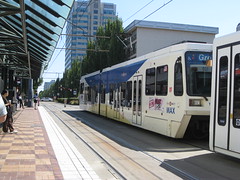
[Portland light rail near the convention center.]

Planning Organizations at Stake


Association of Metropolitan Planning Organizations

AMPO and APTA are jointly recommending to Congress that the reauthorization retain all exixting metropolitan planning organizations (MPOs), regardless of population size.
Removing the decision-making authority from the local level will reduce the voice of the local government, transit agencies, its citizens, and people in the region. Citizens elect their local public officials to reflect the unique nature of their region, and removing the MPO will only increase the distance between the average citizen and the policy-maker.
AMPO and APTA also oppose the 200,000-population threshold for all MPOs as eight states would potentially be left without one unless the Secretary grants approval that they possess the technical capacity to complete the planning requirements. Some that have served as local planning conveners since 1962 would be eliminated.

National Association of Counties
NACo is concerned about reauthorization proposals that fail to maintain planning organizations.
MPOs between 50,000-200,000 would face an uncertain future and are no longer guaranteed a role in the planning process; efforts to enhance the planning role for include rural regions under 50,000 were not successful; the Surface Transportation Program underwent some changes that may not be beneficial to local governments; and funding for the Transportation Enhancement program appears to be no longer mandatory.
[Portland's Amtrak station.]

Amalgamated Transit Union
ATU is advocating in favor of federal operating assistance for transit systems.
Now more than ever we must urge Members of Congress to do the right thing for our communities by voting yes on the amendment to adopt the original “100 Bus” language which also includes targeted and temporary operating assistance for the nation’s medium size and large transit systems which are also in the midst of a mobility crisis.

Other groups, such as Transportation for America, PolicyLink, and the League of American Bicyclists, among others, are advocating for improved transit funding and multi-modal street networks.

As we go to press, there are House members switching sides to back transit and the Senate is likely to put off a vote.
[San Luis Obispo Amtrak station.]

Local Stories

Two of the biggest logistical concerns for working parents are transportation and child care. One transit agency is doing both. To attract good employees who can work the nontraditional hours that transit and other industries demand, Prairie Transit in Spearfish, S.D., "opened its own state-licensed child care facility right in its new transit center." The article, Community care: Day care centers draw workers to towns, appeared in the Rapid City Journal.

Indianapolis, Ind. - APTA reports that IndyGo performed well during the Super Bowl festivities. The transit agency had a “Know Before You Go” campaign to alert riders to temporary route changes and offered free rides Feb. 2-5, funded by a federal Congestion Mitigation Air Quality grant.
Local fixed route ridership surpassed expectations throughout the entire detour period with a 39 percent increase over average ridership: a total of 325,212 rides over 10 days. IndyGo operated additional buses to accommodate the crowds on fixed route service, reaching a peak of 28 extra buses assisting routes on Feb. 4.

APTA's news also highlights another story, this from Cincinnati, where the Everybody Rides Metro Foundation, administered by Metro in Cincinnati, provided more than a million free rides in the past four years to low-income workers traveling to and from work, job training, and related activities. "Almost 100 agencies partner with the foundation, including Talbert House, Freestore Foodbank, St. Vincent de Paul, Lighthouse Youth Services, and Cincinnati Works."

Hi-Tech Town


Boston transit riders have hi-tech ways to get real-time information and engage in public participation. The Massachusetts Bay Transportation Authority is texting real-time information to bus riders. Just the stop identification number and the telephone number are all that is needed. And if you have a smartphone, life is even better because Boston boasts more than 40 apps for transit. Helps having lots of smart, techie college students around. The MBTA is also considering service cuts and fare increases. Like the wired town that it is, Boston's residents are commenting publicly - on twitter. That meeting is so last century. Both stories via the TransitWire.

Tuesday, May 3, 2011

Reauthorization and Other Perspectives on the Future of Mobility Choices

National Conference of State Legislatures
NCSL, in partnership with the National Governors Association (NGA), the National Association of Counties (NACo) and the National League of Cities (NLC), issues a statement of principles for moving forward with transportation reauthorization legislation. "'State and local governments are responsible for 97 percent of the nation’s interconnected surface transportation systems and contribute nearly 75 percent of the annual cost to operate and maintain those systems,' said NGA Executive Director Dan Crippen."

Among others, the principles include:
1. "[T]he continuation of the “user pays” principle to guide transportation funding" with opposition to federally mandated prescriptions of sub-federal authority over demand-side strategies.
2. Stable funding for "reliable, long-term funding certainty" so that state and local governments can execute long-term, multi-year projects.
3. "[M]aximum federal surface transportation program and funding flexibility given our diversity of geography, population, and priorities" and opposition to earmarks.
4. Streamlining of processes to reduce project approval and completion time.
5. "[S]trong federal role in funding transportation solutions for metropolitan and non-metropolitan areas across the country" to address connectivity and congestion issues.
6. Clear, "outcome-oriented performance measures."

National Governors Association

NGA provides a new page on its website entitled "Redesigning State Government," with information about how different states are coping with lean fiscal conditions.

Paralyzed Veterans of America
PVA celebrates accessible design and mobility with its 2011 Accessible City Award going to sixth, seventh and eighth graders from St. Thomas More School in Baton Rouge, LA.
The team took a comprehensive approach to accessibility: the blind had chips embedded on the side of their heads that allowed them to perceive figures so they would not bump into things. An integrative transportation system provided easy transitioning for people in wheelchairs and also sensed when passengers were waiting to board, stopping for them without being summoned.
What impressed the judges was the universality of the team's approach. Their concept of accessibility included people in wheelchairs and strollers, as well as those with physical and sensory challenges. What impresses me is the promise of technological advances and design innovations for making transportation more accessible to wider range of individuals.

The Current State of Rural Transit

For a realistic snapshot of rural transportation generally - including transit, intercity service and human services transportation - read Rethinking Federal Investments in Rural Transportation: Rural Considerations Regarding Reauthorization of the Surface Transportation Act, produced by the Rural Policy Research Institute (RUPRI). In a nutshell, the report states:
There are about 1,200 systems operating in half of rural counties nationwide, but they tend to be local in nature, and generally not connected to regional and national passenger systems. Thirty-eight percent of rural residents live in areas with no public transit. There are also 3,700 systems specifically for the elderly and people with disabilities, and others operated by human services agencies.
Add to the many logistical challenges the reality that many rural areas do not have access to professional staff or sufficient staff to handle their transportation and mobility challenges. Though only one piece of the economic development puzzle, transportation is described as a threshold item for local and regional economic success. The report supports local planning to increase transportation options and suggests that "[t]ransportation funding and planning should be measured against outcomes rather than uniform standards." Helpful charts are provided that categorize the challenges for different types of rural areas.

Friday, April 8, 2011

Events

National Association of Development Organizations
NADO posts that Apr. 12, Governing is hosting a free webinar, Smart, Sustainable, Livable Communities: Plans, Projects and Key Market Drivers. The webinar will explore the “green government” market and opportunities in building sustainable communities.

National Association of Counties

2011 Rail Conference - DuPage County, Ill., on Apr. 27–29, 2011. The conference will focus on the impact of freight and passenger rail on citizens, businesses, and county, city and state governments.

Members of NACo’s Rural Action Caucus (RAC) are currently in Washington, DC, for the Annual RAC Legislative Fly-in. They will meet with more than 60 members of Congress to advance priority issues for rural counties. RAC members will meet with officials from U.S. Environmental Protection Agency, Federal Emergency Management Agency, U.S. Department of Transportation, U.S. Forest Service
and the U.S. Department of Health and Human Services. RAC’s leadership will meet with Secretary of Agriculture Tom Vilsack.

Nearly two-thirds of the nation's 3,068 counties are designated as rural, with a combined population of 60 million. One of RAC's 2011 priorities is transportation reauthorization.

Webinar - Using County Health Indicators to Inform Local Policy Decisions - May 5, 2011 at 2 p.m. EDT. Speakers will discuss how counties can utilize community health and quality of life indicator information to help inform policy decisions and more effectively target local public health resources.

NACo Annual Conference - Multnomah County (Portland), Ore., on July 15–19, 2011. Aron Ralston, mountain climber and inspiration for the Film 127 Hours, will be a featured speaker.

Association of Programs for Rural Independent Living

APRIL Annual Conference - Anchorage, on October 15-17, 2011.

Monday, March 21, 2011

On the Legislative Horizon for Transportation


American Association of State Highway and Transportation Officials

AASHTO's newsletter covers the House Transportation and Infrastructure Committee's budget views and estimates for the next fiscal year. AASHTO's synopsis of the 30-page report was that the committee's message is to make do with less, adding that "[t]he document speaks in broad policy terms and does not provide recommended funding levels."

AASHTO correctly observes that while the committee is interested in the highway trust fund and the gap between revenue and funding needs, and addresses this issue specifically, the committee does not provide a detailed proposal of its own.

The T&I Committee offers its views about a few particular issues. The committee supports the Administration's proposal to streamline certain surface transportation programs. It recommends reducing the Essential Air Service program to rural areas due to near-empty flights. The committee particularly takes issue with Amtrak, its management and cost effectiveness, while announcing its acknowledgment of the importance of the Northeast Corridor to the nation's economic vitality.
[Flickr photo by Wally Gobetz. Sheepshead Bay, an express station on the BMT Brighton Line serving the B (formerly D) and Q lines, was opened in 1908.]

Regional Perspective on Transportation Policy and Spending

Association of Metropolitan Planning Organizations
AMPO posts letters to the House Transportation and Infrastructure Committee from four planning organizations. The letters are from:
* Cowlitz-Wahkiakum Council of Governments in Oregon,
* Metropolitan Transportation Commission for the San Francisco Bay area,
* Chicago Metropolitan Agency for Planning, and
* A Columbus, Ohio area partnership comprised of the Mid-Ohio Regional Planning Commission, the Columbus Partnership, the Columbus Chamber, the Columbus Regional Airport Authority, and the Central Ohio Transit Authority.
The letters trumpet the importance of transportation, its infrastructure and transit to the nation's economy and to the vitality of regions.

Priorities of Counties


National Association of Counties
NACO's legislative conference concluded with new policy positions. These include opposition to proposed reductions in the Department of Agriculture's economic development program, community development block grants, and discretionary - non-military spending. NACO has a whole list of recommendations on environmental issues, with suggestions that county governments not suffer unfunded mandates. NACO supports the Administration's wireless innovations fund proposal. As for transportation, the only recommendation relates to roads that access or pass through certain federal lands.

NACO's 2011 legislative priorities include transportation reauthorization.
Congress should develop a comprehensive legislative effort to create jobs by providing robust funding for bridges, highways, mass transit, assistance for rural roads and other local infrastructure needs by reauthorizing the highway, transit, and safety programs. Congress should explore the various financing sources available to fully fund the Highway Trust Fund into the future while addressing metropolitan congestion and rural road safety. Enactment of these programs will help build our nation’s infrastructure and create additional employment opportunities.

Wednesday, March 9, 2011

American Public Transportation Association (APTA)
APTA reports rising savings for using public transit (and walking or biking) instead of owning a car. Currently, the national average stands at "$9,904 annually and $825 per month based on the March 4, 2011 average national gas price ($3.47 per gallon-reported by AAA) and the national unreserved monthly parking rate." The savings are more impressive in the nation's largest - and most transit-rich cities - with savings of over $14,000 in New York and over $10,000 in Denver. Prices in metropolitan areas and other regions are not assessed; suburban and rural equivalents of the savings rates are not available.

In this same vein, the APTA savings report is featured in a CBS News story about the financial rationale for using transit, on the one hand, and, on the other, the revenue squeeze on transit that has prompted systems to reduce service and/or increase fares.

Public Participation: Not Necessarily Boring


If you are looking to promote public participation in transit promotion, planning and advocacy, view this creative video from Detroit, which uses legos and music to discuss the street configuration for the planned Woodward Ave. line.

Thanks to Chris Zeilinger, Director of the National Resource Center for Human Service Transportation Coordination (NRC) for finding the video material.

The Utah Transit Authority is promoting and using twitter to hear from its customer base about their preferences for service hours and routes. Although the transit system is also employing traditional public hearings and now old-fashioned email as well, management has respect for the thoughtful, quality 140-character (and fewer) tweets they have received.

Livability Goes Local


National Association of Counties
(NACo)
From NACo's newsletter:
NACo will seek input from members about implementing federal livability goals through a new project led by the National Association of Regional Councils (NARC), with support from U.S. Department of Transportation. The two-year project is intended to assist localities in building the governance, strategies and tools needed to create and implement regional transportation plans that support sustainable development. NARC and NACo will partner to offer listening sessions at upcoming NACo conferences.
Contact: James Davenport • 202.661.8807