Showing posts with label Bike/Ped. Show all posts

Tuesday, November 29, 2011

Events and Local Coordination Stories

Centers for Disease Control and Prevention
Webinar - Tackling the Question: Will Complete Streets Cost Too Much? - Dec. 1, 2011. Communities Putting Prevention to Work Webinar series presentation about implementing Complete Streets policies and strategies for responding to the cost concern, including examples and resources. The webinar will provide information both about the low cost of many complete streets treatments, as well as ways to talk to transportation professionals about the added value and community support that result from complete streets implementation.

National Association of Regional Councils
Annual conference - Feb. 12-14, 2012, Washington, DC. The conference will focus on the Administration's priorities, Congressional activities, critical policy issues and pending federal legislation that will impact regions. Environmental and transportation policy, livability and the effect of the current U.S. fiscal situation will be addressed.
[View of mid-renovation Union Station area in Denver at dusk.]

Coordination Stories


The Rio Grande Valley in Texas is realistically appraising its coordination and connectivity challenges via its coordinated transportation plan. "The public transit coordination plan was completed this month to comply with Federal Transit Administration rules requiring similar plans to be in place for access to its funding streams, but the study also provided an overview of how well the Valley’s providers have implemented existing coordination efforts." An article in the Brownsville Herald, Study: Valley's Transit Providers Must Connect Services, also explains the plan for further coordination to enable commuting from one city to another in the area. Other transportation services on the horizon are medical and shopping trips and routes with consistent schedules "throughout the day in the Valley’s urbanized areas."

Binghamton, a city in Upstate New York is using its half million dollar Community Challenge Grant, the only one awarded in the state, to engage the community to envision what type of community it should be in the future and follow up on that vision by writing it into its zoning code. A brief television news piece explains.

Friday, November 4, 2011

Smart Growth Community Assistance and Walkability News

Environmental Protection Agency
EPA has school siting guidelines that include access to transit and biking, as well as walkability.
Connecting a school to a network of sidewalks, bike paths and other infrastructure encourages physical activity by making walking or biking safe and enjoyable. It is also important to provide walking and biking routes that do not bring children close to large roads, highways and other major pollution sources (for both health and safety concerns). Site size, location and design all play a role in determining whether walking or biking will be an option for students. Locations that provide access for students and staff via public transit will also reduce vehicle use as well as potentially promote increased physical activity in getting to the transit stops from both home and school.

More EPA Technical Assistance Opportunities


Through an EPA grant to the Project for Public Spaces under the Building Blocks for Sustainable Communities Program, Livability Solutions will be offering free technical assistance workshops to six to 12 communities around the country. This technical assistance will take the form of one- to two-day workshops utilizing livability tools such as a Community Image Survey (CIS) public engagement tool, a Walk Audit workshop, a Safe Routes to School workshop or a Design Mini-Charrette, among other community-focused analyses and exercises. Selected communities will also be linked to a network of other communities with similar goals and challenges. Each community team will be led by Livability Solutions coalition members.

The application deadline is Nov. 22, 2011. Visit the Livability Solutions technical assistance page for details and the application.

A webinar next week will cover four technical assistance programs under the Building Blocks for Sustainable Communities Program program.

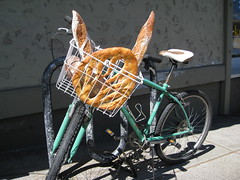
[Bicycle promoting the goods from a bakery in Hood River, Oregon.]

Streets for All Walkers and Wheelchair Users

Access Board
Three weeks left for public comment on Accessibility Guidelines for Public Rights-of-Way. The US Access Board posted the proposed guidelines on its website these are available for public comment through November 23, 2011.

The guidelines will cover sidewalks, street crossings, medians and traffic islands, overpasses, underpasses and bridges, on-street parking, transit stops, toilet facilities, signs, and street furniture. They will apply to permanent as well as temporary facilities, such as temporary routes around work zones and portable toilets.

Issues related to particular disabilities and pedestrian safety are noted.
Wheelchair users usually have a lower eye height above the street than most adult pedestrians, and may be hidden from motorist view behind parked vehicles, plantings, or other visual obstacles. People may have vision, hearing, cognitive, or other considerations that must be considered within the public right-of-way.
Please be aware that certain public comments will be allowed regarding the Access Board's Advance NPRM (notice of public rulemaking) for Shared Use Paths, announced on on March 28, 2011. Although comments were due June 27, 2011, these guidelines are in initial development stages. The proposed guidelines will consider differences between public right-of-way guidelines and recreational trail guidelines. More information is available in the FHWA's Pedestrian Forum newsletter.

Please note that a public hearing will be held in Washington, DC on Nov. 9 at the Access Board Meeting Room, 1331 F Street, NW, Suite 800.

[Buses on Central Park South on a June morning.]

Template for Multi-Modal Street Networks

National Complete Streets Coalition

The coalition is recommending the Model Design Manual for Living Streets. Offered as a street-design template, the manual:
focuses on all users and all modes, seeking to achieve balanced street design that accommodates cars while ensuring that pedestrians, cyclists and transit users can travel safely and comfortably. This manual also incorporates features to make streets lively, beautiful, economically vibrant as well as environmentally sustainable.
For more information about walkability best practices and places, visit the Pedestrian and Bicycle Information Center's walkinginfo.org website, which also houses information about the Walk-Friendly Communities Program. More walkability news and resources are available from America Walks and the Federal Highway Administration's pedestrian resources website.

Tuesday, August 30, 2011

Caregiving Costs & FTA Policy on Access to Transit


AARP

AARP reports that transportation is a major part of caregiving for elderly relatives. Valuing the Invaluable: 2011 Update - The Economic Value of Family Caregiving in 2009, states:
Nearly four in ten (39 percent) Medicare beneficiaries report being accompanied to routine medical visits, typically by spouses or adult children. A recent analysis found that family and friends provide 1.4 billion trips per year for older relatives (age 70+) who do not drive. Adult children provide 33 percent of these trips.
Taking time off to drive a parent or a spouse is not the only responsibility, though it might be one of the most time consuming. AARP also mentions the at-home medical care for people with long-term conditions as well as nursing-type care is performed after major surgeries and other critical procedures. Those people requiring the most care over long periods were individuals with chronic health conditions.

According to "more than one in three (36 percent) caregivers" due to budget cuts "government agencies and nonprofit organizations are now less able to provide services to their relative or friend" than prior to the recession. These include services such as transportation and delivered meals. This is borne out with area agencies on aging statistics in the report. Long-term effects for caregivers include a drain on financial resources and retirement savings, and negatively impacted employment prospects or advancement. Only California and New Jersey have legislation mandating paid family leave programs.

[Fish design bike rack in Long Beach, Calif.]

American Association of State Highway and Transportation Officials
AASHTO publicized the Federal Transit Administration's (FTA) issuance of a policy statement on the eligibility of pedestrian and bicycle improvements for funding under federal transit law - up to a radius of one-half mile for pedestrian improvements and all bicycle improvements located within three miles of a public transportation stop or station." The FTA declares a "de facto physical and functional relationship to public transportation." Funding for bicycle or pedestrian improvements at greater distances to public transportation may also be eligible for FTA funding where it is demonstrated that "the improvement is within the distance that people will travel by foot or by bicycle to use a particular stop or station." And that's just the FTA's introduction to the statement.

Details about funding are available in the NRC Technical Assistance News. The FTA policy statement appears in the Federal Register.

Wednesday, December 22, 2010

High Demand for Intercity Bus Service and Insights into Quality Concerns of the Transportation Challenged

A few years ago, intercity bus companies took notice of successful routes that had sprung up to serve Chinatown in New York. Those companies and a few new ones changed the traditional model of station-to-station service and started curbside departures and arrivals, Internet-supplied tickets, free wifi, comfortable seating and very cheap prices compared to the airlines and Amtrak - prices competitive with driving.

Now a report highlighted by the American Bus Association, from DePaul University, The Intercity Bus: America’s Fastest Growing Transportation Mode - 2010 Update on Scheduled Bus Service, examines the numbers, the phenomenal increase in demand, though generally limited to major cities with good public transportation, that outstrips growth for air and long-distance train travel. Megabus alone boasts a one-year growth in ridership of almost 50 percent, with "33% ... a conservative middle-ground estimate of the growth in curbside traffic between the 4th quarter of 2009 and 2010."

Good Service Brings Alternative to Car Use and Ownership

Though Amtrak pointed to much more modest ridership increases this past year, Amtrak does not have the luxury of adding service and destinations very easily. The bus phenomenon of the last few years demonstrates the potential demand for long-distance service even in places where that demand has not been addressed. Indeed, the bus phenomenon also shows that for "discretionary riders" a nice atmosphere goes a long way, even without the guarantee of on-time arrival that a train generally delivers.

The report makes the rather large claim that:
curbside buses encourage “transit lifestyles” that place comparatively little emphasis on single-occupant automobile travel (and more emphasis on common-carrier providers) and thus apparently lower carbon footprints per mile traveled.
I think that intercity buses are a piece of the mobility puzzle for many people, a piece that means a car is not a necessity for everyone. The buses also provide a cost-effective way for families to reduce car use, which the train and air travel do not provide, a fact in evidence on the highways during the Thanksgiving weekend and the winter holidays every year.

Sea of Buses

In contrast to even a few years ago, now when you are entering the Lincoln Tunnel to head into the city for Thanksgiving, you see a sea of buses, a good percentage of which are these intercity carriers. And to what do we owe this recent change in the mobility landscape? A flexible private sector that has the ability to make changes without the delay of regulatory changes, infrastructure building and repair, and the other factors that slow down public endeavors. Not saying the private sector can do it all, just that this is a good example of its role in publicly-available transportation as well as the insights into markets that the private sector provides and that other public and private modes can learn from.

Deviating from Private Car Ownership

And intercity buses are not the only part of the private market that is seeing increases, creative car sharing businesses are being developed and spreading. Still an urban phenomenon, companies like Flex Car are branching out into more cities. RelayRides adds a new type of business model to the mix. The company, backed by Google, enables people to rent out their cars to friends or strangers for a nominal fee with a standard agreement that includes an insurance arrangement. Read about one person's experience in the Cambridge area. It started in Cambridge and is commencing service in San Francisco.


Different Picture in the Heartland

In the heartland of South Dakota, the availability of mobility options is a very different situation than in the urban centers on the East and West coasts. This is not a transit-rich area; in fact, for people with disabilities, the need is all too real. Assessing Existing and Needed Community Transportation for People with Disabilities in North Dakota outlines the challenges - "Adequate shelter from the weather while waiting, inconvenient schedules, and having a place to sit while waiting were most often cited as a major problem for people with disabilities." Added to the list a little more into the report is difficulty of boarding.

These seem like universal design issues. Though adequate shelter, for example, might allow a person with a disability to ride transit, it also makes transit more welcoming to the parent with a toddler and the guy who is considering taking the bus during the winter. Aspects of street accessibility to transit were listed as problems for more than half of the survey respondents, as was safety and travel information.

[T]hose who do not use transit were significantly more likely to say service is not available, transit users were less likely to think they are not capable of riding, and those who used transit in the past but do not anymore were more likely to say they do not have enough information.

The results indicate it is not lack of need that keep people with disabilities from using public transportation. Rather, lack of service, lack of information, thinking they are not capable of riding (whether true or not), and fear of riding can likely explain many of the differences between those who use public transportation and those who do not.

Insights into Quality of Paratransit Service

The report also addresses the challenges of using paratransit and the unique situation of people with cognitive impairments.

Two-thirds of respondents said that service not being available when they need it was a problem; 35% said it was a major problem. Other significant problems were unkept schedules for pickups and drop-offs or long waits, the need for scheduling trips too far in advance, and trip times that are too variable or unpredictable. Respondents were least concerned about the vehicles, in terms of their mechanical condition, accessibility, and seating availability.

This is an insightful and detailed study that would be helpful to anyone in transit or those serving people with disabilities. Really, it shows the opportunities in terms of demand and advances in quality of life that mobility options, sometimes the synergy of pedestrian-friendly streets and transit, sometimes other options, can provide.

Spreading the Seedlings of Creativity


I think that the innovations of the private market in cities, the willingness of Americans all over the country to vote for more public transportation funding, and the increasing unattractiveness of a fuel-intensive lifestyle will spur changes in places like South Dakota. Maybe different models of volunteer driver programs and vanpooling are just around the corner for rural areas and other places where people do not wish to or are unable to drive.

Here's to allowing Americans all over the country to have more and better mobility options. Next year, I want to hear about how you picture mobility; I want to learn from you about places where good transportation choices (be they taxis or shared rides), good street networks and good transit are working. Let's learn from the success stories, build upon them, and adapt them to the amazing quilt of places of we live in.

Monday, August 30, 2010

Zero and Low Emission Modes Get AASHTO's Attention

The American Association of State Highway and Transportation Officials (AASHTO) had two interesting articles in its weekly newsletter, both involving transit.

First is Boulder's new initiative: www.driventodriveless.com, which promotes commuting to work less, even just one day a week less, and instead biking, walking, using transit, carpooling or telecommuting. Similar to Idaho's I-Way program, the site encourages use of alternatives to the single occupancy vehicle and producing less pollution. There is also a link there that connects to a national trail site with walking routes in every state.

30/10 Plan Reaches Across Party Lines


Second is Los Angeles' 30/10 plan, which seeks to implement a 30-year transit plan within 10 years by using the long-term revenue from a half-cent sales tax, estimated to produce $13 billion for transit, as collateral for long-term bonds and a federal loan. Sen. Barbara Boxer (D. Calif.) was promoting the mayor's idea at LA's city hall. The LA Times reports:

"We are going to get it done and it's going to be a template for the nation," Boxer said during the hourlong forum. "Everything we do is job-focused, but everything we do has to be deficit-neutral, except emergencies …. We have to leverage every single penny that we can."

The newspaper story also stated that Boxer's Republican rival in the upcoming election also backs the ambitious transit plan.

Thursday, June 17, 2010

Bikers and Sluggers

The number of transit, biking, walking, sustainability, and livability blogs is so huge that I fear I might never read them all once, let alone keep up with what is happening everywhere. Okay, many appear and go inactive pretty quickly. An informal search reveals that many low emission-mode blogs are written by bicyclists. Whether announcing biking events, advocating for bike-friendly policies and street designs, or covering news in the increasingly professional biking world, the biking community is far ahead of transit users, pedestrians, and shared-vehicle commuters in getting out their message: We want better, safer and more equitable access to the street network.

My favorite entree into the bike blogosphere is definitely DC.StreetsBlog.org, which is not dedicated solely to biking. However, on the right is a cornucopia of blogs, listed by region, with a separate list for national coverage, many of which are devoted to biking.

And biking associations? There are many. The League of American Bicyclists has information about local organizations, clubs, stores and instructors in every town. The biking community has become an active and effective advocate for its cause. Just watch the youtube video from Boulder that shows what 20 years of dedicated advocacy and volunteering can accomplish. The video is available at http://www.youtube.com/watch?v=X8AYDttJvT8.

Slugging

Today I am interested in the informal world of commuter volunteer transportation - the cousin of old-fashioned hitchhiking - slugging. Slug-Lines.com covers the slugging world, has a discussion forum, maps, etiquette rules and other resources. There is even talk in D.C. of making the arrangement official and allowing cars to stop in designated lanes to pick up passengers. This is an important issue for commuters from transit-deprived areas and slugging keeps many cars off the road at no extra cost to the taxpayer or driver (besides the already "free" costs of pollution, accidents, obesity, etc.). Visit http://www.wtop.com/?nid=25&sid=1982649 for today's WTOP coverage of whether D.C. police have started enforcing no stopping rules in unofficial slugging zones.

Wednesday, June 16, 2010

External Costs of Auto-Dependent Lifestyle and Advances of Zero-Emission Modes

The American Public Health Association (APHA) follows up its 2009 report about the important link between transportation and public health. In At the Intersection of Public Health and Transportation: Promoting Healthy Transportation Policy, APHA turned its attention to mobility options, including public transit, walking, and biking. APHA questioned the current design of communities, the allocation of transportation dollars, and the paucity of public health funding to encourage mobility options that promote health.

Now APHA attempts to start quantifying the health-related external costs of auto-dependency in The Hidden Health Costs of Transportation. The report recommends a re-thinking of the current federal funding allocations that primarily support an inherently unhealthy mode of transportation.
A considerable increase in transportation investments is needed to offer more balanced and affordable modes of transport including biking, walking and public transit. Currently 80%of federal transportation funding goes toward building highways and improving road infrastructures, and approximately 20% goes toward public transit andmotor vehicle safety programs.

This report dovetails nicely with the Department of Transportation (DOT)report, The National Bicycling and Walking Study: 15–Year Status Report, which finds a considerable increase in biking and walking, with a reduction in fatalities. However, walking represents only about 10 percent of all trips, while biking, with all its increases and public relations, comes in at a measly (approximately) one percent.

The report does a good job of describing the available resources and explaining the limitations of its data collection and statistical findings.

Thursday, June 10, 2010

Who Needs Sounds of the Road

American Council of the Blind

ACB has been pushing hard to resolve the dilemma of hybrid vehicles and the safety of people who are visually impaired. Hybrids are quieter than their conventional counterparts and in some circumstances fail to supply noises that are sufficiently loud to enable visually-impaired people to navigate streets. ACB supports passage of, the Pedestrian Safety Enhancement Act (H.R. 734, S. 841). This Act would require a Department of Transportation study and establishment of a motor vehicle safety standard for alerting blind and other pedestrians of motor vehicle operation. Both bills have been in committee since early 2009.

Now a National Highway Traffic Safety Report, Quieter Cars and the Safety of Blind Pedestrians: Phase I, posted on ACB’s website, studies the circumstances in which there is a difference between noise levels, whether those differentials impact safety, and the merits of possible countermeasures. Basically, noise levels differ at speeds up to 20 miles per hour. Two approaches for counter measures are discussed, (1) configuring hybrids so that they emit more noise and (2) producing devices that can be carried that warn people who are visually impaired that a quiet vehicle is nearby.

At present, only countermeasures that cause quiet vehicles to emit additional sound come close to meeting the requirements of blind pedestrians. Within this class of countermeasures, there is a fundamental distinction between systems that emit synthetic engine noise at all times when the vehicle is operating at low speeds, and those that emit noise only when triggered by a transmitter carried by blind pedestrians. The former eliminate the need for blind pedestrians to carry special transmitters, and also warn other pedestrians, cyclists and animals of the approach of quiet vehicles, while the latter minimize community noise impact.

The report wisely observes what is true in many circumstances, that universal design measures that assist people with disabilities also help others. The boys and girls who play soccer and street hockey in the middle of the road or who ride bikes without paying too much attention to their surroundings need vehicle noise almost as much as someone who is blind and they are probably less likely to carry a personal noise emitter. The sound must also be recognizable as vehicular noise, the report noted, discussing the disadvantages of personal device sounds.

Monday, June 7, 2010

Livability - Draft DOT Strategic Plan part 2

Department of Transportation Draft Strategic Plan
LIVABILITY:

Recalling Secretary of Transportation Ray LaHood’s blog entry from several months ago describing a weekend getaway to friends in Hoboken N.J., the Secretary spoke of a night out in the city, being happy to walk, take the train, and leave the car at home for the whole weekend. His department likewise wants to assist communities in affording multi-modal and healthy, environmentally friendly transportation choices to Americans wherever possible.

In an earlier section of the draft plan, DOT sets forth an economic competitiveness goal: "Promote transportation policies and investments that bring lasting and equitable economic benefits to the Nation and its citizens." What does this mean for transit and other publicly available transportation? The plan calls for investment in full range of modes, including transit, an intermodal approach, new ways to finance the transportation system, and reducing congestion through transit, ridesharing, and flextime. However, there are no performance measures in the economic competitiveness section that set transit ridership or alternative transportation goals, except indirectly through reduction of congestion.

Livable communities gets its own section of the draft plan. DOT calls for "place-based policies and investments that increase transportation choices and access to transportation services." DOT expressly wants improved public transit, human services transportation (mentioning the special needs populations and people with disabilities), and better bike/pedestrian networks. The plan envisions transportation coordination with land use and economic development.

The plan directly links the auto-dependent lifestyle to national insecurity and ill health.

The United States’ heavy reliance on car-dependent, dispersed development is not without costs. This kind of development is energy-intensive and contributes to a dependence on fossil fuels and a tendency toward high carbon-emissions; it has been correlated with increasing rates of obesity in the U.S. and higher transportation costs for American families.

A study is cited showing that people who live in compact, walkable communities are more fit and healthy than those who reside in counties with more sprawl. The connection between health and the transportation network is explicitly made and discussed in detail. The plan practically comes out and says that the 40 percent of trips that are two miles or less in length should be able to be made by walking or bicycle, but that our current street network does not allow this - despite studies showing that young adults and baby boomers want to live in walkable neighborhoods and towns.

In case you think DOT is talking about New York, San Francisco, Chicago and Seattle, or a few others, the plan specifically includes rural areas and their desperate need for alternatives to the car.

Creating livable communities is just as important to residents of rural areas as it is to residents of urban and suburban areas. Rural town centers have experienced disinvestment in much the same way as urban core areas and many rural towns are fighting to attract local commercial development through the revitalization of town centers. Rural residents generally must travel greater distances to jobs and services than their urban counterparts and can suffer from greater isolation, especially if they cannot drive.

The DOT-HUD-EPA partnership is already identifying barriers to coordinating transportation, housing, and environmental policies and investments. The three agencies are coordinating and bringing resources together for each others' programs, such as EPA's Smart Growth Technical Assistance Program, HUD’s Sustainable Communities Planning Grants, designed to fund regional, coordinated planning, and "evaluation of DOT’s TIGER Discretionary Grant applications, for which livability and sustainability are two key criteria."

In terms of the economy, DOT maintains that livable community development will do two things: Save on infrastructure investment costs, and help communities be economically resilient through decreased dependence on foreign oil price fluctuations. DOT sees livability as a way to reduce household transportation costs through the availability of alternative mobility choices, such as transit, biking and walking.

And what is DOT envisioning to help states, regions and communities become more livable? Providing technical assistance, advocating for "robust State and local planning efforts," spending transportation dollars where they will capitalize on public and private infrastructure investment, and developing livability performance measures.

Specific strategies that DOT plans to use are increasing access to transit and inter-city services, developing pedestrian and bike-friendly street networks, "where practical" providing better rural transit for access to jobs, services and transportation centers that are currently only automobile accessible, and encouraging mixed-income development, for which DOT has already funded a technical assistance MITOD guide through Reconnecting America.

DOT's plan seems almost ashamed that although walking and biking account for account for "almost 12 percent of trips and about 13 percent of roadway fatalities, these modes receive less than 2 percent of annual Federal Aid Highway funds." The agency is calling for assessments, planning and encouraging the public to use these modes.

Remember that DOT comment invites the public to comment on its proposals. Read the draft plan sections that interest you and respond to DOT.

Best Tidbits from the Draft DOT Strategic Plan

I read the 74-page Department of Transportation Draft Strategic Plan so you would not have to read every section and every word. This is DOT’s first ever draft plan and the agency invites the public to comment on its proposals. So read the blog, read the meaty parts of the draft plan and share your responses with DOT.

In a series of five (yes, five) subsequent blog entries are some facts and objectives buried in the proposed plan. I’ve divided up the blog entries in pretty much the same way DOT has categorized its proposed strategies, with a couple of departures. The blog entries will separately address safety, livability, the Coordinating Council on Access and Mobility, environment and sustainability, and emergency preparedness. The plan also covers employee performance and practices.

Feel free to use these blog entries as a guide to the draft plan and an easy way to find what interests you. Share your responses with the DOT by submitting public comments.

There are some quotes in these blog posts, but mostly I paraphrase pretty closely about interesting tidbits. While my observations follow, I recognize that coming up with such an ambitious document takes great diplomacy a balancing of interests, and fulfilling legislative requirements.

A Bird’s Eye View of the Draft Plan:

The terms that come to mind after reading the entire draft plan are livability, multi-modal, transportation choices and environmental friendliness – or the actual term used, sustainability. Pedestrians, bicyclists as well as the National Complete Streets coalition should be pleased as these three interests are woven into the fabric of DOT’s vision for livable communities with good transportation options beyond the automobile.

Public transportation is featured prominently. It is seen as a safe travel choice and as one that promotes our national goals of reducing reliance on foreign fuel, reducing congestion and improving our environment. Human services transportation is recognized as a big contributor to livability for people who are transportation challenged and wish to remain in their homes.

Not at all mentioned are the privately-run and publicly available modes of taxis (the original guaranteed ride home) and intercity bus service, which complement public transportation and the zero-emission modes of biking and walking. High-speed rail, perhaps because of the crucial role of federal funding, is mentioned, though not given too much space.

Auto travel is prominently discussed in the draft plan, with safety and environmental concerns providing the most interesting reading about that mode. Automobile issues are not covered in this blog except where directly relevant to public and human services transportation.