Transportation Camp - Why Go?
Why get out of bed early on a Saturday morning in the middle of the winter - decidedly not summer camp weather - to leave your partner (if you have one), children (if you have them), pets (if you have them) and absolve yourself of all adult responsibility and the comforts of routine and loved ones to spend an entire day in windowless rooms - also not camp like - to discuss all aspects of transportation with 300 people, many of whom describe themselves as transportation geeks? Why attend an unconference, an event where there are no keynote speakers, predetermined sessions, experts, bios or daises?
Why? Because you will have fun - yes, it's camp - with people excited about walkable streets, better transit, open data, paratransit, bikesharing, bus rapid transit plans, and social media use by, for and perhaps with some hostility to transit. Indeed, upon arrival (without trunk, duffel bags, parents, or junk food), one does not even know what is on the program. But like any returning camper, one knows and sees friends, some from previous stays at camp and some from other venues - in this case twitter, normal conferences, and actual work. (Apologies to any twitter friends not recognized from those tiny twitter photos.)
Indeed, as Transportation Camp is an unconference, the campers suggest what will be discussed and offer their own expertise as speakers or as bunch of nerds interested in talking about something. Some come bearing presentations, cameras, tablets, and laptops; others admit they are concerned citizens without a resume and curious. Some come alone and others with lots of colleagues.
[Attendees reading session ideas posted on colorful, large post-its.]
And what actually happens at the camp social?
Not that anyone was flirting in the social hall or hanging out by the big tree at the lake (wait, that's actual camp), but one sees lots of connections being made, as if data, social media, transit, biking, walking soul mates are finding each other. I saw colleagues and friends from Ithaca, Iowa, Portland, and Boston, and met people from practically my own backyard interested in some of the same hometown (though inside the Beltway) issues. I think half of the
San Francisco DOT attended camp in Arlington. There were also a bunch of
mobility management professionals, some there to promote ideas, some
seeking ideas, and all wanting to share.
In terms of quality, sessions vary from amazing to "I should have chosen something else," with my own experience much more toward the former. As there are only four sessions over the course of the day and about 10 offerings during each time slot, there is often heard the cheerful complaint of an embarrassment of rich choices. If cloning were possible, ...
[Possible offerings displayed. Yes, this photo is intentionally gigantic so that some of the post-its can be read.]
One could easily have spent the entire day immersed in a virtual "track" of data sharing, open source, apps and other things that normal people (translation: someone like me) know little or nothing about. Instead, I chose a variety of different topics - (1) Transit social media engagement (with both the rider and the transit agency perspectives discussed), (2) universal design advocacy and planning for streets and transportation to suit all users (particularly people with disabilities), (3) sharing big ideas, and (4) bus rapid transit (BRT) plans and politics in the DC area.
Rural Roads Meet the Jetsons, Sort of?
What were some big ideas? Cost-effective personal rapid transit for rural areas; walkable streets - with access to transit - in suburban and rural areas; pre-purchased annual transportation with a menu of transportation choices (to replace one or more privately-owned vehicles). There were a ton more; that's just the tiniest of samples.
At the BRT session, a gentleman from Ireland supplied this DC-area crowd with a list of cities around the world with bus systems worthy of comparison.* Another gentleman, originally from suburban Maryland, talked about his BRT planning experiences in Brazil. Montgomery County's Rapid Transit Vehicle (RTV) plan was discussed in detail, including the role of the planning and transportation departments, which, by the way, report to different entities (the former reporting to the county council and the latter to the county executive). Other DC-area BRT activity described included Arlington, Howard and Prince William counties, with some of those more akin to express commuter services.
One Person's Mobility Experiences
The universal design session was led by a person who travels in a wheelchair and the session was very much informed by the her experiences, in terms of using the pedestrian network and transit, as well as advocacy and maintaining relationships with political leaders and other types of advocacy groups. She mentioned biking groups as one example of stakeholders that can be useful for people with disabilities in pushing for universal design and multi-modal streets. A controversy arose during the session about expertise of planners versus advocacy of residents and which deserves more weight, though most of the session was conducted in the spirit of building relationships with various stakeholders rather than a zero-sum game of right and wrong.
The social media session I attended (and there were quite a few offered) concentrated on twitter - from the perspective of the complaining rider and the transit agency. Effective engagement strategies were discussed rather than mere whining about service. At the center of the session was discussion about building relationships with staff at the transit agency and how to do that. Sometimes those tweeting interactions become actual relationships.
Tell your parents to sign you up for camp next year, or sign up yourself. Next camp is coming up soon in Atlanta - in February - another decidedly un-camp-like time of year. If we have camp in July, my porch is open for a front row seat at the Takoma Park July Fourth Parade. I'll even make bug juice.
*Cities with bus networks mentioned were Almere (Netherlands), Melbourne, Helsinki, Gothenburg (Sweden), and Nantes (France).
Showing posts with label Public Transit. Show all posts
Thursday, January 17, 2013
Tuesday, February 7, 2012
Transit Users - What Influences Use; Events and Local Stories
Events
Easter Seals Project ACTION
Forming Partnerships with Transit - Online course - Feb. 13-Mar. 26. Designed for transit advocates interested in increasing their role in the design and implementation of community transportation services, the course includes four learning modules: Transportation planning, funding, becoming a transit supporter, and strategies.
Partnership for Mobility Management
2012 Mobility Management Conference - May 9-10, 2012, Long Beach, CA. To be held in conjunction with the Bus and Paratransit Conference (details below), this conference features sessions on performance measurement, forming partnerships with different organizations, non-emergency medical transportation and brokerages, customer focus, information technology, and integration of facilities. The Partnership is a collaborative effort of seven national organizations and approximately 300 individual mobility managers and mobility management professionals from around the country.
Community Transportation Association of America
EXPO conference - May 20-25, 2012, Baltimore, Md. This year's EXPO will feature tracks on mobility management, connectivity and livability, transportation operations, and management, as well as separate tracks on transportation for dialysis, veterans and employment. There will also be a two-day Job Access Conference that will focus on transportation partners, namely economic development, workforce development, employers and chambers of commerce; and highlight the many transportation options for students, job seekers, employees and businesses.
American Public Transportation Association
2012 Legislative Conference - March 11-13, 2012, Washington, DC.
Bus & Paratransit Conference - May 6-9, 2012, Long Beach, CA.
Rail Conference - June 3-6, 2012,Dallas, TX
Public Transportation & Universities Conference - June 16-19, 2012, Fargo, ND. This conference explores the unique needs of university communities and the population they serve, including the issues of universal access and land use development.
American Public Works Association
Sustainability in Public Works Conference - June 25-27, 2012, Pittsburgh, PA.
Local Stories
Children’s Health Fund
Instead of traveling to the doctor, a CHF mobile medical clinic goes to children and families. This entertaining video shows what the mobile clinics do and what that means for families.
At the other end of the age spectrum, a travel training program for older people fosters independence. This article, Program takes aim at seniors' bus fears, about a Wisconsin mobility manager who does travel training, and the older people he is training, personalizes the significance of the training and the confidence, and the mobility that using public transportation provides for those with transportation and mobility challenges. The article appeared in the GazetteXtra.com.
Transit Riders by Mode
Minetta Transportation Institute
Understanding Transit Ridership Demand for a Multi-Destination, Multimodal Transit Network in an American Metropolitan Area - Lessons for Increasing Choice Ridership While Maintaining Transit Dependent Ridership explores ridership patterns in the Atlanta area, specifically what bus and rail commuters have in common and what transit variables separate them. Though the report looks at the Atlanta area, the findings seem useful for thinking about transit possibilities and realities in other areas of the country. Here are a few excerpts. Many more details can be found in the report.
TOD at Destination
Length of Wait Time Matters
Easter Seals Project ACTION
Forming Partnerships with Transit - Online course - Feb. 13-Mar. 26. Designed for transit advocates interested in increasing their role in the design and implementation of community transportation services, the course includes four learning modules: Transportation planning, funding, becoming a transit supporter, and strategies.
Partnership for Mobility Management
2012 Mobility Management Conference - May 9-10, 2012, Long Beach, CA. To be held in conjunction with the Bus and Paratransit Conference (details below), this conference features sessions on performance measurement, forming partnerships with different organizations, non-emergency medical transportation and brokerages, customer focus, information technology, and integration of facilities. The Partnership is a collaborative effort of seven national organizations and approximately 300 individual mobility managers and mobility management professionals from around the country.
Community Transportation Association of America
EXPO conference - May 20-25, 2012, Baltimore, Md. This year's EXPO will feature tracks on mobility management, connectivity and livability, transportation operations, and management, as well as separate tracks on transportation for dialysis, veterans and employment. There will also be a two-day Job Access Conference that will focus on transportation partners, namely economic development, workforce development, employers and chambers of commerce; and highlight the many transportation options for students, job seekers, employees and businesses.
American Public Transportation Association
2012 Legislative Conference - March 11-13, 2012, Washington, DC.
Bus & Paratransit Conference - May 6-9, 2012, Long Beach, CA.
Rail Conference - June 3-6, 2012,Dallas, TX
Public Transportation & Universities Conference - June 16-19, 2012, Fargo, ND. This conference explores the unique needs of university communities and the population they serve, including the issues of universal access and land use development.
American Public Works Association
Sustainability in Public Works Conference - June 25-27, 2012, Pittsburgh, PA.
Local Stories
Children’s Health Fund
Instead of traveling to the doctor, a CHF mobile medical clinic goes to children and families. This entertaining video shows what the mobile clinics do and what that means for families.
At the other end of the age spectrum, a travel training program for older people fosters independence. This article, Program takes aim at seniors' bus fears, about a Wisconsin mobility manager who does travel training, and the older people he is training, personalizes the significance of the training and the confidence, and the mobility that using public transportation provides for those with transportation and mobility challenges. The article appeared in the GazetteXtra.com.
Transit Riders by Mode
Minetta Transportation Institute
Understanding Transit Ridership Demand for a Multi-Destination, Multimodal Transit Network in an American Metropolitan Area - Lessons for Increasing Choice Ridership While Maintaining Transit Dependent Ridership explores ridership patterns in the Atlanta area, specifically what bus and rail commuters have in common and what transit variables separate them. Though the report looks at the Atlanta area, the findings seem useful for thinking about transit possibilities and realities in other areas of the country. Here are a few excerpts. Many more details can be found in the report.
Bus riders were overwhelmingly transit-dependent riders, and rail riders included a disproportionate number of choice riders. By and large, rail riders tend to come from zones with high levels of vehicle access and bus riders from zones with low levels of vehicle access. The model results highlight important similarities as well as differences between the two rider groups. In terms of similarities, both bus and rail trips are produced in larger numbers in zones with higher populations and higher population densities, and attracted to destinations with larger numbers of jobs, but generally not areas with the highest densities of employment. Both bus and rail riders are also generally quite sensitive to in-vehicle travel time and transfer time.
In terms of differences between bus and rail riders, bus riders tend to come from zones with lower income, lower vehicle access (as noted above), and higher minority populations. While rail riders also disproportionately come from minority zones, they come from zones with high levels of vehicle access and the income variable is not significant, except in the cases of rail riders destined to more dispersed destinations, who tend to come from zones with lower incomes, but also relatively high levels of vehicle access. Bus riders do not place the same importance on out-of-vehicle travel time to transit as do rail riders ... Rail riders, on the other hand, do place a premium on out-of-vehicle travel time ... This is not surprising given the small number of rail stations and their spatial distribution relative to the patterns of population and employment in Atlanta.
TOD at Destination
The results for the land-use variables also reveal important differences between bus and rail riders as well as insights into the importance of transit-oriented development (TOD). Bus riders in Atlanta are not influenced by the presence of a transit-oriented development at either the origin or destination. The CBD does not emerge as a statistically significant destination for bus riders; indeed, lower density employment clusters emerge as important destinations for these riders. For rail riders, on the other hand, the CBD does emerge as an important travel destination, and two of Atlanta’s TODs (Midtown and North Avenue) emerge as important contributors to rail patronage, in excess of what would otherwise be predicted by the employment levels or densities of these zones.
...
Length of Wait Time Matters
The variable that had the greatest effect in determining transit ridership was the transit travel time between the origin zone and the destination zone. [T]ransit-dependent ridership, rather than being a fixed amount regardless of service quality, increases tremendously if the transit travel time between origin and destination is reduced.
...
What we see by looking at the parameters is a model that depicts more affluent, auto- owning riders using transit than does the bus model. The rail riders are willing to use rail transit to get to jobs throughout the region (not just jobs in the CBD), so long as they can walk to jobs once they get off the trains or can easily transfer to frequent buses that do not take long to reach jobs in the vicinity. CBD and TOD at the rail destination (though not at the rail origin) are highly important to potential rail riders.
...
In-vehicle travel time is relatively less important than out-of-vehicle travel time because trains are relatively fast, and their travel time is not an issue to passengers, in contrast to the depressing effect of slow buses, as shown earlier in the bus models. What really matters, however, are lengthy waits when transferring between trains and buses ... This conclusion is reinforced when we look at the tremendous impact that destination TODs have on multiplying rail ridership in comparison to the insignificant impact that origin TODs have on ridership. Where destination TODs exist, walking to the final destination is relatively short and attractive, and rail ridership to the TOD increases by 500% over what the model otherwise would predict for that zone.
Tuesday, January 31, 2012
Transit + Technology = Algorithm of Multiple Possibilities
If you are perturbed that the $230 transit benefit was not extended (the monthly benefit went back to $125 and the New York Times opinion page is not happy either), here are tools for transit and transit boosters.
According to 'I Hate the Blue Line' and Other Things Transit Systems Can Learn From Twitter, an article that appeared on the Atlantic's Cities page, transit systems should employ the free customer service data that twitter provides. What are the riders praising or complaining about? The answers are easier to find on twitter than via conventional tools, such as carefully-worded customer surveys, the author argues. I would agree that is the case in places where ridership is well connected - to apps and smartphones.
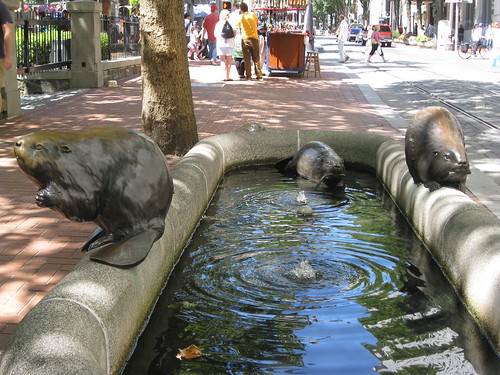
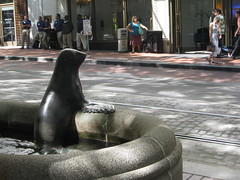
[Cute animal sculptures in Portland.]
What do people want in terms of public transportation? View this video from Kansas City. Lots of transit love and energy even from people accustomed to using their cars.
Penguins: Better than Mad Men?
And if you have 30 seconds of work time to waste, I mean be productive, view a transit ad from Belgium. Cute, has penguins; need I say more?
American Public Transportation Association
APTA's public transit ridership numbers are out and the numbers are up. What is causing the momentum in favor of transit? Thrift, environmental consciousness, quality improvements, free wifi, desire for a vacation from doing traffic battle before and after work?
Can Technology Boost Ridership?
The answer is yes if the technology provides real-time information regionally. The Daily Iowan reports that ridership is up five percent in the one month since real-time information monitors were installed around the University of Iowa's campus - even in dorms. The article, Officials: Bus monitors help to increase ridership, goes into more detail, but implies that the transit system is the same otherwise, so that the jump in business is attributable to the one significant change. Thank you to the TransitWire for the link.
Interesting blog post from Planetizen about mapping health, commuting, income and educational patterns across the United States.
According to 'I Hate the Blue Line' and Other Things Transit Systems Can Learn From Twitter, an article that appeared on the Atlantic's Cities page, transit systems should employ the free customer service data that twitter provides. What are the riders praising or complaining about? The answers are easier to find on twitter than via conventional tools, such as carefully-worded customer surveys, the author argues. I would agree that is the case in places where ridership is well connected - to apps and smartphones.
[Cute animal sculptures in Portland.]
What do people want in terms of public transportation? View this video from Kansas City. Lots of transit love and energy even from people accustomed to using their cars.
Penguins: Better than Mad Men?
And if you have 30 seconds of work time to waste, I mean be productive, view a transit ad from Belgium. Cute, has penguins; need I say more?
American Public Transportation Association
APTA's public transit ridership numbers are out and the numbers are up. What is causing the momentum in favor of transit? Thrift, environmental consciousness, quality improvements, free wifi, desire for a vacation from doing traffic battle before and after work?
This is a 2.0 percent increase over the same quarter last year, representing an increase of nearly 52 million trips. Ridership in all public transportation modes increased, led by light rail which increased by 5.8 percent.The full ridership report is available. I usually read the whole thing, but this time I relied on the summary. If you have an extra 10 minutes or so, there are always thought-provoking details in the report as well as interesting statistics by mode and locations. APTA also posted an explanation about the transit benefit reduction and the increase in the parking benefit.
This is also the first time in three years that ridership has increased for all three quarters. The ridership increase is attributed to a number of factors including high gas prices, improved real time passenger information, and a recovering economy.
Can Technology Boost Ridership?
The answer is yes if the technology provides real-time information regionally. The Daily Iowan reports that ridership is up five percent in the one month since real-time information monitors were installed around the University of Iowa's campus - even in dorms. The article, Officials: Bus monitors help to increase ridership, goes into more detail, but implies that the transit system is the same otherwise, so that the jump in business is attributable to the one significant change. Thank you to the TransitWire for the link.
Interesting blog post from Planetizen about mapping health, commuting, income and educational patterns across the United States.
Thursday, January 13, 2011
Partnering to Multiply Benefits of Transit
Two publications are being distributed that demonstrate partnering across funding streams and types of public and private works. These partnerships have multiple benefits for communities.
Community Transportation Association of America (CTAA)
CTAA's current issue of Community Transportation Magazine focuses on examples of partnerships for coordination, whether among transit and long-distance systems, in the case of San Francisco's planned new terminal (said to rival Grand Central Station) or a transit hub in Spearfish, S.D., or among human service agencies and public transit, such as in Massachusetts. The issue profiles Cape Cod's employment of technology to assist transit and for rider information and scheduling. The issue also covers Institutes for Coordination, complete streets and ride sharing models.
(As for any station competing with Grand Central, first visit Grand Central at 8:30 on any particular sunny morning with streams of light falling across the station and then tell me whether another facility can rival the beauty of this New York landmark. The answer might be yes, in which case there will be a new place to inspire us all.)
Putting Money into Transit-Oriented Development
Reconnecting America
The latest Reconnecting America TOD publication, 2010 Inventory of TOD Programs, covers federal, state and local funding for TOD. The report does not examine any other type of TOD inducements, such as zoning changes or partnerships with transit. Most of the TOD programs mentioned seek to capitalize on existing transit rather than developing transit and residential or commercial projects in conjunction with one another. Reconnecting America announces that TOD programs are on the rise, with many interested communities seeking advice from existing program personnel.
Community Transportation Association of America (CTAA)
CTAA's current issue of Community Transportation Magazine focuses on examples of partnerships for coordination, whether among transit and long-distance systems, in the case of San Francisco's planned new terminal (said to rival Grand Central Station) or a transit hub in Spearfish, S.D., or among human service agencies and public transit, such as in Massachusetts. The issue profiles Cape Cod's employment of technology to assist transit and for rider information and scheduling. The issue also covers Institutes for Coordination, complete streets and ride sharing models.
(As for any station competing with Grand Central, first visit Grand Central at 8:30 on any particular sunny morning with streams of light falling across the station and then tell me whether another facility can rival the beauty of this New York landmark. The answer might be yes, in which case there will be a new place to inspire us all.)
Putting Money into Transit-Oriented Development
Reconnecting America
The latest Reconnecting America TOD publication, 2010 Inventory of TOD Programs, covers federal, state and local funding for TOD. The report does not examine any other type of TOD inducements, such as zoning changes or partnerships with transit. Most of the TOD programs mentioned seek to capitalize on existing transit rather than developing transit and residential or commercial projects in conjunction with one another. Reconnecting America announces that TOD programs are on the rise, with many interested communities seeking advice from existing program personnel.
Monday, August 30, 2010
Zero and Low Emission Modes Get AASHTO's Attention
The American Association of State Highway and Transportation Officials (AASHTO) had two interesting articles in its weekly newsletter, both involving transit.
First is Boulder's new initiative: www.driventodriveless.com, which promotes commuting to work less, even just one day a week less, and instead biking, walking, using transit, carpooling or telecommuting. Similar to Idaho's I-Way program, the site encourages use of alternatives to the single occupancy vehicle and producing less pollution. There is also a link there that connects to a national trail site with walking routes in every state.
30/10 Plan Reaches Across Party Lines
Second is Los Angeles' 30/10 plan, which seeks to implement a 30-year transit plan within 10 years by using the long-term revenue from a half-cent sales tax, estimated to produce $13 billion for transit, as collateral for long-term bonds and a federal loan. Sen. Barbara Boxer (D. Calif.) was promoting the mayor's idea at LA's city hall. The LA Times reports:
The newspaper story also stated that Boxer's Republican rival in the upcoming election also backs the ambitious transit plan.
First is Boulder's new initiative: www.driventodriveless.com, which promotes commuting to work less, even just one day a week less, and instead biking, walking, using transit, carpooling or telecommuting. Similar to Idaho's I-Way program, the site encourages use of alternatives to the single occupancy vehicle and producing less pollution. There is also a link there that connects to a national trail site with walking routes in every state.
30/10 Plan Reaches Across Party Lines
Second is Los Angeles' 30/10 plan, which seeks to implement a 30-year transit plan within 10 years by using the long-term revenue from a half-cent sales tax, estimated to produce $13 billion for transit, as collateral for long-term bonds and a federal loan. Sen. Barbara Boxer (D. Calif.) was promoting the mayor's idea at LA's city hall. The LA Times reports:
"We are going to get it done and it's going to be a template for the nation," Boxer said during the hourlong forum. "Everything we do is job-focused, but everything we do has to be deficit-neutral, except emergencies …. We have to leverage every single penny that we can."
The newspaper story also stated that Boxer's Republican rival in the upcoming election also backs the ambitious transit plan.
Thursday, August 5, 2010
News from State Public Transportation Partnerships Conference
Okay, I will try to write about the conference and not keep dreaming about living in Seattle so that I can spend more time in a beautiful city where you see seagulls and you can walk to the ballpark. I personally recommend the Ebbets Field Flannels store. (Yes, the owner and the salesperson are from Brooklyn, Park Slope in this case.)
What partnerships are everyone talking about? Every type of coordination has been mentioned, from collaboration with states Department of Justice to students from local colleges. Creative use of facebook, twitter, and bus roadeos are being discussed. Recommended for roadeo success were a barbecue at the roadeo and local radio station participation.
Tidbits of Useful Practices
1. Use of college students to advocate and campaign for transit funding and ballot measures. They use facebook in a viral way, which exponentially garners support.
2. Partnering at the local, state and federal way. These partnerships can mirror the federal sustainability partnership, work on traditional connections to human service agencies, and can involve everyone else.
3. Focus on how transit and mobility services help every constituency and agency. One example was coordination with a state Department of Corrections, which was motivated to sit at the proverbial table by the message that parolees are required to work, which necessitates transportation to work.
4. Work with business, people with disabilities, cyclists, environmentalists, and others on messages and service needs.
Who Is Here?
On hand at the conference are staff from the Federal Transit Administration (FTA), the Community Transportation Association of America (CTAA), the American Association of State Highway and Transportation Officials (AASHTO), the American Public Transportation Association (APTA), Easter Seals Project ACTION, National RTAP, and the National Conference of State Legislatures (NCSL).
No offense to the above entities, I do not think that anyone here would dispute that the most interesting information, comments and ideas have come from state players, people with local stories and advocates who have worked locally to support transit.
There is no question that despite the current economic and funding (or lack thereof) climate, ordinary people are looking for and want public dollars to pay for more transit service, whether for older adults, low-wage earners who work for and with those we care about, students, people with disabilities or those who wish to transition from a gas-guzzler lifestyle. Food for thought.
With that, I am getting hungry for that salmon dinner in the not-too-distant future, though my family's breakfast at Tea and Crumpet (complete with smoked salmon good enough for Zabars lovers) is also on my mind. Hope my stomach rumblings are not distracting my fellow conference attendees.
What partnerships are everyone talking about? Every type of coordination has been mentioned, from collaboration with states Department of Justice to students from local colleges. Creative use of facebook, twitter, and bus roadeos are being discussed. Recommended for roadeo success were a barbecue at the roadeo and local radio station participation.
Tidbits of Useful Practices
1. Use of college students to advocate and campaign for transit funding and ballot measures. They use facebook in a viral way, which exponentially garners support.
2. Partnering at the local, state and federal way. These partnerships can mirror the federal sustainability partnership, work on traditional connections to human service agencies, and can involve everyone else.
3. Focus on how transit and mobility services help every constituency and agency. One example was coordination with a state Department of Corrections, which was motivated to sit at the proverbial table by the message that parolees are required to work, which necessitates transportation to work.
4. Work with business, people with disabilities, cyclists, environmentalists, and others on messages and service needs.
Who Is Here?
On hand at the conference are staff from the Federal Transit Administration (FTA), the Community Transportation Association of America (CTAA), the American Association of State Highway and Transportation Officials (AASHTO), the American Public Transportation Association (APTA), Easter Seals Project ACTION, National RTAP, and the National Conference of State Legislatures (NCSL).
No offense to the above entities, I do not think that anyone here would dispute that the most interesting information, comments and ideas have come from state players, people with local stories and advocates who have worked locally to support transit.
There is no question that despite the current economic and funding (or lack thereof) climate, ordinary people are looking for and want public dollars to pay for more transit service, whether for older adults, low-wage earners who work for and with those we care about, students, people with disabilities or those who wish to transition from a gas-guzzler lifestyle. Food for thought.
With that, I am getting hungry for that salmon dinner in the not-too-distant future, though my family's breakfast at Tea and Crumpet (complete with smoked salmon good enough for Zabars lovers) is also on my mind. Hope my stomach rumblings are not distracting my fellow conference attendees.
Tuesday, June 15, 2010
News and Resources for Transit and Transportation Staff and Advocates
The Amalgamated Transit Union (ATU) has enhanced its website with current news of transit funding realities and ideas as well as articles about what is happening in communities around the nation. Right now, ATU has posted an article from Metro magazine, CTAA EXPO Covers Funding, Healthcare, Green Alternatives, with excellent coverage of the conference and the types of education it provides every year.
The Community Transportation Association of America (CTAA) offers Fast Mail, a newsletter with transit news from around the country as well as national policy and legislative developments. Fast Mail is a great resource for quickly staying on top of the steady stream of transportation information. A subscription link is available on CTAA's homepage.
Monday, June 7, 2010
Livability - Draft DOT Strategic Plan part 2
Department of Transportation Draft Strategic Plan
LIVABILITY:
Recalling Secretary of Transportation Ray LaHood’s blog entry from several months ago describing a weekend getaway to friends in Hoboken N.J., the Secretary spoke of a night out in the city, being happy to walk, take the train, and leave the car at home for the whole weekend. His department likewise wants to assist communities in affording multi-modal and healthy, environmentally friendly transportation choices to Americans wherever possible.
In an earlier section of the draft plan, DOT sets forth an economic competitiveness goal: "Promote transportation policies and investments that bring lasting and equitable economic benefits to the Nation and its citizens." What does this mean for transit and other publicly available transportation? The plan calls for investment in full range of modes, including transit, an intermodal approach, new ways to finance the transportation system, and reducing congestion through transit, ridesharing, and flextime. However, there are no performance measures in the economic competitiveness section that set transit ridership or alternative transportation goals, except indirectly through reduction of congestion.
Livable communities gets its own section of the draft plan. DOT calls for "place-based policies and investments that increase transportation choices and access to transportation services." DOT expressly wants improved public transit, human services transportation (mentioning the special needs populations and people with disabilities), and better bike/pedestrian networks. The plan envisions transportation coordination with land use and economic development.
The plan directly links the auto-dependent lifestyle to national insecurity and ill health.
A study is cited showing that people who live in compact, walkable communities are more fit and healthy than those who reside in counties with more sprawl. The connection between health and the transportation network is explicitly made and discussed in detail. The plan practically comes out and says that the 40 percent of trips that are two miles or less in length should be able to be made by walking or bicycle, but that our current street network does not allow this - despite studies showing that young adults and baby boomers want to live in walkable neighborhoods and towns.
In case you think DOT is talking about New York, San Francisco, Chicago and Seattle, or a few others, the plan specifically includes rural areas and their desperate need for alternatives to the car.
The DOT-HUD-EPA partnership is already identifying barriers to coordinating transportation, housing, and environmental policies and investments. The three agencies are coordinating and bringing resources together for each others' programs, such as EPA's Smart Growth Technical Assistance Program, HUD’s Sustainable Communities Planning Grants, designed to fund regional, coordinated planning, and "evaluation of DOT’s TIGER Discretionary Grant applications, for which livability and sustainability are two key criteria."
In terms of the economy, DOT maintains that livable community development will do two things: Save on infrastructure investment costs, and help communities be economically resilient through decreased dependence on foreign oil price fluctuations. DOT sees livability as a way to reduce household transportation costs through the availability of alternative mobility choices, such as transit, biking and walking.
And what is DOT envisioning to help states, regions and communities become more livable? Providing technical assistance, advocating for "robust State and local planning efforts," spending transportation dollars where they will capitalize on public and private infrastructure investment, and developing livability performance measures.
Specific strategies that DOT plans to use are increasing access to transit and inter-city services, developing pedestrian and bike-friendly street networks, "where practical" providing better rural transit for access to jobs, services and transportation centers that are currently only automobile accessible, and encouraging mixed-income development, for which DOT has already funded a technical assistance MITOD guide through Reconnecting America.
DOT's plan seems almost ashamed that although walking and biking account for account for "almost 12 percent of trips and about 13 percent of roadway fatalities, these modes receive less than 2 percent of annual Federal Aid Highway funds." The agency is calling for assessments, planning and encouraging the public to use these modes.
Remember that DOT comment invites the public to comment on its proposals. Read the draft plan sections that interest you and respond to DOT.
LIVABILITY:
Recalling Secretary of Transportation Ray LaHood’s blog entry from several months ago describing a weekend getaway to friends in Hoboken N.J., the Secretary spoke of a night out in the city, being happy to walk, take the train, and leave the car at home for the whole weekend. His department likewise wants to assist communities in affording multi-modal and healthy, environmentally friendly transportation choices to Americans wherever possible.
In an earlier section of the draft plan, DOT sets forth an economic competitiveness goal: "Promote transportation policies and investments that bring lasting and equitable economic benefits to the Nation and its citizens." What does this mean for transit and other publicly available transportation? The plan calls for investment in full range of modes, including transit, an intermodal approach, new ways to finance the transportation system, and reducing congestion through transit, ridesharing, and flextime. However, there are no performance measures in the economic competitiveness section that set transit ridership or alternative transportation goals, except indirectly through reduction of congestion.
Livable communities gets its own section of the draft plan. DOT calls for "place-based policies and investments that increase transportation choices and access to transportation services." DOT expressly wants improved public transit, human services transportation (mentioning the special needs populations and people with disabilities), and better bike/pedestrian networks. The plan envisions transportation coordination with land use and economic development.
The plan directly links the auto-dependent lifestyle to national insecurity and ill health.
The United States’ heavy reliance on car-dependent, dispersed development is not without costs. This kind of development is energy-intensive and contributes to a dependence on fossil fuels and a tendency toward high carbon-emissions; it has been correlated with increasing rates of obesity in the U.S. and higher transportation costs for American families.
A study is cited showing that people who live in compact, walkable communities are more fit and healthy than those who reside in counties with more sprawl. The connection between health and the transportation network is explicitly made and discussed in detail. The plan practically comes out and says that the 40 percent of trips that are two miles or less in length should be able to be made by walking or bicycle, but that our current street network does not allow this - despite studies showing that young adults and baby boomers want to live in walkable neighborhoods and towns.
In case you think DOT is talking about New York, San Francisco, Chicago and Seattle, or a few others, the plan specifically includes rural areas and their desperate need for alternatives to the car.
Creating livable communities is just as important to residents of rural areas as it is to residents of urban and suburban areas. Rural town centers have experienced disinvestment in much the same way as urban core areas and many rural towns are fighting to attract local commercial development through the revitalization of town centers. Rural residents generally must travel greater distances to jobs and services than their urban counterparts and can suffer from greater isolation, especially if they cannot drive.
The DOT-HUD-EPA partnership is already identifying barriers to coordinating transportation, housing, and environmental policies and investments. The three agencies are coordinating and bringing resources together for each others' programs, such as EPA's Smart Growth Technical Assistance Program, HUD’s Sustainable Communities Planning Grants, designed to fund regional, coordinated planning, and "evaluation of DOT’s TIGER Discretionary Grant applications, for which livability and sustainability are two key criteria."
In terms of the economy, DOT maintains that livable community development will do two things: Save on infrastructure investment costs, and help communities be economically resilient through decreased dependence on foreign oil price fluctuations. DOT sees livability as a way to reduce household transportation costs through the availability of alternative mobility choices, such as transit, biking and walking.
And what is DOT envisioning to help states, regions and communities become more livable? Providing technical assistance, advocating for "robust State and local planning efforts," spending transportation dollars where they will capitalize on public and private infrastructure investment, and developing livability performance measures.
Specific strategies that DOT plans to use are increasing access to transit and inter-city services, developing pedestrian and bike-friendly street networks, "where practical" providing better rural transit for access to jobs, services and transportation centers that are currently only automobile accessible, and encouraging mixed-income development, for which DOT has already funded a technical assistance MITOD guide through Reconnecting America.
DOT's plan seems almost ashamed that although walking and biking account for account for "almost 12 percent of trips and about 13 percent of roadway fatalities, these modes receive less than 2 percent of annual Federal Aid Highway funds." The agency is calling for assessments, planning and encouraging the public to use these modes.
Remember that DOT comment invites the public to comment on its proposals. Read the draft plan sections that interest you and respond to DOT.
Subscribe to:
Posts (Atom)