Easter Seals Project ACTION
The Online Dialogue on Veterans Transportation hosted by ESPA
Easter Seals Project ACTION (ESPA) in partnership with the Federal Transit Administration is now complete. ESPA will be releasing a report next month. Visit the website now to peruse the suggestions and conversations about improving transportation for vulnerable veterans and their families.
Community Transportation Association of America
The Veterans Transportation and Community Living Initiative (VTCLI) is underway. As part of the commencement of this FTA initiative, the National Resource Center (NRC) released a report, Transportation for America's Veterans and Their Families. The report showcases the NRC's - particularly, its ambassadors' - successes in assisting veterans by improving transportation through effective partnerships and coordination. Some of these stories involve transporting veterans to VA medical centers and others involve travel to the same places we all need to go to. The report demonstrates what coordination and committed partnerships can achieve to improve transit and transportation services.
[Union Station, Kansas City]
The VTCLI website showcases resources for communities as well as for project grantees. Information about outreach to veteran and military organizations, one-call/one-click services and costs, relevant statistics, and transportation technical assistance, among more resources, are available on the community resource page.
For more resources relating to veterans and serving their transportation needs, please visit the NRC Veterans Transportation Bookshelf. Like all of the NRC bookshelves, there is comprehensive information about the topic.
Showing posts with label Community Transportation Association of America. Show all posts
Monday, June 11, 2012
Tuesday, February 14, 2012
Associations Educating Members, Urge Members to Contact Congress
Community Transportation Association of America
CTAA has created Reauthorization Central, which contains the different proposed bills in Congress, summaries and CTAA analysis of the legislation, key Congressional committees' documents, Department of Transportation responses and the schedule of possible Congressional actions. Letters to Congress with comments on the funding provisions also are posted, including a joint letter signed on by CTAA, the National League of Cities, the National Association of Counties, the U.S. Conference of Mayors, the National Association of City Transportation Officials, Reconnecting America, and the American Public Transportation Association.
American Public Transportation Association
APTA is strongly opposing the reauthorization proposal in the House.
APTA has also prepared talking points to use when communicating with members of Congress. These include the point that "[t]he Ways and Means proposal to fund public transportation investment with a one-time appropriation would leave transit without any funding source when those funds run out in 2016."
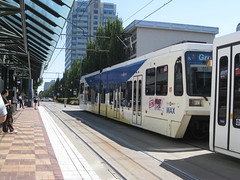
[Portland light rail near the convention center.]
Planning Organizations at Stake
Association of Metropolitan Planning Organizations
AMPO and APTA are jointly recommending to Congress that the reauthorization retain all exixting metropolitan planning organizations (MPOs), regardless of population size.
National Association of Counties
NACo is concerned about reauthorization proposals that fail to maintain planning organizations.
Amalgamated Transit Union
ATU is advocating in favor of federal operating assistance for transit systems.
Other groups, such as Transportation for America, PolicyLink, and the League of American Bicyclists, among others, are advocating for improved transit funding and multi-modal street networks.
As we go to press, there are House members switching sides to back transit and the Senate is likely to put off a vote.
[San Luis Obispo Amtrak station.]
Local Stories
Two of the biggest logistical concerns for working parents are transportation and child care. One transit agency is doing both. To attract good employees who can work the nontraditional hours that transit and other industries demand, Prairie Transit in Spearfish, S.D., "opened its own state-licensed child care facility right in its new transit center." The article, Community care: Day care centers draw workers to towns, appeared in the Rapid City Journal.
Indianapolis, Ind. - APTA reports that IndyGo performed well during the Super Bowl festivities. The transit agency had a “Know Before You Go” campaign to alert riders to temporary route changes and offered free rides Feb. 2-5, funded by a federal Congestion Mitigation Air Quality grant.
APTA's news also highlights another story, this from Cincinnati, where the Everybody Rides Metro Foundation, administered by Metro in Cincinnati, provided more than a million free rides in the past four years to low-income workers traveling to and from work, job training, and related activities. "Almost 100 agencies partner with the foundation, including Talbert House, Freestore Foodbank, St. Vincent de Paul, Lighthouse Youth Services, and Cincinnati Works."
Hi-Tech Town
Boston transit riders have hi-tech ways to get real-time information and engage in public participation. The Massachusetts Bay Transportation Authority is texting real-time information to bus riders. Just the stop identification number and the telephone number are all that is needed. And if you have a smartphone, life is even better because Boston boasts more than 40 apps for transit. Helps having lots of smart, techie college students around. The MBTA is also considering service cuts and fare increases. Like the wired town that it is, Boston's residents are commenting publicly - on twitter. That meeting is so last century. Both stories via the TransitWire.
CTAA has created Reauthorization Central, which contains the different proposed bills in Congress, summaries and CTAA analysis of the legislation, key Congressional committees' documents, Department of Transportation responses and the schedule of possible Congressional actions. Letters to Congress with comments on the funding provisions also are posted, including a joint letter signed on by CTAA, the National League of Cities, the National Association of Counties, the U.S. Conference of Mayors, the National Association of City Transportation Officials, Reconnecting America, and the American Public Transportation Association.
American Public Transportation Association
APTA is strongly opposing the reauthorization proposal in the House.
The bill eliminates the Mass Transit Account of the Highway Trust Fund and creates the new Alternative Transportation Account that would provide funding for public transportation, the Congestion Mitigation and Air Quality Control (CMAQ) program, and several other programs. Dedicated funding for the new account has not yet been identified.APTA calls for a predictable and dedicated source of funding. It is supporting a bi-partisan effort in the House to restore transit's funding source. "It is not yet clear if the Rules Committee will allow a vote on this amendment. APTA is urging a full floor vote on this amendment prior to final passage."
APTA has also prepared talking points to use when communicating with members of Congress. These include the point that "[t]he Ways and Means proposal to fund public transportation investment with a one-time appropriation would leave transit without any funding source when those funds run out in 2016."
[Portland light rail near the convention center.]
Planning Organizations at Stake
Association of Metropolitan Planning Organizations
AMPO and APTA are jointly recommending to Congress that the reauthorization retain all exixting metropolitan planning organizations (MPOs), regardless of population size.
Removing the decision-making authority from the local level will reduce the voice of the local government, transit agencies, its citizens, and people in the region. Citizens elect their local public officials to reflect the unique nature of their region, and removing the MPO will only increase the distance between the average citizen and the policy-maker.AMPO and APTA also oppose the 200,000-population threshold for all MPOs as eight states would potentially be left without one unless the Secretary grants approval that they possess the technical capacity to complete the planning requirements. Some that have served as local planning conveners since 1962 would be eliminated.
National Association of Counties
NACo is concerned about reauthorization proposals that fail to maintain planning organizations.
MPOs between 50,000-200,000 would face an uncertain future and are no longer guaranteed a role in the planning process; efforts to enhance the planning role for include rural regions under 50,000 were not successful; the Surface Transportation Program underwent some changes that may not be beneficial to local governments; and funding for the Transportation Enhancement program appears to be no longer mandatory.[Portland's Amtrak station.]
Amalgamated Transit Union
ATU is advocating in favor of federal operating assistance for transit systems.
Now more than ever we must urge Members of Congress to do the right thing for our communities by voting yes on the amendment to adopt the original “100 Bus” language which also includes targeted and temporary operating assistance for the nation’s medium size and large transit systems which are also in the midst of a mobility crisis.
Other groups, such as Transportation for America, PolicyLink, and the League of American Bicyclists, among others, are advocating for improved transit funding and multi-modal street networks.
As we go to press, there are House members switching sides to back transit and the Senate is likely to put off a vote.
[San Luis Obispo Amtrak station.]
Local Stories
Two of the biggest logistical concerns for working parents are transportation and child care. One transit agency is doing both. To attract good employees who can work the nontraditional hours that transit and other industries demand, Prairie Transit in Spearfish, S.D., "opened its own state-licensed child care facility right in its new transit center." The article, Community care: Day care centers draw workers to towns, appeared in the Rapid City Journal.
Indianapolis, Ind. - APTA reports that IndyGo performed well during the Super Bowl festivities. The transit agency had a “Know Before You Go” campaign to alert riders to temporary route changes and offered free rides Feb. 2-5, funded by a federal Congestion Mitigation Air Quality grant.
Local fixed route ridership surpassed expectations throughout the entire detour period with a 39 percent increase over average ridership: a total of 325,212 rides over 10 days. IndyGo operated additional buses to accommodate the crowds on fixed route service, reaching a peak of 28 extra buses assisting routes on Feb. 4.
APTA's news also highlights another story, this from Cincinnati, where the Everybody Rides Metro Foundation, administered by Metro in Cincinnati, provided more than a million free rides in the past four years to low-income workers traveling to and from work, job training, and related activities. "Almost 100 agencies partner with the foundation, including Talbert House, Freestore Foodbank, St. Vincent de Paul, Lighthouse Youth Services, and Cincinnati Works."
Hi-Tech Town
Boston transit riders have hi-tech ways to get real-time information and engage in public participation. The Massachusetts Bay Transportation Authority is texting real-time information to bus riders. Just the stop identification number and the telephone number are all that is needed. And if you have a smartphone, life is even better because Boston boasts more than 40 apps for transit. Helps having lots of smart, techie college students around. The MBTA is also considering service cuts and fare increases. Like the wired town that it is, Boston's residents are commenting publicly - on twitter. That meeting is so last century. Both stories via the TransitWire.
Tuesday, December 13, 2011
Models to Improve Transportation for Veterans, Patients and People with Disabilities
Community Transportation Association of America
CTAA's National Resource Center for Human Service Transportation Coordination released NRC Report: Transportation for America's Veterans and Their Families, which discusses improving transportation for our nation's veterans through partnerships and coordination. Examples of the work of regional ambassadors are given. The NRC also maintains a webpage "bookshelf" with veterans transportation resources.
Life-Saving Transportation
CTAA also distributed the Dialysis Report, which discusses the dire, complicated transportation demands that dialysis patients present.
Solutions Possible to Realize Decades-Old Commitments
Association of Programs for Rural Independent Living
APRIL's Executive Director, Billy Altom, testified before the Senate Health, Education, Labor and Pensions Committee about the need for affordable, accessible and available rural transportation. Forty years after the Urban Mass Transportation Act and 20 years after the passing of the ADA, Altom argues, "minimal or nonexistent transit services in rural areas still create serious barriers to employment, accessible health care, and full participation in society for people with disabilities."
Altom sees some solutions that are working - mobility management and voucher programs. Altom praised the Easter Seals Project ACTION Mobility Management Independent Living Coaches program and he cited as an example the Center for Independent Living for Western Wisconsin Regional Mobility Management/New Freedom Program, which provided 12,000 rides last year and coordinates in seven counties with public and private transportation providers. More than 140 volunteer drivers provide the rides and the program is expanding into an 18-county area. Already weekly rides are being supplied to 130 veterans.
Partnership for Mobility Management member Denise Larson is the mobility manager for the program. She also serves on the Partnership's advisory committee.
Another Type of Coordination
American Public Human Services Association
Bridging the Divide: Leveraging New Opportunities to Integrate Health and Human Services is APHSA's new report about the value added of coordinating and aligning health and human services for clients beyond eligibility and enrollment for a "customer‐focused, one‐stop shop, 'service home'." Such coordination makes sense, according to the report, because:
CTAA's National Resource Center for Human Service Transportation Coordination released NRC Report: Transportation for America's Veterans and Their Families, which discusses improving transportation for our nation's veterans through partnerships and coordination. Examples of the work of regional ambassadors are given. The NRC also maintains a webpage "bookshelf" with veterans transportation resources.
Life-Saving Transportation
CTAA also distributed the Dialysis Report, which discusses the dire, complicated transportation demands that dialysis patients present.
The crux of the transportation challenge is that the majority of dialysis patients are covered by Medicare, which — unlike Medicaid — does not offer non-emergency transportation as a benefit. Three out of four dialysis patients in the U.S., are Medicare primary, meaning that Medicare sets the reimbursement rate and pays 80 percent of that amount ...The situation places transportation providers between the proverbial rock and a hard place. CTAA is advocating for a funding mechanism within Medicare and for increased kidney organ donation. "Transplants can add decades to people’s lives and significantly forestall the need for dialysis, but only when the needed organs are available."
Indeed, in background discussions with community and public transit officials around the country for this article, a common refrain was the difficult position in which many transit operators find themselves — how to continuously add new dialysis patients to the transit schedule with no means of payment.
Solutions Possible to Realize Decades-Old Commitments
Association of Programs for Rural Independent Living
APRIL's Executive Director, Billy Altom, testified before the Senate Health, Education, Labor and Pensions Committee about the need for affordable, accessible and available rural transportation. Forty years after the Urban Mass Transportation Act and 20 years after the passing of the ADA, Altom argues, "minimal or nonexistent transit services in rural areas still create serious barriers to employment, accessible health care, and full participation in society for people with disabilities."
Altom sees some solutions that are working - mobility management and voucher programs. Altom praised the Easter Seals Project ACTION Mobility Management Independent Living Coaches program and he cited as an example the Center for Independent Living for Western Wisconsin Regional Mobility Management/New Freedom Program, which provided 12,000 rides last year and coordinates in seven counties with public and private transportation providers. More than 140 volunteer drivers provide the rides and the program is expanding into an 18-county area. Already weekly rides are being supplied to 130 veterans.
Partnership for Mobility Management member Denise Larson is the mobility manager for the program. She also serves on the Partnership's advisory committee.
Another Type of Coordination
American Public Human Services Association
Bridging the Divide: Leveraging New Opportunities to Integrate Health and Human Services is APHSA's new report about the value added of coordinating and aligning health and human services for clients beyond eligibility and enrollment for a "customer‐focused, one‐stop shop, 'service home'." Such coordination makes sense, according to the report, because:
Many of the same people who qualify for Medicaid, CHIP or some level of premium subsidy identified through the Exchanges also qualify for one or more human service assistance programs.The report contains case studies of what several states are doing and the impending impact of the new healthcare law.
The positive impact of coordinated care and integrated case management on improving the overall health and well‐being of individuals and populations— strengthening families, achieving employment and independence, improving the well‐being of children, youth, people with disabilities, seniors and other vulnerable populations—is well documented. Better outcomes mean healthier, safer, stabilized individuals and families with a better chance of sustainable independence from government services and long‐term personal success.
Monday, October 17, 2011
Sharing the Truth about Transportation Services & Transit
Community Transportation Association of America
CTAA's Director, Dale Marsico, provides historical context for the Federal Transit Administration's proposed changes to current policies on implementing the requirements of Title VI of the Civil Rights Act of 1964.
CTAA has a new blog, Truth in Transit. The blog contains stories about transit systems, rider experiences, and funding. It is a resource for community and public transportation leaders and advocates to share best practices in building effective, strategic relationships with local, state and federal elected officials and with other key partners. I really like the 101 piece written by a Wisconsin legislator about how to approach political leaders. The advice applies everywhere and beyond transportation.
[Portland's Union Station.]
American Public Transportation Association
APTA releases the APTA Primer on Transit Funding - The Safe, Accountable, Flexible, Efficient Transportation Equity Act: A Legacy for Users, Extensions, and Other Related Laws, FY 2004 Through FY 2011, a report that explains all of the transit funding programs and how many dollars are authorized and appropriated for them. In another report, APTA analyzes what will happen if cost-cutting proposals become the law of the land in the next reauthorization. An Analysis of Proposed U.S. House of Representatives Actions and Their Impact on Public Transportation looks at impacts on riders, jobs, service, maintenance and new projects.
AARP
AARP has written a report about the safety and mobility considerations involved with golf-cart-like vehicles, called Low-speed vehicles (LSVs). Use in specific communities is analyzed as well as accident rates. Use of these vehicles has increased, though they are not designed for car-like speeds or impacts.
Map of Senior Transportation Programs
The Beverly Foundation has compiled a map of senior transportation that shows the number of programs in each state, where they are and a link to further information about each program.
Local Stories
Ohio Valley of West Virginia announces plans to revisit its coordinated transportation plan. The study's director sees challenges in mobility needs as well as perceived barriers of liability and funding to interstate service. See the local news video.
Like many areas of the country, Palm Beach County, Florida, is seeing an increase in transit ridership. This increase remained even during a dip in gas prices. Sundays, the only day for which there was no increase, remained steady in ridership, though service has been cut.
[Tile art on Portland building.]
CTAA's Director, Dale Marsico, provides historical context for the Federal Transit Administration's proposed changes to current policies on implementing the requirements of Title VI of the Civil Rights Act of 1964.
[K]eep in mind that it is fair for us to be asked if we are living up not just to our responsibilities on Civil Rights under Title VI. Remembering that these proposals represent something more for us than a typical government regulation, I believe that everyone who has questions or concerns about them use the full range of comment procedures and meetings to discuss them with the FTA. I'd also urge you to suggest different strategies to provide the kind of factual information that tells our ongoing story of the role we play in expanding Civil Rights for everyone.Visit the FTA site for information about the proposals relating to civil rights and environmental justice and the ADA.
CTAA has a new blog, Truth in Transit. The blog contains stories about transit systems, rider experiences, and funding. It is a resource for community and public transportation leaders and advocates to share best practices in building effective, strategic relationships with local, state and federal elected officials and with other key partners. I really like the 101 piece written by a Wisconsin legislator about how to approach political leaders. The advice applies everywhere and beyond transportation.
[Portland's Union Station.]
American Public Transportation Association
APTA releases the APTA Primer on Transit Funding - The Safe, Accountable, Flexible, Efficient Transportation Equity Act: A Legacy for Users, Extensions, and Other Related Laws, FY 2004 Through FY 2011, a report that explains all of the transit funding programs and how many dollars are authorized and appropriated for them. In another report, APTA analyzes what will happen if cost-cutting proposals become the law of the land in the next reauthorization. An Analysis of Proposed U.S. House of Representatives Actions and Their Impact on Public Transportation looks at impacts on riders, jobs, service, maintenance and new projects.
AARP
AARP has written a report about the safety and mobility considerations involved with golf-cart-like vehicles, called Low-speed vehicles (LSVs). Use in specific communities is analyzed as well as accident rates. Use of these vehicles has increased, though they are not designed for car-like speeds or impacts.
Map of Senior Transportation Programs
The Beverly Foundation has compiled a map of senior transportation that shows the number of programs in each state, where they are and a link to further information about each program.
Local Stories
Ohio Valley of West Virginia announces plans to revisit its coordinated transportation plan. The study's director sees challenges in mobility needs as well as perceived barriers of liability and funding to interstate service. See the local news video.
Like many areas of the country, Palm Beach County, Florida, is seeing an increase in transit ridership. This increase remained even during a dip in gas prices. Sundays, the only day for which there was no increase, remained steady in ridership, though service has been cut.
[Tile art on Portland building.]
Wednesday, August 31, 2011
Webinars - Performance Measurement, Creative Responses to Reduced Funding
Performing For Individual, Organizational and Collective Impact - webinar - Sept. 14, 2011 at 2 p.m. Eastern time. The Partnership for Mobility Management and the Community Transportation Association of America jointly present this webinar to explore the fundamentals of performance measurement. Hear how a results-based accountability framework is used to support quality of life. Learn about mobility management measures that gauge success of programs and outcomes for customers. Speakers include representatives of transit, transportation services and workforce agencies as well as a staff member of the Federal Transit Administration.
Creative Solutions to Reduced Funding for Public and Human Services Transportation - webinar - Sept. 20, 2011 at 2 p.m. Eastern time. The National Consortium on the Coordination of Human Services Transportation presents this colloquium via webinar to assist national organizations, states and communities during these fiscally challenging times. Speakers are representatives of communities that have taken different approaches to solving or alleviating the problem of cutbacks as well as a panel representing national organizations.
Monday, July 18, 2011
More Responses to the House Reauthorization Proposal
Association for Commuter Transportation
ACT responded to the House reauthorization proposal by stating that while the association understands the need for fiscal constraints, it points to underinvestment in transportation. ACT applauds the proposed expansion of public-private partnerships where appropriate, and the development of performance measures for both highway and transit projects.
[Taxis about to leave Central Park on a summer morning.]
Association of Metropolitan Planning Organizations
AMPO warns that if all current metropolitan planning organizations (MPOs) are not grandfathered in the next reauthorization bill, which could institute a 200,000 population threshold, then it is possible that almost two thirds of the current MPOs will disappear and that eight states will no longer have an MPO.
Community Transportation Association of America
CTAA currently has links on its homepage to the overview of the House proposal, the House Democratic response, and a Senate Banking Committee state-by-state table of current spending levels and expected reductions.
[Maine fishermen relaxing on shore on a cool evening.]
ACT responded to the House reauthorization proposal by stating that while the association understands the need for fiscal constraints, it points to underinvestment in transportation. ACT applauds the proposed expansion of public-private partnerships where appropriate, and the development of performance measures for both highway and transit projects.
[Taxis about to leave Central Park on a summer morning.]
Association of Metropolitan Planning Organizations
AMPO warns that if all current metropolitan planning organizations (MPOs) are not grandfathered in the next reauthorization bill, which could institute a 200,000 population threshold, then it is possible that almost two thirds of the current MPOs will disappear and that eight states will no longer have an MPO.
As required under U.S. Code Title 23, Chapter 1, Section 134, MPOs are policy boards comprised of local elected officials, representatives of public agencies that administer or operate transportation modes and state officials. The boards are responsible for carrying out federally required transportation planning activities that include, but are not limited to, development of long-term multimodal transportation plans, coordinated selection of transportation improvements in a fiscally constrained manner, public outreach, and coordination with states and numerous public and citizen interests.AMPO asserts that MPOs are crucial for transportation decisions to reflect "the voice of the local government, its citizens, and people in the regions."
Community Transportation Association of America
CTAA currently has links on its homepage to the overview of the House proposal, the House Democratic response, and a Senate Banking Committee state-by-state table of current spending levels and expected reductions.
[Maine fishermen relaxing on shore on a cool evening.]
Friday, July 1, 2011
Planning for Emergencies and Disaster Response
On Wednesday morning, members of the National Consortium on the Coordination of Human Services Transportation engaged in a colloquium about emergency planning and disaster response, both in general and in particular regarding transportation, transportation providers, and transportation-challenged populations and areas. The speakers were Sheryl Gross-Glaser of the National Resource Center for Human Service Transportation Coordination (NRC) (a technical assistance center housed at the Community Transportation Association of America (CTAA)), Virginia Dize and Jo Reed of the National Association of Area Agencies on Aging (N4A), and Patricia Monaghan of the National Rural Transit Assistance Program (RTAP).
To understand the different types and categorization of emergencies and disasters, and preparedness, a good concise guide is the Federal Transit Administration (FTA) Introduction to All-Hazards Preparedness for Transit Agencies.
Never Introduce Yourself at the Disaster
"Never introduce yourself at the disaster" was a terrific soundbite from a recent FEMA (Federal Emergency Management Administration) webinar. Richard Devylder, Senior Advisor for Accessible Transportation at the U.S. Department of Transportation, gave this advice. It is too late to be involved in planning for emergency response when disaster hits and even at the point where officials are looking for endorsement of a plan.
Early and Often Involvement
Unlike voting, involvement in emergency planning should be early and often, counsels Devylder (who did not refer to voting). Involvement while a plan is being crafted ensures that preparedness actively includes populations beyond those of average age and abilities.
[Central Park South yesterday was full with pedicabs, taxis, buses, cyclists and walkers (left out of the photograph).]
After Hurricane Katrina's disproportionate impact on older adults (47 percent of the people who died were 75 or older), area agencies on aging (AAAs) are participating in emergency preparedness by providing information, establishing partnerships, providing communications links, outreach and services in the event of a disaster. (More information about AAA participation in emergency preparedness and response is available in an N4A 2009 survey.)
Redundant and Universal Communication
Also mentioned during the webinar, which is not currently archived, was the wisdom of redundant communications in multiple formats and with attention paid to those with communication challenges, such as people with visual or auditory impairments. Information provided in visual updates, such as maps or information scrolled at the bottom of a screen, or announcements via radio or television, should be duplicated in other formats.
[A bus stop on Broadway, about 63rd St. The new shelters are chic, though not hi-tech like the Portland ones.]
Building in Redundancies for an Imperfect World
Since no one measure is perfect to identify and keep track of who will need assistance, transportation, health-related or otherwise, redundancy in identification and monitoring is necessary. No one system of determining need - before or during an emergency - will be completely accurate. There will be people who are injured or disoriented during a disaster who were perfectly well beforehand and who would not show up on a registry. Likewise, depending on time of day, many children who do not usually have transportation challenges would be unsupervised and in need of assistance.
For example, we discussed the value of registries for meeting the needs of transportation-challenged individuals. Both N4A and CTAA include the development and use of registries in their recommendations. A participant in the FEMA webinar, June Isaacson Kailes, Disability Policy Consultant/Associate Director at Western University in California, spoke against reliance on registries because she believes that they provide a false security to registrants, who assume that registering means that the government will be taking care of them, and they provide no service to those who fail to register, whether out of ignorance, distrust of the government, or privacy concerns.
Kailes recommends that governments assess what will be needed and in what amounts to keep people independent and in good health - wheelchairs, medications, vehicles, meals, health aides - based upon the demographics. Jo Reed of N4A described door hanger notification systems that residents can hang outside to indicate whether they are fine or need assistance. As Reed's door hangers suggest, notification of need can be inexpensive and will supplement whatever other monitoring or identification systems are in place.
The Model of AAAs
Other examples of AAA involvement in preparedness are :
* Florida's emergency communications network, its plans for people with disabilities and home health care, and its registries;
* Iowa's requirement that local transportation providers have emergency plans; and
* A rural Colorado area's designation of the AAA as the designated emergency transportation provider.
Numbers Speak
Jo Reed spoke about emergency planning findings in the 2011 Maturing of America survey of local governments, last performed in 2005. An exception to a general finding of lack of assessment and preparation for the greater number of older adults in the future was the tremendous increase in specialized training to handle older adult needs in emergencies. However, a smaller percentage of communities than in 2005 were planning for evacuations of older adults or had systems in place to track where older adults reside.
Patti Monaghan discussed the relevant RTAP products, two updated training resources. The highest attendance numbers for an RTAP webinar was the one held about its emergency procedures training, demonstrating the substantial interest in this topic. Patti also noted the current preparation of a TCRP handbook for emergency preparedness.
Resources
CTAA:
On the CTAA website is the Transportation and Emergency Preparedness Checklist, which organizes the planning and response measures that community, regional and state leaders, as well as stakeholders, should be paying attention to. Training and information are available for planning and response from the National Incident Management Systems (NIMS) resource center and the Incident Command System.
The NRC has an Emergency Preparedness and Response Bookshelf with resources that focus on populations with special needs. CTAA also maintains a webpage with emergency preparedness resources.
RTAP:
Emergency Procedures for Rural Transit Drivers - a training module.
Threat and Vulnerability Toolbox.
Personal Notes
Special thanks to Kelly Shawn of CTAA for his assistance in discussing important emergency preparedness issues and resources and thanks to Patti Monaghan for discussing RTAP's resources and Hal Morgan for bringing and discussing the FTA All-Hazards publication.
I have seen some disasters and potential disasters in New York, one of which was the blackout of 2003 that affected the whole Northeast. I visited an apartment house that was a naturally occurring retirement community. Many people could not get to their apartments and others could not walk down the stairs and to go out of the building. Staff and neighbors knocked on all doors, retrieved medications (some from apartments on the 20th floor and above), arranged for meals, and made people in their 80s and 90s comfortable for a night spent in the lobby. Most everyone else walked up the stairs to their apartments or spent the night elsewhere. I saw police officers calmly direct traffic on streets filled with both packed vehicles of all types and pedestrians (some barefoot and carrying their high heels). The Port Authority bus terminal recreated itself outside on 43rd Street.
Every disaster is unique, but what remains the same is that there are special challenges to getting through an emergency and its aftermath being older, living with a significant disability, or living in a rural community. Neighborliness, flexibility and ingenuity all have a place, but preparedness makes a big difference.

Wednesday, June 15, 2011
Resources to Dump the Pump
American Public Transportation Association
Remind your constituencies to participate in National Dump the Pump Day, Thursday, June 16. Secretary LaHood is encouraging people to take transit that day and save money, reduce "our nation's dependence on foreign oil," and "discover an economical, comfortable, stress-free option for getting around that they hadn't considered before." More information is available from APTA, which has materials for promoting and publicizing Dump the Pump Day, including button templates, sample proclamations and suggested activities.
Community Transportation Association of America
CTAA joins with Families USA and other groups to support the Medicaid program and oppose the suggested transformation of Medicaid into a block grant program. "Medicaid is an important program for many public and community transportation systems around the country and the Association feels strongly that it must be protected in the ongoing budget debates in Washington," said CTAA Executive Director Dale J. Marsico, CCTM.
NRC Capitol Clips explains how a Department of Housing and Urban Development (HUD) funding programs offer opportunities for transportation options and mobility management efforts. Deadlines are coming up at the end of June and mid-July.
Big City Resources are Transferable
Okay, Brooklyn is not the first place in the country to post or allow posting of bus arrival times or to arrange for text messages to riders and smartphone access to a transit authority website, but a New York TV station did a nice little video about how the bus arrival notification system works. For Brooklynites, the information will mean a few more minutes to shop, but I think this type of system, which depends on business owners as much as the transit system because shops display bus arrival times in their windows, has even more potential for rural riders. With headways of an hour being common, people would be able to not only have time to shop, but to alert babysitters and bosses of delays, perhaps even to sit down somewhere and use an extra fifteen minutes to get something else done instead of looking up the road for the bus.
San Fransisco is utilizing its army of riders to send notices of what needs fixing. First, the transit agency asked for text messages about graffiti and vandalism locations and now it is about to unroll the same type of service for problems with cleanliness and security. Again, these are issues as much for rural as urban transit systems. In fact, this type of communication with riders probably would be more significant for a small operation with limited resources.
For these two stories, I am grateful to the Transit Wire, which I read each day. It is mostly technology/transit stories related to large urban systems, but it sometimes features small urban systems and their innovations, such as the recent start of free wifi on buses in Missoula, Mont.
Tuesday, March 8, 2011
Policies and Funding for Rural and Coordinated Transportation Options
Community Transportation Association of America (CTAA)
CTAA has on its homepage a collection of materials that declare the benefits of rural transportation services, including rural public transit, and an explanation of the history and scope of Medicaid's non-emergency transportation (NEMT) benefit.
American Bus Association (ABA)
ABA responds to the Obama Administration's recommendation for funding to develop a high-speed rail network with a reminder that intercity bus travel is a far less expensive form of long-distance publicly-available transportation.
Quoting from the ABA publication, the Insider, the association declares:
The Insider article emphasizes the importance of motorcoach service to rural Americans. Bus service still covers a much greater proportion of rural residents than current or projected train lines.
Detailed Look at Coordination of Government Programs
In his NRC Capitol Clips post on March 4, Chris Zeilinger, the Director of the National Resource Center for Human Service Transportation Coordination (NRC), does a terrific job of summarizing and examining the findings of the recent Government Accountability Office report, Opportunities to Reduce Potential Duplication in Government Programs, Save Tax Dollars, and Enhance Revenue. The blog finds in the report strong evidence to support coordination of government services. The report is well worth reading and transportation coordination is addressed at pages 48-50, which will appear as 53-55 in your pdf toolbar, and discussion of coordination for the transportation-challenged appears at 134-138 (appearing as 139-143).
Speaking of coordination, I read an interesting opinion blog in the New York Times online edition about coordination to improve education for low-performing public school systems. Coming Together to Give Schools a Boost talks about strong coordinating organizations and partners with clear goals and a focus on performance measures. I will not say that the strategies mentioned should be transferred to transit and transportation services, but the model is worth considering for its comprehensiveness and the honest assessment of its proponents that new methods were needed.
CTAA has on its homepage a collection of materials that declare the benefits of rural transportation services, including rural public transit, and an explanation of the history and scope of Medicaid's non-emergency transportation (NEMT) benefit.
American Bus Association (ABA)
ABA responds to the Obama Administration's recommendation for funding to develop a high-speed rail network with a reminder that intercity bus travel is a far less expensive form of long-distance publicly-available transportation.
Quoting from the ABA publication, the Insider, the association declares:
"We're asking lawmakers to invest in motorcoach transportation," said ABA President and CEO, Peter J. Pantuso, CTIS. "Even under the best circumstances, a high-speed rail network will not become a reality for years. Motorcoaches are here today. We cost a tiny fraction of what high-speed rail will cost. We are environmentally friendly, and we provide service to rural Americans that high-speed rail will never be able to reach. When you look at all of that, it just makes sense to go with the motorcoach."
The Insider article emphasizes the importance of motorcoach service to rural Americans. Bus service still covers a much greater proportion of rural residents than current or projected train lines.
Detailed Look at Coordination of Government Programs
In his NRC Capitol Clips post on March 4, Chris Zeilinger, the Director of the National Resource Center for Human Service Transportation Coordination (NRC), does a terrific job of summarizing and examining the findings of the recent Government Accountability Office report, Opportunities to Reduce Potential Duplication in Government Programs, Save Tax Dollars, and Enhance Revenue. The blog finds in the report strong evidence to support coordination of government services. The report is well worth reading and transportation coordination is addressed at pages 48-50, which will appear as 53-55 in your pdf toolbar, and discussion of coordination for the transportation-challenged appears at 134-138 (appearing as 139-143).
Speaking of coordination, I read an interesting opinion blog in the New York Times online edition about coordination to improve education for low-performing public school systems. Coming Together to Give Schools a Boost talks about strong coordinating organizations and partners with clear goals and a focus on performance measures. I will not say that the strategies mentioned should be transferred to transit and transportation services, but the model is worth considering for its comprehensiveness and the honest assessment of its proponents that new methods were needed.
Wednesday, February 23, 2011
March: Stay at the Office for these Events
American Public Works Association (APWA)
APWA will host a webinar on March 10 about using social media to deliver your message. The webinar is geared towards public works departments.
Easter Seals Project ACTION (ESPA)
On March 9, ESPA will host a livable communities teleconference. Planning for the Accessibility of Livable and Sustainable Communities will feature staff from the Department of Transportation, including the Federal Transit Administration, to promote the creation of community linkages among housing, employment and economic development through accessible transportation. For questions, contact Rik Opstelten at 800-659-6428 or espadistancelearning@easterseals.com.info.
For a list of events related to transit and transportation services, visit the calendar of the Community Transportation Association of America (CTAA).
Legislative News
CTAA has just posted materials about the Administration's proposed budget, cuts contained in the pending continuing resolution, new House members and the Transportation and Infrastructure Committee listening tour. Visit CTAA's homepage for updates.
Okay, I thought I would take a glance at Secretary LaHood's blog today and good thing I did as the Secretary put the spotlight on a school bus driver at our old elementary school. According to the Secretary, children are safer taking the school bus than traveling any other way to their daily destination. As the blog and the video declare, school buses are a common, recognizable form of transportation that operate from coast to coast.
[Via a U.K. Daily Mail article about a woman so upset about the vandalizing of her local bus stop that she redecorated it.]
Local News
Phoenix Strategic Plan to include transit, livability and sustainability projects.
Hattiesburg, MS seeks to become pedestrian and transit friendly.
The Round Rock and Pflugerville area of Texas cites transportation as the number one issue that "affects every demographic in need." Other concerns for social service organizations included child care, housing and dental health.
The Georgia legislature is likely to abolish local planning mandates. The bill, according to its proponents, is not intended to do away with coordinated planning.
Monday, February 14, 2011
Happy Valentine's Day
Transit is not just for policy geeks and people who need a ride. Transit, according to the Valentine's Day post on the CityFix blog, is for lovers and lovers of transit.
Read about romantic encounters and creative transit promotions. Honestly, the marriage of transit and love could put Valentine's Day ahead of Halloween.
Resources
National Head Start Association (NHSA)
NHSA has posted a national map of Head Start investments by state.
National Governors' Association (NGA)
NGA released an analysis of the state-of-the-state addresses from the nation's governors. Read about priorities and challenges across the nation.
Government Accountability Office (GAO)
Rail Transit: FTA Programs Are Helping Address Transit Agencies’ Safety Challenges, but Improved Performance Goals and Measures Could Better Focus Efforts may say "rail" in the title, but the discussion of a "safety culture," seems to apply to transit and transportation services of all types. The GAO report states:
Federal Transit Administration (FTA) officials used qualitative language to describe the attributes of a safety culture, including non-punitive reporting. But they also cited quantifiable measures of cost, hiring challenges, old infrastructure and other issues that impact safety.
FTA efforts include an FTA-produced video, “A Knock at Your Door,” which re-enacts fatal rail transit accidents to underscore the importance of safety procedures. FTA officials also mentioned that they have encouraged discussions about the importance of safety culture at roundtable meetings with transit agency management and other officials, teleconferences, and training classes.
Safety Courses
Community Transportation Association of America (CTAA)
CTAA has a course to train Certified Safety and Security Managers. The training offers a protocol for on-site assessments by Certified Safety and Security Managers of their respective transit systems preparedness in the critical components and core elements of the Federal Transit Administration's Bus Safety and Security Program.
American Public Transportation Association (APTA)
Information about APTA's safety resources and training can be located at http://www.apta.com/resources/safetyandsecurity/Pages/default.aspx.
Read about romantic encounters and creative transit promotions. Honestly, the marriage of transit and love could put Valentine's Day ahead of Halloween.
Resources
National Head Start Association (NHSA)
NHSA has posted a national map of Head Start investments by state.
National Governors' Association (NGA)
NGA released an analysis of the state-of-the-state addresses from the nation's governors. Read about priorities and challenges across the nation.
Government Accountability Office (GAO)
Rail Transit: FTA Programs Are Helping Address Transit Agencies’ Safety Challenges, but Improved Performance Goals and Measures Could Better Focus Efforts may say "rail" in the title, but the discussion of a "safety culture," seems to apply to transit and transportation services of all types. The GAO report states:
One expert in particular said that all the other safety challenges transit agencies faced flow from safety culture issues. Some experts we interviewed identified the importance of training to help instill a safety culture at all levels of a transit agency.
Federal Transit Administration (FTA) officials used qualitative language to describe the attributes of a safety culture, including non-punitive reporting. But they also cited quantifiable measures of cost, hiring challenges, old infrastructure and other issues that impact safety.
FTA efforts include an FTA-produced video, “A Knock at Your Door,” which re-enacts fatal rail transit accidents to underscore the importance of safety procedures. FTA officials also mentioned that they have encouraged discussions about the importance of safety culture at roundtable meetings with transit agency management and other officials, teleconferences, and training classes.
Safety Courses
Community Transportation Association of America (CTAA)
CTAA has a course to train Certified Safety and Security Managers. The training offers a protocol for on-site assessments by Certified Safety and Security Managers of their respective transit systems preparedness in the critical components and core elements of the Federal Transit Administration's Bus Safety and Security Program.
American Public Transportation Association (APTA)
Information about APTA's safety resources and training can be located at http://www.apta.com/resources/safetyandsecurity/Pages/default.aspx.
Tuesday, February 1, 2011
Upcoming Events
Community Transportation Association of America (CTAA)
The 25th Annual EXPO conference will be held at the location of the first EXPO, Indianapolis, from June 5-11, 2011. This year's gathering for the early part of the week will be a mobility management conference.
Center for Transportation Excellence (CFTE)
Transit Initiatives and Communities Conference - June 20-22, 2011 in St. Louis. Learn about winning at the ballot box for transit initiatives. CFTE also has resources about transit advocacy groups and ballot measures across the country.
More Event News and Updates
For more transit and human services transportation events, visit CTAA's calendar.
Some previously announced events in this blog have been updated. These include:
National Association of Regional Councils (NARC)
2011 National Conference of Regions, Feb. 13-15, Washington, DC. Sessions will address homeland security, transportation and infrastructure, livable and sustainable communities, and economic development. Secretary of Housing and Urban Development Shaun Donovan will be the keynote speaker.
American Association of State Highway and Transportation Officials (AASHTO)
Washington Briefing, Mar. 2-4, 2011, Washington, D.C. Details at http://www.transportation.org/meetings/297.aspx. Legislation, intercity rail and the financial outlook for transportation will be discussed. Secretary of Transportation Ray LaHood will be the keynote speaker.
American Public Transportation Association (APTA)
2011 Legislative Conference, Mar. 13-15, 2011, Washington, DC. Reauthorization and other legislative developments will be addressed. Keynote speakers include Secretary of Transportation Ray LaHood and Federal Transit Administrator Peter Rogoff. There are many more events coming up that are listed on APTA's website.
Thursday, January 13, 2011
Partnering to Multiply Benefits of Transit
Two publications are being distributed that demonstrate partnering across funding streams and types of public and private works. These partnerships have multiple benefits for communities.
Community Transportation Association of America (CTAA)
CTAA's current issue of Community Transportation Magazine focuses on examples of partnerships for coordination, whether among transit and long-distance systems, in the case of San Francisco's planned new terminal (said to rival Grand Central Station) or a transit hub in Spearfish, S.D., or among human service agencies and public transit, such as in Massachusetts. The issue profiles Cape Cod's employment of technology to assist transit and for rider information and scheduling. The issue also covers Institutes for Coordination, complete streets and ride sharing models.
(As for any station competing with Grand Central, first visit Grand Central at 8:30 on any particular sunny morning with streams of light falling across the station and then tell me whether another facility can rival the beauty of this New York landmark. The answer might be yes, in which case there will be a new place to inspire us all.)
Putting Money into Transit-Oriented Development
Reconnecting America
The latest Reconnecting America TOD publication, 2010 Inventory of TOD Programs, covers federal, state and local funding for TOD. The report does not examine any other type of TOD inducements, such as zoning changes or partnerships with transit. Most of the TOD programs mentioned seek to capitalize on existing transit rather than developing transit and residential or commercial projects in conjunction with one another. Reconnecting America announces that TOD programs are on the rise, with many interested communities seeking advice from existing program personnel.
Tuesday, January 11, 2011
Technical Assistance Resources
Joblinks Continues with Mobility Management for Employment Transportation
The Joblinks Employment Transportation Center at the Community Transportation Association of America (CTAA)has an upcoming webinar on Jan. 19 about using mobility management strategies for job access needs. A previous webinar on this topic is archived at http://ctaa.acrobat.com/p41899599/.
New Resources for Rural Transportation
The National Rural Transit Assistance Program (RTAP) releases its revised Emergency Procedures for Rural Transit Drivers training module, which contains a learner’s Guide, a self-paced eLearning course disc, an instructor’s guide, a disc with videos and a trainer’s PowerPoint presentation. These materials can be covered in a single day or over a series of days. The module is presented in stand-alone units designed to meet a multitude of transit agency requirements. It can be used in a classroom setting or by a single student, and is appropriate for both new and experienced transit drivers.
The training guide is also helpful for those who need an overview of emergency types, preparation procedures and responses.
RTAP also announces the relaunch of its peer network by adding mentors as participants. "Mentors are classified as peer participants who engage in long term technical assistance projects." The peer network is now also connected to the National RTAP Resource Center Library. More information is available at http://www.nationalrtap.org/.
Driver Transition Resource in Development
If you have not experienced the transition of a parent or other person close to you from life as a driver to the next step, know that this is an emotional and significant step. For some families this is a smooth transition, but for others there are months or years of worry that a loved one or a stranger will pay the cost of delaying a difficult and unwanted intervention. Having been the recipient of calls about such accidents, fortunately without terrible consequences, I point out the following new resource being developed by the National Center on Senior Transportation. (NCST is a technical assistance center administered by Easter Seals Inc., in partnership with the National Association of Area Agencies on Aging.)
NCST is funding a research project aimed at understanding how older adults think and feel about the mobility transitions in aging. The project has resulted in the production of a tool that will aid mobility counselors and social service professionals to assist older adults and their families to prepare for aging-related changes in mobility. The goal is to promote effective planning for the future and possible transitions.
Contact Lucinda Shannon at LShannon@easterseals.com for more information or to participate as an organization with mobility counselors serving older adults to assist in expanded utilization of the tool.
Technical Assistance News
Today, the NRC Technical Assistance News covers the blogs of the United We Ride Ambassadors and a new monthly NRC Director's column from none other than Chris Zeilinger.
Mobility Management Story
College towns tend to be harbingers of likely developments because what students have they expect in other places after graduation. In this case, University of Toledo students will have the opportunity to use a pre-paid taxi card. The card idea was a bit of a compromise because the taxi credit card technology would not accept the student debit cards, though that will probably be coming soon to some college town. The card system will notify students when balances go below $20 and the college is pushing for more taxi stands. A commercial enterprise is paying for the cards with the bargain of advertising on them. University officials hope that intoxicated students will pose less of a danger to themselves and others. The goal is that taxi availability and ease is one step toward putting the campus on the young, hip, and urban map.
Friday, December 17, 2010
Fiscal Realities Addressed
The Government Accountability Office addresses the current best of times and worst of times for transit - how systems are dealing with increasing in ridership at the same time that costs are going up and public dollars are in short supply. Transit Agencies’ Actions to Address Increased Ridership Demand and Options to Help Meet Future Demand discusses not only the current situation, but also demographic changes, such as a more urban America, popularity of transit and an aging citizenry, that will contribute to expanding ridership for a long time.
In terms of costs, the report examines the expenses of greater demand for transit and the inability of cash-strapped governments to supply the necessary funds. Attention is given to the pleas of transit staff to use funds to maintain a state of good repair. Likewise, streamlining of paperwork for federal programs is also discussed. On a positive note, operators with newer infrastructure and assets are heeding the lessons of old systems that require more funds for maintenance as they age.
Fiscal Report
The National Commission on Fiscal Responsibility and Reform's final report, The Moment of Truth, explicitly addresses transportation and recommends a 15-cent increase in the gas tax. But it goes further, calling for smarter spending.
Not discussed were strategies for making sure better transportation choices, who should make them, performance measurements and mode splits.
The Commission recommends a cap on discretionary outlays, but really seems to desire a different approach to spending. For example, in terms of emergency response, the report suggests a planned budgetary response, instead of ad hoc after-disaster-hits spending. I quote at length here.
The National Response Framework Center at the Federal Emergency Management Administration (FEMA) has technical assistance resources for communities to learn about planning for disaster response and the role of different levels of government.
In terms of redundancy and questionable results of federal expenditures, the report, using the examples of multiple job training and math and science programs, calls for demonstration "to Congress or taxpayers [these programs] are actually accomplishing their intended purpose." Earmarks are expressly singled out as a practice that should be banned, but federal travel, printing, and hiring all receive attention.
Medical costs are discussed in detail, including a repeal or reform of the CLASS Act (Community Living Assistance Services and Supports). It is the Commission's opinion that the program as currently conceived is financially unsustainable. The Commission goes into detail about reforms of Medicare and Medicaid, including use of pilot programs and a long-term global budget for health care. Sections on Social Security, retirement and protecting those disadvantaged by disability and low income are well worth reading.
More Bang for the Buck
One method of addressing fiscal constraints, though certainly not a complete or a magic solution, is mobility management to achieve coordination. The premier digital issue of CT Magazine, Managing Mobility, a publication of the Community Transportation Association of America (CTAA), provides a mobility management primer as well as examples of mobility managers producing results for riders across the country. These examples demonstrate that mobility management can be employed both for transportation-challenged populations and for the public at large for livability purposes.
In terms of costs, the report examines the expenses of greater demand for transit and the inability of cash-strapped governments to supply the necessary funds. Attention is given to the pleas of transit staff to use funds to maintain a state of good repair. Likewise, streamlining of paperwork for federal programs is also discussed. On a positive note, operators with newer infrastructure and assets are heeding the lessons of old systems that require more funds for maintenance as they age.
Fiscal Report
The National Commission on Fiscal Responsibility and Reform's final report, The Moment of Truth, explicitly addresses transportation and recommends a 15-cent increase in the gas tax. But it goes further, calling for smarter spending.
Under current law, the Transportation Trust Fund has hybrid budget treatment in which contract authority is mandatory, while outlays are discretionary. This hybrid treatment results in less accountability and discipline for transportation spending and allows for budget gimmicks to circumvent budget limits to increase spending. The Commission plan reclassifies spending from the Transportation Trust Fund to make both contract authority and outlays mandatory, and then limits spending to actual revenues collected by the trust fund in the prior year once the gas tax is fully phased in. Shortfalls up until that point would be financed by the general fund.
... ... ...
Congress must limit spending from trust funds to the level of dedicated revenues from the previous year. Before asking taxpayers to pay more for roads, rail, bridges, and infrastructure, we must ensure existing funds are not wasted. The Commission recommends significant reforms to control federal highway spending. Congress should limit trust fund spending to the most pressing infrastructure needs rather than forcing states to fund low-priority projects. It should also end the practice of highway authorization earmarks such as the infamous Bridge to Nowhere.
Not discussed were strategies for making sure better transportation choices, who should make them, performance measurements and mode splits.
The Commission recommends a cap on discretionary outlays, but really seems to desire a different approach to spending. For example, in terms of emergency response, the report suggests a planned budgetary response, instead of ad hoc after-disaster-hits spending. I quote at length here.
Any given disaster may itself be unpredictable, but the need to pay for some level of disaster relief is not. Yet federal budgets rarely set aside adequate resources in anticipation of such disasters, and instead rely on emergency supplemental funding requests. The Commission plan explicitly sets aside funds for disaster relief and establishes stricter parameters for the use of these funds. The disaster fund budget authority (BA) will be limited to the rolling average of disaster spending in the most recent 10 years, excluding the highest and lowest year. Any unused budget authority will be rolled forward to increase the disaster fund BA available in the following year. Any spending above the disaster fund limit must be offset with reductions in spending or subject to a 60-vote point of order (and all other requirements established for regular emergency spending).
The Commission recommends codifying a strict definition of what qualifies as a disaster, and requiring Congress and the President to separately designate spending as an emergency and as necessary for the purposes of disaster response.
The National Response Framework Center at the Federal Emergency Management Administration (FEMA) has technical assistance resources for communities to learn about planning for disaster response and the role of different levels of government.
In terms of redundancy and questionable results of federal expenditures, the report, using the examples of multiple job training and math and science programs, calls for demonstration "to Congress or taxpayers [these programs] are actually accomplishing their intended purpose." Earmarks are expressly singled out as a practice that should be banned, but federal travel, printing, and hiring all receive attention.
Medical costs are discussed in detail, including a repeal or reform of the CLASS Act (Community Living Assistance Services and Supports). It is the Commission's opinion that the program as currently conceived is financially unsustainable. The Commission goes into detail about reforms of Medicare and Medicaid, including use of pilot programs and a long-term global budget for health care. Sections on Social Security, retirement and protecting those disadvantaged by disability and low income are well worth reading.
More Bang for the Buck
One method of addressing fiscal constraints, though certainly not a complete or a magic solution, is mobility management to achieve coordination. The premier digital issue of CT Magazine, Managing Mobility, a publication of the Community Transportation Association of America (CTAA), provides a mobility management primer as well as examples of mobility managers producing results for riders across the country. These examples demonstrate that mobility management can be employed both for transportation-challenged populations and for the public at large for livability purposes.
Monday, November 8, 2010
Emergency Evacuations
The newsletter of the National Association of Development Organizations (NADO) , Rural Transportation News, announces two reports relevant to emergency evacuations in rural areas. Both are available at www.evacuationandtransportation.org. The newsletter gives an in-depth summary of the reports. One examines the capacity of transit and school buses to provide transportation during emergency evacuations in places like the Gulf Coast, where many rural residents do not have cars and hurricanes are a fact of life, making evacuations a seasonal routine. The report also covers coordination and communications.
The other report looks into workforce, operating budget, and communication in rural evacuations. The evacuations discussed n this publication involve moving people from urban areas into rural ones.
From the Archives
Here are some emergency management resources from my old newsletter, with valuable input from Kelly Shawn of the Community Transportation Association of America (CTAA).
National Resource Center for Human Service Transportation Coordination (NRC), housed at CTAA:
The NRC website has a page, Emergency Preparedness and Response, with many resources listed. These include materials about emergency evacuation, planning and reentry. Especially noteworthy is Evacuating Populations With Special Needs - Routes to Effective Evacuation Planning Primer Series and Transportation's Role in Emergency Evacuation and Reentry.
CTAA’s Emergency Management Resource Alert page has a wealth of resources listed that address specific vulnerable populations, coordination, rural areas, planning organizations, case studies and more. Also available from CTAA are the presentations from the 2008 Emergency Evacuation Conference.
Interagency Coordinating Council on Emergency Preparedness and Individuals with Disabilities:
This council has a host of materials, including a couple of items we developed at the NRC, on its web site at http://www.dotcr.ost.dot.gov/asp/emergencyprep.asp.
House Infrastructure and Transportation Committee summary of a hearing, U.S. Mayors Speak Out: Addressing Disasters in Cities about H.R. 3377, the Disaster Response, Recovery, And Mitigation Enhancement Act of 2009. (This legislation has not yet moved forward in either the House or the Senate.)
Future resources
Due out next year is TRB’s A-33 – Communication with Vulnerable Populations: A Transportation and Emergency Management Toolkit.
September 2011 – TCRP A-33: Communication with Vulnerable Populations: A Transportation and Emergency Management Toolkit. Interim report due out in September 2010.
October 2011 - TCRP A-37 [RFP]: Paratransit Emergency Preparedness and Operations Handbook
September 2012 (approximately) – TCRP A-36 [RFP]: Command-Level Decision Making for Transit Emergency Managers
Wednesday, October 6, 2010
Health Care Reform - Integrating Transportation
The Administration on Aging released the Affordable Care Act - Opportunities for the Aging Network, which is a quick summary of health care reform's changes for the public health system and communities.
There are opportunities for transportation providers because successful aging in place, getting people healthy after a hospital stay and providing a modern medical workforce will all require moving people from home to a medical facility.
Medicaid expansion is addressed in Covering Low-Income Childless Adults in Medicaid:
Experiences from Selected States. "The paper attempts to summarize: (a) what is known about the incoming population, including their health care needs and costs; (b) the outreach and enrollment challenges presented by the expansion population; and (c) the delivery system design questions that need to be answered to adequately address their needs."
Medical Transportation
Non-emergency medical transportation (NEMT) will be play a big part in getting people to appointments. With greater numbers of people to be covered by Medicaid and preventive and maintenance medicine to be practiced, there may well be many more people traveling to regular doctor appointments. The Community Transportation Association of America is assisting providers with current issues and helping them to be more efficient for when the new law takes effect.
CTAA has a new training to address these needs.
Secretary LaHood's Blog in My Neighborhood
On a personal note, I read the Secretary's blog a moment ago and noticed he has been in my neighborhood for Walk to School Day. The Secretary is photographed at a nearby school surrounded by children. A video posted on the blog shows children walking to their local elementary school (yes, my daughters' old school) and discusses safety. I will brag a little to say that Takoma Park Elementary School boasts a 30 percent walker rate, thanks to pedestrian-friendly streets and child-friendly crossing guards on the corners.
There are opportunities for transportation providers because successful aging in place, getting people healthy after a hospital stay and providing a modern medical workforce will all require moving people from home to a medical facility.
Medicaid expansion is addressed in Covering Low-Income Childless Adults in Medicaid:
Experiences from Selected States. "The paper attempts to summarize: (a) what is known about the incoming population, including their health care needs and costs; (b) the outreach and enrollment challenges presented by the expansion population; and (c) the delivery system design questions that need to be answered to adequately address their needs."
Medical Transportation
Non-emergency medical transportation (NEMT) will be play a big part in getting people to appointments. With greater numbers of people to be covered by Medicaid and preventive and maintenance medicine to be practiced, there may well be many more people traveling to regular doctor appointments. The Community Transportation Association of America is assisting providers with current issues and helping them to be more efficient for when the new law takes effect.
CTAA has a new training to address these needs.
Limited funding combined with growing patient loads has states seeking intermediaries that can control costs through competition. Community and public transportation providers must become efficient, safe, cost-effective and accountable to maintain these important medical transportation services. CTAA, in response to requests from its members, is introducing a new initiative this fall -- the Competitive Edge -- which will give community and public transit providers the tools, resources and benefits they need to make them central players in this new medical transportation environment. For more information, contact Charles Dickson at 202.247.8356 or email dickson@ctaa.org.
Secretary LaHood's Blog in My Neighborhood
On a personal note, I read the Secretary's blog a moment ago and noticed he has been in my neighborhood for Walk to School Day. The Secretary is photographed at a nearby school surrounded by children. A video posted on the blog shows children walking to their local elementary school (yes, my daughters' old school) and discusses safety. I will brag a little to say that Takoma Park Elementary School boasts a 30 percent walker rate, thanks to pedestrian-friendly streets and child-friendly crossing guards on the corners.
Thursday, September 16, 2010
Livable Communities : Legislative Information
The Livable Communities Act (S. 1619, H.R.4690) is proceeding in the Senate, having been approved by the Senate Committee on Banking, Housing and Urban Affairs. The Act is receiving broad support in the transit and planning communities. If passed, the bill would provide more than $2 billion in investment for planning and challenge grant programs for public and community transportation infrastructure, services, transit-oriented development and other vital efforts, all under the auspices of the innovative working partnership among the U.S. Departments of Transportation, Housing and Urban Development, and the Environmental Protection Agency.
The text of the Act and actions in Congress are available at Thomas.
Analysis of the Act
Community Transportation Association of America (CTAA) - CTAA has prepared an explanation of the Act's importance and an analysis and summary of the Act.
American Public Transportation Association (APTA) continues to have legislative updates on its homepage and in its weekly newsletters.
National Association of Development Organizations (NADO) has its Association's testimony about the Livable Communities Act posted and linked from its home page at Latest News & Press.
National Association of Regional Councils (NARC) has a livability page devoted to resources and congressional information.
AARP has also posted a letter to Congress in support of the Act. AARP's Public Policy Institute also has released reports about livability and seniors.
The National Association of Area Agencies on Aging (N4A) http://n4a.org/files/advocacy/campaigns/policy-priority-10.pdf
By the way, the American Public Works Association
will be participating in NARC's Regional Metropolitan and Urban Policy Forum in Austin, TX on Sept. 27-28. APWA staff will discuss sustainability, livability and infrastructure planning. APEA has more information at its Center for Sustainability
Monday, August 23, 2010
Food Access: Tip of the Iceberg
I read a recent blog post from the Farmers Market Coalition about barriers preventing many SNAP participants from buying fresh and healthy food at farmers markets. Impediments listed mostly concerned financial issues of the SNAP customer and the farmer as well as cultural issues. Technical assistance for farmers markets was recommended.
Curious, I went to the report on which the blog post was based, REAL FOOD, REAL CHOICE Connecting SNAP Recipients with Farmers Markets. The report identified other impediments to buying at a farmers market, such as lack of transportation and lack of time to do multiple shopping trips.
In fact, lack of transportation was identified as a barrier in both urban and rural communities. In suburbia, 10 blocks that are dangerous to cross are as much an obstacle as life without a car in a rural area with 20 miles to a store or market that has food. These obstacles are practical for the consumer, but are complex for state and local agencies that have not previously had relationships. For example, in Michigan:
A December 2009, a brief about obesity prevention and health promotion prepared by the National Association of Counties (NACo) acknowledged the dire transportation challenges to reach supermarkets in rural communities for those without cars. These suggestions were offered.
Good News
The good news is that transit funding ballot measures are being embraced. The homepage of the Community Transportation Association of America (CTAA)tells the story of service boosts and an 80 percent ballot initiative pass rate.
Curious, I went to the report on which the blog post was based, REAL FOOD, REAL CHOICE Connecting SNAP Recipients with Farmers Markets. The report identified other impediments to buying at a farmers market, such as lack of transportation and lack of time to do multiple shopping trips.
An additional barrier highlighted by those individuals contacted was transportation. This not only includes the distance from a home to the market, but also concerns regarding transporting children/families to the market or finding childcare for children in order to complete shopping needs. Some organizations and markets, such as Hunger Action LA and the Lents Market in Portland, OR, have attempted to address transportation concerns by providing van or bus services from lower income neighborhoods to the market, but those organizations do not have the resources to provide transportation over the long-term.
In fact, lack of transportation was identified as a barrier in both urban and rural communities. In suburbia, 10 blocks that are dangerous to cross are as much an obstacle as life without a car in a rural area with 20 miles to a store or market that has food. These obstacles are practical for the consumer, but are complex for state and local agencies that have not previously had relationships. For example, in Michigan:
Many statewide farmers market organizations do not presently have the connections with transportation authorities to address transportation barriers. Additionally, many transportation decisions are made locally and it is difficult to coordinate advocacy on transportation barriers at a statewide level.
A December 2009, a brief about obesity prevention and health promotion prepared by the National Association of Counties (NACo) acknowledged the dire transportation challenges to reach supermarkets in rural communities for those without cars. These suggestions were offered.
Enhancements to public transportation systems can also help improve residents’ access to healthy and affordable foods. Local officials or community organizations can partner with the local public transportation system to improve routes that link lower-income areas with supermarkets or offer businesses financial incentives to develop projects near public transportation routes.
Good News
The good news is that transit funding ballot measures are being embraced. The homepage of the Community Transportation Association of America (CTAA)tells the story of service boosts and an 80 percent ballot initiative pass rate.
Thursday, August 5, 2010
News from State Public Transportation Partnerships Conference
Okay, I will try to write about the conference and not keep dreaming about living in Seattle so that I can spend more time in a beautiful city where you see seagulls and you can walk to the ballpark. I personally recommend the Ebbets Field Flannels store. (Yes, the owner and the salesperson are from Brooklyn, Park Slope in this case.)
What partnerships are everyone talking about? Every type of coordination has been mentioned, from collaboration with states Department of Justice to students from local colleges. Creative use of facebook, twitter, and bus roadeos are being discussed. Recommended for roadeo success were a barbecue at the roadeo and local radio station participation.
Tidbits of Useful Practices
1. Use of college students to advocate and campaign for transit funding and ballot measures. They use facebook in a viral way, which exponentially garners support.
2. Partnering at the local, state and federal way. These partnerships can mirror the federal sustainability partnership, work on traditional connections to human service agencies, and can involve everyone else.
3. Focus on how transit and mobility services help every constituency and agency. One example was coordination with a state Department of Corrections, which was motivated to sit at the proverbial table by the message that parolees are required to work, which necessitates transportation to work.
4. Work with business, people with disabilities, cyclists, environmentalists, and others on messages and service needs.
Who Is Here?
On hand at the conference are staff from the Federal Transit Administration (FTA), the Community Transportation Association of America (CTAA), the American Association of State Highway and Transportation Officials (AASHTO), the American Public Transportation Association (APTA), Easter Seals Project ACTION, National RTAP, and the National Conference of State Legislatures (NCSL).
No offense to the above entities, I do not think that anyone here would dispute that the most interesting information, comments and ideas have come from state players, people with local stories and advocates who have worked locally to support transit.
There is no question that despite the current economic and funding (or lack thereof) climate, ordinary people are looking for and want public dollars to pay for more transit service, whether for older adults, low-wage earners who work for and with those we care about, students, people with disabilities or those who wish to transition from a gas-guzzler lifestyle. Food for thought.
With that, I am getting hungry for that salmon dinner in the not-too-distant future, though my family's breakfast at Tea and Crumpet (complete with smoked salmon good enough for Zabars lovers) is also on my mind. Hope my stomach rumblings are not distracting my fellow conference attendees.
Subscribe to:
Posts (Atom)