Showing posts with label Mobility Management. Show all posts

Thursday, January 17, 2013

Transportation Camp: No Lake, Bunk Beds, and it's in the Winter

Transportation Camp - Why Go?

Why get out of bed early on a Saturday morning in the middle of the winter - decidedly not summer camp weather - to leave your partner (if you have one), children (if you have them), pets (if you have them) and absolve yourself of all adult responsibility and the comforts of routine and loved ones to spend an entire day in windowless rooms - also not camp like - to discuss all aspects of transportation with 300 people, many of whom describe themselves as transportation geeks? Why attend an unconference, an event where there are no keynote speakers, predetermined sessions, experts, bios or daises?  

Why? Because you will have fun - yes, it's camp - with people excited about walkable streets, better transit, open data, paratransit, bikesharing, bus rapid transit plans, and social media use by, for and perhaps with some hostility to transit. Indeed, upon arrival (without trunk, duffel bags, parents, or junk food), one does not even know what is on the program. But like any returning camper, one knows and sees friends, some from previous stays at camp and some from other venues - in this case twitter, normal conferences, and actual work. (Apologies to any twitter friends not recognized from those tiny twitter photos.)

Indeed, as Transportation Camp is an unconference, the campers suggest what will be discussed and offer their own expertise as speakers or as bunch of nerds interested in talking about something.  Some come bearing presentations, cameras, tablets, and laptops; others admit they are concerned citizens without a resume and curious. Some come alone and others with lots of colleagues.

[Attendees reading session ideas posted on colorful, large post-its.]

And what actually happens at the camp social?

Not that anyone was flirting in the social hall or hanging out by the big tree at the lake (wait, that's actual camp), but one sees lots of connections being made, as if data, social media, transit, biking, walking soul mates are finding each other. I saw colleagues and friends from Ithaca, Iowa, Portland, and Boston, and met people from practically my own backyard interested in some of the same hometown (though inside the Beltway) issues. I think half of the San Francisco DOT attended camp in Arlington. There were also a bunch of mobility management professionals, some there to promote ideas, some seeking ideas, and all wanting to share.

In terms of quality, sessions vary from amazing to "I should have chosen something else," with my own experience much more toward the former. As there are only four sessions over the course of the day and about 10 offerings during each time slot, there is often heard the cheerful complaint of an embarrassment of rich choices. If cloning were possible, ...

[Possible offerings displayed. Yes, this photo is intentionally gigantic so that some of the post-its can be read.]

One could easily have spent the entire day immersed in a virtual "track" of data sharing, open source, apps and other things that normal people (translation: someone like me) know little or nothing about. Instead, I chose a variety of different topics - (1) Transit social media engagement (with both the rider and the transit agency perspectives discussed), (2) universal design advocacy and planning for streets and transportation to suit all users (particularly people with disabilities), (3) sharing big ideas, and (4) bus rapid transit (BRT) plans and politics in the DC area. 

Rural Roads Meet the Jetsons, Sort of?

What were some big ideas? Cost-effective personal rapid transit for rural areas; walkable streets - with access to transit - in suburban and rural areas; pre-purchased annual transportation with a menu of transportation choices (to replace one or more privately-owned vehicles). There were a ton more; that's just the tiniest of samples.

At the BRT session, a gentleman from Ireland supplied this DC-area crowd with a list of cities around the world with bus systems worthy of comparison.* Another gentleman, originally from suburban Maryland, talked about his BRT planning experiences in Brazil. Montgomery County's Rapid Transit Vehicle (RTV) plan was discussed in detail, including the role of the planning and transportation departments, which, by the way, report to different entities (the former reporting to the county council and the latter to the county executive). Other DC-area BRT activity described included Arlington, Howard and Prince William counties, with some of those more akin to express commuter services. 

One Person's Mobility Experiences

The universal design session was led by a person who travels in a wheelchair and the session was very much informed by the her experiences, in terms of using the pedestrian network and transit, as well as advocacy and maintaining relationships with political leaders and other types of advocacy groups. She mentioned biking groups as one example of stakeholders that can be useful for people with disabilities in pushing for universal design and multi-modal streets. A controversy arose during the session about expertise of planners versus advocacy of residents and which deserves more weight, though most of the session was conducted in the spirit of building relationships with various stakeholders rather than a zero-sum game of right and wrong.

The social media session I attended (and there were quite a few offered) concentrated on twitter - from the perspective of the complaining rider and the transit agency. Effective engagement strategies were discussed rather than mere whining about service. At the center of the session was discussion about building relationships with staff at the transit agency and how to do that. Sometimes those tweeting interactions become actual relationships.

Tell your parents to sign you up for camp next year, or sign up yourself. Next camp is coming up soon in Atlanta - in February - another decidedly un-camp-like time of year. If we have camp in July, my porch is open for a front row seat at the Takoma Park July Fourth Parade. I'll even make bug juice.

*Cities with bus networks mentioned were Almere (Netherlands), Melbourne, Helsinki, Gothenburg (Sweden), and Nantes (France).

Thursday, April 19, 2012

Social Equity and Mobility Management

The Victoria Transport Policy Institute (VTPI) issues two reports that surprised me in terms of making the case for a wholistic view of mobility options in terms of environmental benefits, how people choose travel options, and how different populations - particularly transportation-challenged individuals - bear the impacts of funding decisions and how they advocate for their positions.

In New Social Equity Agenda For Sustainable Transportation VTPI takes aim at conventional transportation/social equity/environmental justice analysis. Comparing discrimination in the South prior to the civil rights movement, the report notes progress, but argues "[t]ransport system discrimination has changed: it results less from race or ethnicity and more from disability and poverty." The report criticizes the proxy use of race for poverty and age for disability status as well as a lack of funding for those who walk, bike or take transit.

Among VTPI's points are:
A major portion of total transport funding is dedicated to roads and parking facilities, and cannot be used for other modes even where demand exists and they are cost effective investments.
...
Non-drivers as a group receive less than their fair share of transport funding which is unfair (horizontally inequitable).
...
Wider roads and higher motor vehicle traffic volumes and speeds impose delay, risk, discomfort and pollution on other road users, particularly pedestrians and cyclists.

Since physically, economically and socially disadvantaged people tend to rely heavily on walking, cycling and public transit (or described differently, people who drive less than average tend to be disadvantaged compared with high-annual-mileage motorists), these impacts tend to be regressive (vertically inequitable).
These policies tend to cause automobile-dependency: transport systems and land use patterns which favor automobile access. This provides inferior access for non-drivers, and transport costs on lower-income households (Agrawal 2011).
The report urges those who represent communities of low-income and people with disabilities to shift their perspective.
Environmental justice advocates tend to treat public transit funding as a zero-sum game, which pits interests groups against each other. For example, they sometimes criticize rail transit because it diverts resources from basic bus service. Yet, rail transit funds are often shifted from highway accounts or generated by special new taxes. Cities with high quality rail transit systems tend to have more total public transit, including more bus transit service per capita, than cities that lack rail transit (Litman 2004), and rail transit tends to increase the social status and build political support for alternative modes and supportive land use policies. It is therefore wrong to assume that rail transit investments necessarily harm disadvantaged people. Although it may seem so in the short run, over the long run, rail transit development can be an effective way to create more multi-modal transport systems and accessible land use development.

Mobility Management's Wholistic Perspective for Environmental Decisionmaking

Skipping completely the mobility benefits to transportation-challenged populations and focusing instead on a wide range of factors that affect travel-mode choices of the general population (basically, for those who have choices), the VTPI report Comprehensive Evaluation of Transport Energy Conservation and Emission Reduction Policies finds that mobility management is a more effective method of reducing emissions and saving money than just making vehicles cleaner and more efficient. Included in VTPI's analysis is parking, congestion costs and other factors that contribute to mode selection.

At the heart of the argument is a reluctance to accept that everyone prefers to travel by car all of the time; in essence, VTPI posits that mobility management examines the primacy of auto travel as a reflection of lack of choice rather than preference.

FTA Celebrates Earth Day


The Federal Transit Administration (FTA) observes the environmental holiday with a new Earth Day web page devoted to its environmental accomplishments, efforts and even bragging about the fact that almost 90 percent of its own employees travel by transit to get to work each day (I am guessing that among the other 13 percent there are quite a few bikers and some walkers).

Pages linked to the site tout the environmental, health and safety benefits of transit. From fewer transportation accidents in places with higher transit mode share to transit riders' far greater walking in comparison to the general population, the new website demonstrates the outsize contribution of public transportation.

On a personal note, I will be doing a nice amount of traveling in the next few months. Will be sampling transit and streets wherever I go. Hope to be taking many pictures along the way of buses, trains, streets and people.

Tuesday, February 7, 2012

Transit Users - What Influences Use; Events and Local Stories

Events

Easter Seals Project ACTION

Forming Partnerships with Transit - Online course - Feb. 13-Mar. 26. Designed for transit advocates interested in increasing their role in the design and implementation of community transportation services, the course includes four learning modules: Transportation planning, funding, becoming a transit supporter, and strategies.

Partnership for Mobility Management
2012 Mobility Management Conference - May 9-10, 2012, Long Beach, CA. To be held in conjunction with the Bus and Paratransit Conference (details below), this conference features sessions on performance measurement, forming partnerships with different organizations, non-emergency medical transportation and brokerages, customer focus, information technology, and integration of facilities. The Partnership is a collaborative effort of seven national organizations and approximately 300 individual mobility managers and mobility management professionals from around the country.

Community Transportation Association of America

EXPO conference - May 20-25, 2012, Baltimore, Md. This year's EXPO will feature tracks on mobility management, connectivity and livability, transportation operations, and management, as well as separate tracks on transportation for dialysis, veterans and employment. There will also be a two-day Job Access Conference that will focus on transportation partners, namely economic development, workforce development, employers and chambers of commerce; and highlight the many transportation options for students, job seekers, employees and businesses.

American Public Transportation Association
2012 Legislative Conference - March 11-13, 2012, Washington, DC.
Bus & Paratransit Conference - May 6-9, 2012, Long Beach, CA.
Rail Conference - June 3-6, 2012,Dallas, TX
Public Transportation & Universities Conference - June 16-19, 2012, Fargo, ND. This conference explores the unique needs of university communities and the population they serve, including the issues of universal access and land use development.

American Public Works Association
Sustainability in Public Works Conference - June 25-27, 2012, Pittsburgh, PA.

Local Stories


Children’s Health Fund
Instead of traveling to the doctor, a CHF mobile medical clinic goes to children and families. This entertaining video shows what the mobile clinics do and what that means for families.

At the other end of the age spectrum, a travel training program for older people fosters independence. This article, Program takes aim at seniors' bus fears, about a Wisconsin mobility manager who does travel training, and the older people he is training, personalizes the significance of the training and the confidence, and the mobility that using public transportation provides for those with transportation and mobility challenges. The article appeared in the GazetteXtra.com.

Transit Riders by Mode


Minetta Transportation Institute

Understanding Transit Ridership Demand for a Multi-Destination, Multimodal Transit Network in an American Metropolitan Area - Lessons for Increasing Choice Ridership While Maintaining Transit Dependent Ridership explores ridership patterns in the Atlanta area, specifically what bus and rail commuters have in common and what transit variables separate them. Though the report looks at the Atlanta area, the findings seem useful for thinking about transit possibilities and realities in other areas of the country. Here are a few excerpts. Many more details can be found in the report.

Bus riders were overwhelmingly transit-dependent riders, and rail riders included a disproportionate number of choice riders. By and large, rail riders tend to come from zones with high levels of vehicle access and bus riders from zones with low levels of vehicle access. The model results highlight important similarities as well as differences between the two rider groups. In terms of similarities, both bus and rail trips are produced in larger numbers in zones with higher populations and higher population densities, and attracted to destinations with larger numbers of jobs, but generally not areas with the highest densities of employment. Both bus and rail riders are also generally quite sensitive to in-vehicle travel time and transfer time.

In terms of differences between bus and rail riders, bus riders tend to come from zones with lower income, lower vehicle access (as noted above), and higher minority populations. While rail riders also disproportionately come from minority zones, they come from zones with high levels of vehicle access and the income variable is not significant, except in the cases of rail riders destined to more dispersed destinations, who tend to come from zones with lower incomes, but also relatively high levels of vehicle access. Bus riders do not place the same importance on out-of-vehicle travel time to transit as do rail riders ... Rail riders, on the other hand, do place a premium on out-of-vehicle travel time ... This is not surprising given the small number of rail stations and their spatial distribution relative to the patterns of population and employment in Atlanta.

TOD at Destination


The results for the land-use variables also reveal important differences between bus and rail riders as well as insights into the importance of transit-oriented development (TOD). Bus riders in Atlanta are not influenced by the presence of a transit-oriented development at either the origin or destination. The CBD does not emerge as a statistically significant destination for bus riders; indeed, lower density employment clusters emerge as important destinations for these riders. For rail riders, on the other hand, the CBD does emerge as an important travel destination, and two of Atlanta’s TODs (Midtown and North Avenue) emerge as important contributors to rail patronage, in excess of what would otherwise be predicted by the employment levels or densities of these zones.

...

Length of Wait Time Matters

The variable that had the greatest effect in determining transit ridership was the transit travel time between the origin zone and the destination zone. [T]ransit-dependent ridership, rather than being a fixed amount regardless of service quality, increases tremendously if the transit travel time between origin and destination is reduced.

...

What we see by looking at the parameters is a model that depicts more affluent, auto- owning riders using transit than does the bus model. The rail riders are willing to use rail transit to get to jobs throughout the region (not just jobs in the CBD), so long as they can walk to jobs once they get off the trains or can easily transfer to frequent buses that do not take long to reach jobs in the vicinity. CBD and TOD at the rail destination (though not at the rail origin) are highly important to potential rail riders.

...

In-vehicle travel time is relatively less important than out-of-vehicle travel time because trains are relatively fast, and their travel time is not an issue to passengers, in contrast to the depressing effect of slow buses, as shown earlier in the bus models. What really matters, however, are lengthy waits when transferring between trains and buses ... This conclusion is reinforced when we look at the tremendous impact that destination TODs have on multiplying rail ridership in comparison to the insignificant impact that origin TODs have on ridership. Where destination TODs exist, walking to the final destination is relatively short and attractive, and rail ridership to the TOD increases by 500% over what the model otherwise would predict for that zone.

Monday, January 23, 2012

Transportation Camp

A camp that does not require or supply duffel bags, trunks, bunks, tents, swim instruction, or counselors, Transportation Camp is an unconference - no pre-planned sessions or experts - with transit, alternative mode, planner and data, self-described geeks gathering for a day of exchanging ideas and learning.

I met friends from the worlds of transit technical assistance, mobility management, and the Federal Transit Administration (FTA). I also ran into people whom I had not met before, but have been in contact with through twitter and blogs. Two surprises were meeting TransitWire (Susan Bregman, who started the blog/twitter service as a Transit Cooperative Research Program (TCRP) project) (I felt like I was meeting a transit celebrity) and someone from Austria who knows all about mobility management in the European Union and pointed me to performance measures developed in Sweden. There were even a couple of people from my neighborhood who are involved in local transit and alternative mode issues.

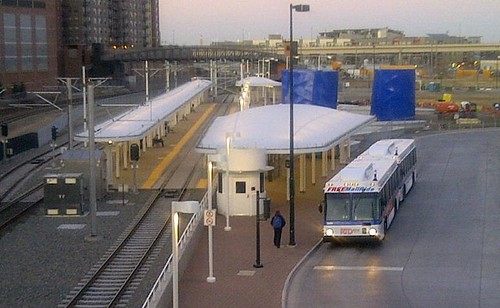
[Multi-modal in Denver at the under-construction hub at Union Station.]

Designing Your Own Unconference


Because there were so many sessions, maybe 10 at a time, everyone's experience was different. I attended a mix of sessions on topics I know something about and others about which I acknowledge total ignorance. So, on the ignorant side, I went to a demonstration of an open trip planner that provides route information for walkers, bikers, wheelchair users and transit riders. Incredibly impressive, especially for bikers because the program allows for input of preferences, but not on a real-time level. For example, for wheelchair users, the program has data about accessible streets and transit entrances and exits, but it does not collect or transmit data that an elevator just went out of service at a particular station. I do not doubt, however, that the techie folks will get there.

I also went to Greening the Suburbs, which connected two DC-exurban planners from far outside different circumference points on the Beltway, to discuss common issues of residents who drove til they qualified for a mortgage and others who want a country-like lifestyle. The question is not preference as the idea of green is popular (where would we be without Kermit?), but how to make green convenient, particularly in relation to travel habits, as that is a prime consideration of people with long commutes and no infrastructure to walk or bike to a convenience or grocery store even if it is only a few blocks away. Arlington's decades-long effort to be a green city/suburb and Houston's decentralized employment nodes were examples discussed. A Houston native said that high energy prices would soon green the suburbs whatever the preferences of their residents, while another decried the huge expenditures to support the expense and costs of the auto-centric lifestyle.

[A Portland tech-savvy bus stop with wait times, seating and protection from precipitation.]

I also went to a session in which a rural Virginia transit employee asked for ideas about promoting and improving transit, particularly for young professionals. Though, like many sessions, conversation veered off course at times, he walked away with suggestions about how to engage transit leadership, market transit and make low-cost improvements that will attract riders.

For a wonderful synopsis of the energy and connections made at Transportation Camp, read today's TransitWire.

Friday, April 15, 2011

How to Get Folks on the Bus

The American Bus Association posts a link to a long article on the Bloomberg Business Week news site about still-growing intercity bus services.

An absolutely fabulous article appears in the Atlantic about convincing commuters to switch to transit. It is an article about cultural change, convenience, meeting needs and making car-free (for at least one major source of trips) seem "cool." Thanks to Chris Zeilinger for the tweet about this.


Mobility Management Conference in Indianapolis on June 6-7, 2011. Sessions will cover the different partnerships that allow for customer-focused and community-generated transit and mobility services. Also, information about livability, one-call/one-click services, statewide perspectives, and employment transportation, among others. The Partnership for Mobility Management is working together to put on the conference. There will be representation from the professional worlds of transit, community transportation services, workforce,
regional planning and state departments of transportation.

President's Deficit Reduction Proposal

Yesterday's New York Times coverage of the President's deficit reduction speech, did not mention transit, high-speed rail or any medical, human service or employment transportation programs. In my pre-vacation mode this morning, I admit that I am not scouring the news sites or Consortium webpages, but there are always news alerts and emails that arrive by this point whenever a major budget-related proposal is made that mentions these programs. The President's speech echoes themes from the bipartisan National Commission on Fiscal Responsibility and Reform. A November 2010 blog post linked to the Commission co-chairs' recommendations, summaries and responses to the Commission's work. The full Commission recommended that the gas tax be increased by 15 cents and would "limit[] spending to actual revenues collected by the trust fund in the prior year once the gas tax is fully phased in." Transit and other non-motor vehicle modes were not mentioned.

Wednesday, March 23, 2011

Older Adults: Challenges of Individual and Public Health

National Association of States United for Aging and Disabilities
NASUAD posts a report with case studies and information about overcoming the barriers to preventive and diagnostic health services for older adults. One of the main barriers identified is transportation. Enhancing Use of Clinical Preventive Services Among Older Adults Closing the Gap gives one intriguing example from New England of co-locating influenza vaccinations with mammograms and providing free transportation.

National Association of Area Agencies on Aging

N4A provides a link to 2011 Alzheimer’s Disease: Facts and Figures, which supplies of plethora of detail about the care that a person needs when suffering with Alzheimer's or other type of dementia. Transportation is mentioned as one need, but this report goes into the home, as it were, to give a picture of the labor intensive, daily tasks that such individuals cannot do without assistance.

Mobility Management


Read mobility management and public participation stories from around the country in the NRC Technical Assistance News. There is truly amazing energy out there for mobility management and coordination.

To learn about mobility management from around the country, attend the Mobility Management Conference on June 6-7, 2011 in Indianapolis. The conference is a collaborative effort of the Partnership for Mobility Management. Plenary sessions will focus on partnerships, for financial sustainability, crossing jurisdictional lines and achieving other goals. Breakout sessions will address specific projects, such as one-call services, medical transportation, livability and employment transportation. A full list is available at http://web1.ctaa.org/webmodules/webarticles/anmviewer.asp?a=2233&z=100.

Events

The National Association of Regional Councils NARC) will be hosting a webinar about emergency preparedness lessons learned from Japan's multi-dimensional disasters that occurred one on top of each other. Sudden Emergency: An Insight into Japan's State of Emergency will be held today, March 23, at 3 p.m. ET.

The Administration on Aging (AoA) is hosting a webinar, Care Transitions in Action: From Hospital to Home in Two Communities, which will explore in depth care transitions partnerships between hospitals and area agencies on aging in two communities. Transportation issues are not specifically mentioned. The webinar will be held on March 30 at 2 p.m. ET.

National Council on Independent Living

NCIL Annual Conference - July 13-16, 2011 in Washington, D.C. The theme is Independence! Keeping our eyes on the prize.

A little background for our transportation work appears in an interesting article about the history of powering automobiles and transit from the Atlantic. Food for thought about energy distribution, marketing, and public relations.

Tuesday, January 11, 2011

Technical Assistance Resources

Joblinks Continues with Mobility Management for Employment Transportation

The Joblinks Employment Transportation Center at the Community Transportation Association of America (CTAA)has an upcoming webinar on Jan. 19 about using mobility management strategies for job access needs. A previous webinar on this topic is archived at http://ctaa.acrobat.com/p41899599/.

New Resources for Rural Transportation

The National Rural Transit Assistance Program (RTAP) releases its revised Emergency Procedures for Rural Transit Drivers training module, which contains a learner’s Guide, a self-paced eLearning course disc, an instructor’s guide, a disc with videos and a trainer’s PowerPoint presentation. These materials can be covered in a single day or over a series of days. The module is presented in stand-alone units designed to meet a multitude of transit agency requirements. It can be used in a classroom setting or by a single student, and is appropriate for both new and experienced transit drivers.

The training guide is also helpful for those who need an overview of emergency types, preparation procedures and responses.

RTAP also announces the relaunch of its peer network by adding mentors as participants. "Mentors are classified as peer participants who engage in long term technical assistance projects." The peer network is now also connected to the National RTAP Resource Center Library. More information is available at http://www.nationalrtap.org/.


Driver Transition Resource in Development

If you have not experienced the transition of a parent or other person close to you from life as a driver to the next step, know that this is an emotional and significant step. For some families this is a smooth transition, but for others there are months or years of worry that a loved one or a stranger will pay the cost of delaying a difficult and unwanted intervention. Having been the recipient of calls about such accidents, fortunately without terrible consequences, I point out the following new resource being developed by the National Center on Senior Transportation. (NCST is a technical assistance center administered by Easter Seals Inc., in partnership with the National Association of Area Agencies on Aging.)

NCST is funding a research project aimed at understanding how older adults think and feel about the mobility transitions in aging. The project has resulted in the production of a tool that will aid mobility counselors and social service professionals to assist older adults and their families to prepare for aging-related changes in mobility. The goal is to promote effective planning for the future and possible transitions.

Contact Lucinda Shannon at LShannon@easterseals.com for more information or to participate as an organization with mobility counselors serving older adults to assist in expanded utilization of the tool.

Technical Assistance News

Today, the NRC Technical Assistance News covers the blogs of the United We Ride Ambassadors and a new monthly NRC Director's column from none other than Chris Zeilinger.

Mobility Management Story


College towns tend to be harbingers of likely developments because what students have they expect in other places after graduation. In this case, University of Toledo students will have the opportunity to use a pre-paid taxi card. The card idea was a bit of a compromise because the taxi credit card technology would not accept the student debit cards, though that will probably be coming soon to some college town. The card system will notify students when balances go below $20 and the college is pushing for more taxi stands. A commercial enterprise is paying for the cards with the bargain of advertising on them. University officials hope that intoxicated students will pose less of a danger to themselves and others. The goal is that taxi availability and ease is one step toward putting the campus on the young, hip, and urban map.

Friday, December 17, 2010

Fiscal Realities Addressed

The Government Accountability Office addresses the current best of times and worst of times for transit - how systems are dealing with increasing in ridership at the same time that costs are going up and public dollars are in short supply. Transit Agencies’ Actions to Address Increased Ridership Demand and Options to Help Meet Future Demand discusses not only the current situation, but also demographic changes, such as a more urban America, popularity of transit and an aging citizenry, that will contribute to expanding ridership for a long time.

In terms of costs, the report examines the expenses of greater demand for transit and the inability of cash-strapped governments to supply the necessary funds. Attention is given to the pleas of transit staff to use funds to maintain a state of good repair. Likewise, streamlining of paperwork for federal programs is also discussed. On a positive note, operators with newer infrastructure and assets are heeding the lessons of old systems that require more funds for maintenance as they age.

Fiscal Report

The National Commission on Fiscal Responsibility and Reform's final report, The Moment of Truth, explicitly addresses transportation and recommends a 15-cent increase in the gas tax. But it goes further, calling for smarter spending.

Under current law, the Transportation Trust Fund has hybrid budget treatment in which contract authority is mandatory, while outlays are discretionary. This hybrid treatment results in less accountability and discipline for transportation spending and allows for budget gimmicks to circumvent budget limits to increase spending. The Commission plan reclassifies spending from the Transportation Trust Fund to make both contract authority and outlays mandatory, and then limits spending to actual revenues collected by the trust fund in the prior year once the gas tax is fully phased in. Shortfalls up until that point would be financed by the general fund.

... ... ...

Congress must limit spending from trust funds to the level of dedicated revenues from the previous year. Before asking taxpayers to pay more for roads, rail, bridges, and infrastructure, we must ensure existing funds are not wasted. The Commission recommends significant reforms to control federal highway spending. Congress should limit trust fund spending to the most pressing infrastructure needs rather than forcing states to fund low-priority projects. It should also end the practice of highway authorization earmarks such as the infamous Bridge to Nowhere.

Not discussed were strategies for making sure better transportation choices, who should make them, performance measurements and mode splits.

The Commission recommends a cap on discretionary outlays, but really seems to desire a different approach to spending. For example, in terms of emergency response, the report suggests a planned budgetary response, instead of ad hoc after-disaster-hits spending. I quote at length here.

Any given disaster may itself be unpredictable, but the need to pay for some level of disaster relief is not. Yet federal budgets rarely set aside adequate resources in anticipation of such disasters, and instead rely on emergency supplemental funding requests. The Commission plan explicitly sets aside funds for disaster relief and establishes stricter parameters for the use of these funds. The disaster fund budget authority (BA) will be limited to the rolling average of disaster spending in the most recent 10 years, excluding the highest and lowest year. Any unused budget authority will be rolled forward to increase the disaster fund BA available in the following year. Any spending above the disaster fund limit must be offset with reductions in spending or subject to a 60-vote point of order (and all other requirements established for regular emergency spending).

The Commission recommends codifying a strict definition of what qualifies as a disaster, and requiring Congress and the President to separately designate spending as an emergency and as necessary for the purposes of disaster response.

The National Response Framework Center at the Federal Emergency Management Administration (FEMA) has technical assistance resources for communities to learn about planning for disaster response and the role of different levels of government.

In terms of redundancy and questionable results of federal expenditures, the report, using the examples of multiple job training and math and science programs, calls for demonstration "to Congress or taxpayers [these programs] are actually accomplishing their intended purpose." Earmarks are expressly singled out as a practice that should be banned, but federal travel, printing, and hiring all receive attention.

Medical costs are discussed in detail, including a repeal or reform of the CLASS Act (Community Living Assistance Services and Supports). It is the Commission's opinion that the program as currently conceived is financially unsustainable. The Commission goes into detail about reforms of Medicare and Medicaid, including use of pilot programs and a long-term global budget for health care. Sections on Social Security, retirement and protecting those disadvantaged by disability and low income are well worth reading.

More Bang for the Buck

One method of addressing fiscal constraints, though certainly not a complete or a magic solution, is mobility management to achieve coordination. The premier digital issue of CT Magazine, Managing Mobility, a publication of the Community Transportation Association of America (CTAA), provides a mobility management primer as well as examples of mobility managers producing results for riders across the country. These examples demonstrate that mobility management can be employed both for transportation-challenged populations and for the public at large for livability purposes.

Thursday, November 4, 2010

Mobility Management: Thinking Mulberry Street (NYC)


Last week I read a terrific synopsis of what mobility management aims for. Rich Weaver of the American Public Transportation Association (APTA) was interviewed in the September issue of the National Center on Senior Transportation (NCST) newsletter and he gave concise summaries of the goals for mobility management and livability. (NCST is a technical assistance center administered by Easter Seals Inc., in partnership with the National Association of Area Agencies on Aging.) He described mobility management as promoting the partnership among "mobility providers," such as transit, vanpools, and other shared-ride services.

Mobility management is a concept that cuts across large and small communities. It looks beyond traditional fixed-route service and works to improve the operation of other transportation resources. Mobility management involves creating partnerships with transportation providers in a community or region to enhance travel options and then developing the means to effectively communicate those options to the public, including seniors.

Think Little Italy

To me, at least today, I am thinking of mobility management as akin to an association for a business district. The two restaurants on the street may be competitors in some sense, but if people don't know where they are, that the disctrict is a destination, or the special atmosphere and activities of the business district, then all the businesses suffer. So, too vanpools might be considered competition for fixed-route service, but not if each has its role in a family of transportation choices. (Or, as my niece was doing recently, taking the Metro someplace in the evening and then, on the way home, getting off at a station with taxis for the last mile.) As an example, if the streets are not pedestrian friendly, then no matter how much transit or other shared modes are environmentally friendly or economically enhancing, then people will not use them.

Mobility Management as a Connecting Concept


What does this have to do with the title of this post? How does mobility management connect to poverty, the environment and their ties to connectivity?

I am seeing reports right and left about changes needed to improve the environment and changes needed to address poverty. Authors of both types of publications are seeing the connection between transit and zero-emission modes (walking and biking) and the environment and equitable economic development. Also starting to happen and I would also like to see more is a more multi-modal approach that incorporates shared private transportation, such as vanpools, carpools and slugging, as well as taxis and flex car services. A few publications are even addressing how parking policies affect transportation choices.

Mobility management means partnering across modes and types of public interests. Just like the different types of businesses I am picturing from Little Italy, which banded together to create a brand that now attracts busloads of tourists and a few locals (okay once the tourists come, it's not cool anymore and New Yorkers, like high school kids, have moved on), fans of transit and alternative modes must band together to promote themselves as a family of services that provide environmentally friendly and economically-enhancing transportation options.

With all the Little Italy talk I am not nostalgic for Luna's, the old whole-in-the-wall restaurant that had zero atmosphere and amazing food. Plus, I feel proud to have successfully inserted a photo.