Transportation Camp - Why Go?
Why get out of bed early on a Saturday morning in the middle of the winter - decidedly not summer camp weather - to leave your partner (if you have one), children (if you have them), pets (if you have them) and absolve yourself of all adult responsibility and the comforts of routine and loved ones to spend an entire day in windowless rooms - also not camp like - to discuss all aspects of transportation with 300 people, many of whom describe themselves as transportation geeks? Why attend an unconference, an event where there are no keynote speakers, predetermined sessions, experts, bios or daises?
Why? Because you will have fun - yes, it's camp - with people excited about walkable streets, better transit, open data, paratransit, bikesharing, bus rapid transit plans, and social media use by, for and perhaps with some hostility to transit. Indeed, upon arrival (without trunk, duffel bags, parents, or junk food), one does not even know what is on the program. But like any returning camper, one knows and sees friends, some from previous stays at camp and some from other venues - in this case twitter, normal conferences, and actual work. (Apologies to any twitter friends not recognized from those tiny twitter photos.)
Indeed, as Transportation Camp is an unconference, the campers suggest what will be discussed and offer their own expertise as speakers or as bunch of nerds interested in talking about something. Some come bearing presentations, cameras, tablets, and laptops; others admit they are concerned citizens without a resume and curious. Some come alone and others with lots of colleagues.
[Attendees reading session ideas posted on colorful, large post-its.]
And what actually happens at the camp social?
Not that anyone was flirting in the social hall or hanging out by the big tree at the lake (wait, that's actual camp), but one sees lots of connections being made, as if data, social media, transit, biking, walking soul mates are finding each other. I saw colleagues and friends from Ithaca, Iowa, Portland, and Boston, and met people from practically my own backyard interested in some of the same hometown (though inside the Beltway) issues. I think half of the
San Francisco DOT attended camp in Arlington. There were also a bunch of
mobility management professionals, some there to promote ideas, some
seeking ideas, and all wanting to share.
In terms of quality, sessions vary from amazing to "I should have chosen something else," with my own experience much more toward the former. As there are only four sessions over the course of the day and about 10 offerings during each time slot, there is often heard the cheerful complaint of an embarrassment of rich choices. If cloning were possible, ...
[Possible offerings displayed. Yes, this photo is intentionally gigantic so that some of the post-its can be read.]
One could easily have spent the entire day immersed in a virtual "track" of data sharing, open source, apps and other things that normal people (translation: someone like me) know little or nothing about. Instead, I chose a variety of different topics - (1) Transit social media engagement (with both the rider and the transit agency perspectives discussed), (2) universal design advocacy and planning for streets and transportation to suit all users (particularly people with disabilities), (3) sharing big ideas, and (4) bus rapid transit (BRT) plans and politics in the DC area.
Rural Roads Meet the Jetsons, Sort of?
What were some big ideas? Cost-effective personal rapid transit for rural areas; walkable streets - with access to transit - in suburban and rural areas; pre-purchased annual transportation with a menu of transportation choices (to replace one or more privately-owned vehicles). There were a ton more; that's just the tiniest of samples.
At the BRT session, a gentleman from Ireland supplied this DC-area crowd with a list of cities around the world with bus systems worthy of comparison.* Another gentleman, originally from suburban Maryland, talked about his BRT planning experiences in Brazil. Montgomery County's Rapid Transit Vehicle (RTV) plan was discussed in detail, including the role of the planning and transportation departments, which, by the way, report to different entities (the former reporting to the county council and the latter to the county executive). Other DC-area BRT activity described included Arlington, Howard and Prince William counties, with some of those more akin to express commuter services.
One Person's Mobility Experiences
The universal design session was led by a person who travels in a wheelchair and the session was very much informed by the her experiences, in terms of using the pedestrian network and transit, as well as advocacy and maintaining relationships with political leaders and other types of advocacy groups. She mentioned biking groups as one example of stakeholders that can be useful for people with disabilities in pushing for universal design and multi-modal streets. A controversy arose during the session about expertise of planners versus advocacy of residents and which deserves more weight, though most of the session was conducted in the spirit of building relationships with various stakeholders rather than a zero-sum game of right and wrong.
The social media session I attended (and there were quite a few offered) concentrated on twitter - from the perspective of the complaining rider and the transit agency. Effective engagement strategies were discussed rather than mere whining about service. At the center of the session was discussion about building relationships with staff at the transit agency and how to do that. Sometimes those tweeting interactions become actual relationships.
Tell your parents to sign you up for camp next year, or sign up yourself. Next camp is coming up soon in Atlanta - in February - another decidedly un-camp-like time of year. If we have camp in July, my porch is open for a front row seat at the Takoma Park July Fourth Parade. I'll even make bug juice.
*Cities with bus networks mentioned were Almere (Netherlands), Melbourne, Helsinki, Gothenburg (Sweden), and Nantes (France).
Showing posts with label Rural. Show all posts
Thursday, January 17, 2013
Monday, January 23, 2012
Transportation Camp
A camp that does not require or supply duffel bags, trunks, bunks, tents, swim instruction, or counselors, Transportation Camp is an unconference - no pre-planned sessions or experts - with transit, alternative mode, planner and data, self-described geeks gathering for a day of exchanging ideas and learning.
I met friends from the worlds of transit technical assistance, mobility management, and the Federal Transit Administration (FTA). I also ran into people whom I had not met before, but have been in contact with through twitter and blogs. Two surprises were meeting TransitWire (Susan Bregman, who started the blog/twitter service as a Transit Cooperative Research Program (TCRP) project) (I felt like I was meeting a transit celebrity) and someone from Austria who knows all about mobility management in the European Union and pointed me to performance measures developed in Sweden. There were even a couple of people from my neighborhood who are involved in local transit and alternative mode issues.
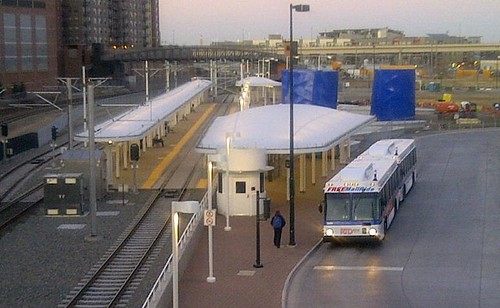
[Multi-modal in Denver at the under-construction hub at Union Station.]
Designing Your Own Unconference
Because there were so many sessions, maybe 10 at a time, everyone's experience was different. I attended a mix of sessions on topics I know something about and others about which I acknowledge total ignorance. So, on the ignorant side, I went to a demonstration of an open trip planner that provides route information for walkers, bikers, wheelchair users and transit riders. Incredibly impressive, especially for bikers because the program allows for input of preferences, but not on a real-time level. For example, for wheelchair users, the program has data about accessible streets and transit entrances and exits, but it does not collect or transmit data that an elevator just went out of service at a particular station. I do not doubt, however, that the techie folks will get there.
I also went to Greening the Suburbs, which connected two DC-exurban planners from far outside different circumference points on the Beltway, to discuss common issues of residents who drove til they qualified for a mortgage and others who want a country-like lifestyle. The question is not preference as the idea of green is popular (where would we be without Kermit?), but how to make green convenient, particularly in relation to travel habits, as that is a prime consideration of people with long commutes and no infrastructure to walk or bike to a convenience or grocery store even if it is only a few blocks away. Arlington's decades-long effort to be a green city/suburb and Houston's decentralized employment nodes were examples discussed. A Houston native said that high energy prices would soon green the suburbs whatever the preferences of their residents, while another decried the huge expenditures to support the expense and costs of the auto-centric lifestyle.
[A Portland tech-savvy bus stop with wait times, seating and protection from precipitation.]
I also went to a session in which a rural Virginia transit employee asked for ideas about promoting and improving transit, particularly for young professionals. Though, like many sessions, conversation veered off course at times, he walked away with suggestions about how to engage transit leadership, market transit and make low-cost improvements that will attract riders.
For a wonderful synopsis of the energy and connections made at Transportation Camp, read today's TransitWire.
Wednesday, November 2, 2011
NARC Speaks Up for Rural Development Funding
National Association of Regional Councils
In a letter to the Senate dated Oct. 31, NARC opposes Senator Coburn's proposed amendment to the Agriculture Appropriations Bill for Fiscal Year 2012, which NARC maintains would reduce Fiscal 2012 federal rural development spending by $1 billion or about 40 percent. Rural development funds pay for such programs as expansion of rural broadband and clean drinking water facilities. NARC states:
The amendment sponsored by Senator Coburn will further decimate an agency and programs already hard hit by budget cuts. In recent years, Congress and the Administration have repeatedly reduced annual appropriations for rural development. The FY 12 level recommended in the Senate’s version of H.R. 2112 is some $175 million below the FY 11 rate. Between 2003 and 2011, appropriations for rural water sewer, business programs and community facilities were cut by 30% and rural housing direct lending and related grant programs by over 50%.
The Coburn amendment will not only curtail improvements in housing, water and waste facilities, broadband deployment, and economic opportunity; it has the potential to displace thousands of families living in rural rental housing developments. The Senate bill contains appropriations to renew 205,000 expiring rural rental assistance contacts. The Coburn amendment requires that each rural development account is proportionately reduced (by 40%) to achieve a $1 billion reduction. Over 80,000 rural families – all of whom are low-income and most of whom are elderly or persons with disabilities – will face almost certain loss of their apartments if the amendment is approved and their rental assistance is terminated.
Friday, July 1, 2011
Planning for Emergencies and Disaster Response
On Wednesday morning, members of the National Consortium on the Coordination of Human Services Transportation engaged in a colloquium about emergency planning and disaster response, both in general and in particular regarding transportation, transportation providers, and transportation-challenged populations and areas. The speakers were Sheryl Gross-Glaser of the National Resource Center for Human Service Transportation Coordination (NRC) (a technical assistance center housed at the Community Transportation Association of America (CTAA)), Virginia Dize and Jo Reed of the National Association of Area Agencies on Aging (N4A), and Patricia Monaghan of the National Rural Transit Assistance Program (RTAP).
To understand the different types and categorization of emergencies and disasters, and preparedness, a good concise guide is the Federal Transit Administration (FTA) Introduction to All-Hazards Preparedness for Transit Agencies.
Never Introduce Yourself at the Disaster
"Never introduce yourself at the disaster" was a terrific soundbite from a recent FEMA (Federal Emergency Management Administration) webinar. Richard Devylder, Senior Advisor for Accessible Transportation at the U.S. Department of Transportation, gave this advice. It is too late to be involved in planning for emergency response when disaster hits and even at the point where officials are looking for endorsement of a plan.
Early and Often Involvement
Unlike voting, involvement in emergency planning should be early and often, counsels Devylder (who did not refer to voting). Involvement while a plan is being crafted ensures that preparedness actively includes populations beyond those of average age and abilities.
[Central Park South yesterday was full with pedicabs, taxis, buses, cyclists and walkers (left out of the photograph).]
After Hurricane Katrina's disproportionate impact on older adults (47 percent of the people who died were 75 or older), area agencies on aging (AAAs) are participating in emergency preparedness by providing information, establishing partnerships, providing communications links, outreach and services in the event of a disaster. (More information about AAA participation in emergency preparedness and response is available in an N4A 2009 survey.)
Redundant and Universal Communication
Also mentioned during the webinar, which is not currently archived, was the wisdom of redundant communications in multiple formats and with attention paid to those with communication challenges, such as people with visual or auditory impairments. Information provided in visual updates, such as maps or information scrolled at the bottom of a screen, or announcements via radio or television, should be duplicated in other formats.
[A bus stop on Broadway, about 63rd St. The new shelters are chic, though not hi-tech like the Portland ones.]
Building in Redundancies for an Imperfect World
Since no one measure is perfect to identify and keep track of who will need assistance, transportation, health-related or otherwise, redundancy in identification and monitoring is necessary. No one system of determining need - before or during an emergency - will be completely accurate. There will be people who are injured or disoriented during a disaster who were perfectly well beforehand and who would not show up on a registry. Likewise, depending on time of day, many children who do not usually have transportation challenges would be unsupervised and in need of assistance.
For example, we discussed the value of registries for meeting the needs of transportation-challenged individuals. Both N4A and CTAA include the development and use of registries in their recommendations. A participant in the FEMA webinar, June Isaacson Kailes, Disability Policy Consultant/Associate Director at Western University in California, spoke against reliance on registries because she believes that they provide a false security to registrants, who assume that registering means that the government will be taking care of them, and they provide no service to those who fail to register, whether out of ignorance, distrust of the government, or privacy concerns.
Kailes recommends that governments assess what will be needed and in what amounts to keep people independent and in good health - wheelchairs, medications, vehicles, meals, health aides - based upon the demographics. Jo Reed of N4A described door hanger notification systems that residents can hang outside to indicate whether they are fine or need assistance. As Reed's door hangers suggest, notification of need can be inexpensive and will supplement whatever other monitoring or identification systems are in place.
The Model of AAAs
Other examples of AAA involvement in preparedness are :
* Florida's emergency communications network, its plans for people with disabilities and home health care, and its registries;
* Iowa's requirement that local transportation providers have emergency plans; and
* A rural Colorado area's designation of the AAA as the designated emergency transportation provider.
Numbers Speak
Jo Reed spoke about emergency planning findings in the 2011 Maturing of America survey of local governments, last performed in 2005. An exception to a general finding of lack of assessment and preparation for the greater number of older adults in the future was the tremendous increase in specialized training to handle older adult needs in emergencies. However, a smaller percentage of communities than in 2005 were planning for evacuations of older adults or had systems in place to track where older adults reside.
Patti Monaghan discussed the relevant RTAP products, two updated training resources. The highest attendance numbers for an RTAP webinar was the one held about its emergency procedures training, demonstrating the substantial interest in this topic. Patti also noted the current preparation of a TCRP handbook for emergency preparedness.
Resources
CTAA:
On the CTAA website is the Transportation and Emergency Preparedness Checklist, which organizes the planning and response measures that community, regional and state leaders, as well as stakeholders, should be paying attention to. Training and information are available for planning and response from the National Incident Management Systems (NIMS) resource center and the Incident Command System.
The NRC has an Emergency Preparedness and Response Bookshelf with resources that focus on populations with special needs. CTAA also maintains a webpage with emergency preparedness resources.
RTAP:
Emergency Procedures for Rural Transit Drivers - a training module.
Threat and Vulnerability Toolbox.
Personal Notes
Special thanks to Kelly Shawn of CTAA for his assistance in discussing important emergency preparedness issues and resources and thanks to Patti Monaghan for discussing RTAP's resources and Hal Morgan for bringing and discussing the FTA All-Hazards publication.
I have seen some disasters and potential disasters in New York, one of which was the blackout of 2003 that affected the whole Northeast. I visited an apartment house that was a naturally occurring retirement community. Many people could not get to their apartments and others could not walk down the stairs and to go out of the building. Staff and neighbors knocked on all doors, retrieved medications (some from apartments on the 20th floor and above), arranged for meals, and made people in their 80s and 90s comfortable for a night spent in the lobby. Most everyone else walked up the stairs to their apartments or spent the night elsewhere. I saw police officers calmly direct traffic on streets filled with both packed vehicles of all types and pedestrians (some barefoot and carrying their high heels). The Port Authority bus terminal recreated itself outside on 43rd Street.
Every disaster is unique, but what remains the same is that there are special challenges to getting through an emergency and its aftermath being older, living with a significant disability, or living in a rural community. Neighborliness, flexibility and ingenuity all have a place, but preparedness makes a big difference.
Tuesday, May 3, 2011
Reauthorization and Other Perspectives on the Future of Mobility Choices
National Conference of State Legislatures
NCSL, in partnership with the National Governors Association (NGA), the National Association of Counties (NACo) and the National League of Cities (NLC), issues a statement of principles for moving forward with transportation reauthorization legislation. "'State and local governments are responsible for 97 percent of the nation’s interconnected surface transportation systems and contribute nearly 75 percent of the annual cost to operate and maintain those systems,' said NGA Executive Director Dan Crippen."
Among others, the principles include:
1. "[T]he continuation of the “user pays” principle to guide transportation funding" with opposition to federally mandated prescriptions of sub-federal authority over demand-side strategies.
2. Stable funding for "reliable, long-term funding certainty" so that state and local governments can execute long-term, multi-year projects.
3. "[M]aximum federal surface transportation program and funding flexibility given our diversity of geography, population, and priorities" and opposition to earmarks.
4. Streamlining of processes to reduce project approval and completion time.
5. "[S]trong federal role in funding transportation solutions for metropolitan and non-metropolitan areas across the country" to address connectivity and congestion issues.
6. Clear, "outcome-oriented performance measures."
National Governors Association
NGA provides a new page on its website entitled "Redesigning State Government," with information about how different states are coping with lean fiscal conditions.
Paralyzed Veterans of America
PVA celebrates accessible design and mobility with its 2011 Accessible City Award going to sixth, seventh and eighth graders from St. Thomas More School in Baton Rouge, LA.
The Current State of Rural Transit
For a realistic snapshot of rural transportation generally - including transit, intercity service and human services transportation - read Rethinking Federal Investments in Rural Transportation: Rural Considerations Regarding Reauthorization of the Surface Transportation Act, produced by the Rural Policy Research Institute (RUPRI). In a nutshell, the report states:
NCSL, in partnership with the National Governors Association (NGA), the National Association of Counties (NACo) and the National League of Cities (NLC), issues a statement of principles for moving forward with transportation reauthorization legislation. "'State and local governments are responsible for 97 percent of the nation’s interconnected surface transportation systems and contribute nearly 75 percent of the annual cost to operate and maintain those systems,' said NGA Executive Director Dan Crippen."
Among others, the principles include:
1. "[T]he continuation of the “user pays” principle to guide transportation funding" with opposition to federally mandated prescriptions of sub-federal authority over demand-side strategies.
2. Stable funding for "reliable, long-term funding certainty" so that state and local governments can execute long-term, multi-year projects.
3. "[M]aximum federal surface transportation program and funding flexibility given our diversity of geography, population, and priorities" and opposition to earmarks.
4. Streamlining of processes to reduce project approval and completion time.
5. "[S]trong federal role in funding transportation solutions for metropolitan and non-metropolitan areas across the country" to address connectivity and congestion issues.
6. Clear, "outcome-oriented performance measures."
National Governors Association
NGA provides a new page on its website entitled "Redesigning State Government," with information about how different states are coping with lean fiscal conditions.
Paralyzed Veterans of America
PVA celebrates accessible design and mobility with its 2011 Accessible City Award going to sixth, seventh and eighth graders from St. Thomas More School in Baton Rouge, LA.
The team took a comprehensive approach to accessibility: the blind had chips embedded on the side of their heads that allowed them to perceive figures so they would not bump into things. An integrative transportation system provided easy transitioning for people in wheelchairs and also sensed when passengers were waiting to board, stopping for them without being summoned.What impressed the judges was the universality of the team's approach. Their concept of accessibility included people in wheelchairs and strollers, as well as those with physical and sensory challenges. What impresses me is the promise of technological advances and design innovations for making transportation more accessible to wider range of individuals.
The Current State of Rural Transit
For a realistic snapshot of rural transportation generally - including transit, intercity service and human services transportation - read Rethinking Federal Investments in Rural Transportation: Rural Considerations Regarding Reauthorization of the Surface Transportation Act, produced by the Rural Policy Research Institute (RUPRI). In a nutshell, the report states:
There are about 1,200 systems operating in half of rural counties nationwide, but they tend to be local in nature, and generally not connected to regional and national passenger systems. Thirty-eight percent of rural residents live in areas with no public transit. There are also 3,700 systems specifically for the elderly and people with disabilities, and others operated by human services agencies.Add to the many logistical challenges the reality that many rural areas do not have access to professional staff or sufficient staff to handle their transportation and mobility challenges. Though only one piece of the economic development puzzle, transportation is described as a threshold item for local and regional economic success. The report supports local planning to increase transportation options and suggests that "[t]ransportation funding and planning should be measured against outcomes rather than uniform standards." Helpful charts are provided that categorize the challenges for different types of rural areas.
Tuesday, March 8, 2011
Policies and Funding for Rural and Coordinated Transportation Options
Community Transportation Association of America (CTAA)
CTAA has on its homepage a collection of materials that declare the benefits of rural transportation services, including rural public transit, and an explanation of the history and scope of Medicaid's non-emergency transportation (NEMT) benefit.
American Bus Association (ABA)
ABA responds to the Obama Administration's recommendation for funding to develop a high-speed rail network with a reminder that intercity bus travel is a far less expensive form of long-distance publicly-available transportation.
Quoting from the ABA publication, the Insider, the association declares:
The Insider article emphasizes the importance of motorcoach service to rural Americans. Bus service still covers a much greater proportion of rural residents than current or projected train lines.
Detailed Look at Coordination of Government Programs
In his NRC Capitol Clips post on March 4, Chris Zeilinger, the Director of the National Resource Center for Human Service Transportation Coordination (NRC), does a terrific job of summarizing and examining the findings of the recent Government Accountability Office report, Opportunities to Reduce Potential Duplication in Government Programs, Save Tax Dollars, and Enhance Revenue. The blog finds in the report strong evidence to support coordination of government services. The report is well worth reading and transportation coordination is addressed at pages 48-50, which will appear as 53-55 in your pdf toolbar, and discussion of coordination for the transportation-challenged appears at 134-138 (appearing as 139-143).
Speaking of coordination, I read an interesting opinion blog in the New York Times online edition about coordination to improve education for low-performing public school systems. Coming Together to Give Schools a Boost talks about strong coordinating organizations and partners with clear goals and a focus on performance measures. I will not say that the strategies mentioned should be transferred to transit and transportation services, but the model is worth considering for its comprehensiveness and the honest assessment of its proponents that new methods were needed.
CTAA has on its homepage a collection of materials that declare the benefits of rural transportation services, including rural public transit, and an explanation of the history and scope of Medicaid's non-emergency transportation (NEMT) benefit.
American Bus Association (ABA)
ABA responds to the Obama Administration's recommendation for funding to develop a high-speed rail network with a reminder that intercity bus travel is a far less expensive form of long-distance publicly-available transportation.
Quoting from the ABA publication, the Insider, the association declares:
"We're asking lawmakers to invest in motorcoach transportation," said ABA President and CEO, Peter J. Pantuso, CTIS. "Even under the best circumstances, a high-speed rail network will not become a reality for years. Motorcoaches are here today. We cost a tiny fraction of what high-speed rail will cost. We are environmentally friendly, and we provide service to rural Americans that high-speed rail will never be able to reach. When you look at all of that, it just makes sense to go with the motorcoach."
The Insider article emphasizes the importance of motorcoach service to rural Americans. Bus service still covers a much greater proportion of rural residents than current or projected train lines.
Detailed Look at Coordination of Government Programs
In his NRC Capitol Clips post on March 4, Chris Zeilinger, the Director of the National Resource Center for Human Service Transportation Coordination (NRC), does a terrific job of summarizing and examining the findings of the recent Government Accountability Office report, Opportunities to Reduce Potential Duplication in Government Programs, Save Tax Dollars, and Enhance Revenue. The blog finds in the report strong evidence to support coordination of government services. The report is well worth reading and transportation coordination is addressed at pages 48-50, which will appear as 53-55 in your pdf toolbar, and discussion of coordination for the transportation-challenged appears at 134-138 (appearing as 139-143).
Speaking of coordination, I read an interesting opinion blog in the New York Times online edition about coordination to improve education for low-performing public school systems. Coming Together to Give Schools a Boost talks about strong coordinating organizations and partners with clear goals and a focus on performance measures. I will not say that the strategies mentioned should be transferred to transit and transportation services, but the model is worth considering for its comprehensiveness and the honest assessment of its proponents that new methods were needed.
Tuesday, January 25, 2011
Winter Hibernation: Cuddle Up with Blueprint America Series and Economic Development Opportunities
Blueprint America, the PBS series about infrastructure in the United States, has some videos and reports archived that provide some interesting watching and reading for transit geeks. There are reports about competing ideas about what infrastructure to invest in, what type of transportation will create job growth, and mobility options that promote public health.
With some popcorn, a blanket and some hot chocolate, this might serve constitute work on one of those upcoming snow days - not that I would personally do that. Confession: Yes, I already watched one infrastructure documentary on a work-at-home day, but that was during lunch (soup, if I remember correctly).
Economic Development
Community Transportation Association of America (CTAA)
The Rural and Tribal Passenger Transportation Technical Assistance Programs are inviting applications for long-term technical assistance projects. These projects help rural communities enhance economic growth and development by improving passenger transportation services and facilities. Technical assistance provides planning to support transit service improvements and expansion, system start-up, facility development, development of marketing plans and materials, transportation coordination, training and other public transit problem solving activities. Technical Assistance is provided by CTAA staff and consultants and involves on-site and off-site work conducted over a period of eight to twelve months. No local match is required. Information is available at http://web1.ctaa.org/webmodules/webarticles/anmviewer.asp?a=49&z=5.
National Association of Regional Councils (NARC)
On Feb. 8, 2011, at the 2011 Good Jobs Green Jobs Conference, NARC and its Pathways Out of Poverty project team will present a workshop on the importance of partnerships in regional workforce and economic development programs, entitled “Partnerships and Pathways: Keys to Success in Regional Green Jobs Training and Placement.” This will be a forum for sharing ideas and strategies for building a green economy that creates good jobs, reduces global warming and other environmental problems, and secures America’s economic and environmental future.
Tuesday, January 11, 2011
Technical Assistance Resources
Joblinks Continues with Mobility Management for Employment Transportation
The Joblinks Employment Transportation Center at the Community Transportation Association of America (CTAA)has an upcoming webinar on Jan. 19 about using mobility management strategies for job access needs. A previous webinar on this topic is archived at http://ctaa.acrobat.com/p41899599/.
New Resources for Rural Transportation
The National Rural Transit Assistance Program (RTAP) releases its revised Emergency Procedures for Rural Transit Drivers training module, which contains a learner’s Guide, a self-paced eLearning course disc, an instructor’s guide, a disc with videos and a trainer’s PowerPoint presentation. These materials can be covered in a single day or over a series of days. The module is presented in stand-alone units designed to meet a multitude of transit agency requirements. It can be used in a classroom setting or by a single student, and is appropriate for both new and experienced transit drivers.
The training guide is also helpful for those who need an overview of emergency types, preparation procedures and responses.
RTAP also announces the relaunch of its peer network by adding mentors as participants. "Mentors are classified as peer participants who engage in long term technical assistance projects." The peer network is now also connected to the National RTAP Resource Center Library. More information is available at http://www.nationalrtap.org/.
Driver Transition Resource in Development
If you have not experienced the transition of a parent or other person close to you from life as a driver to the next step, know that this is an emotional and significant step. For some families this is a smooth transition, but for others there are months or years of worry that a loved one or a stranger will pay the cost of delaying a difficult and unwanted intervention. Having been the recipient of calls about such accidents, fortunately without terrible consequences, I point out the following new resource being developed by the National Center on Senior Transportation. (NCST is a technical assistance center administered by Easter Seals Inc., in partnership with the National Association of Area Agencies on Aging.)
NCST is funding a research project aimed at understanding how older adults think and feel about the mobility transitions in aging. The project has resulted in the production of a tool that will aid mobility counselors and social service professionals to assist older adults and their families to prepare for aging-related changes in mobility. The goal is to promote effective planning for the future and possible transitions.
Contact Lucinda Shannon at LShannon@easterseals.com for more information or to participate as an organization with mobility counselors serving older adults to assist in expanded utilization of the tool.
Technical Assistance News
Today, the NRC Technical Assistance News covers the blogs of the United We Ride Ambassadors and a new monthly NRC Director's column from none other than Chris Zeilinger.
Mobility Management Story
College towns tend to be harbingers of likely developments because what students have they expect in other places after graduation. In this case, University of Toledo students will have the opportunity to use a pre-paid taxi card. The card idea was a bit of a compromise because the taxi credit card technology would not accept the student debit cards, though that will probably be coming soon to some college town. The card system will notify students when balances go below $20 and the college is pushing for more taxi stands. A commercial enterprise is paying for the cards with the bargain of advertising on them. University officials hope that intoxicated students will pose less of a danger to themselves and others. The goal is that taxi availability and ease is one step toward putting the campus on the young, hip, and urban map.
Monday, November 8, 2010
Emergency Evacuations
The newsletter of the National Association of Development Organizations (NADO) , Rural Transportation News, announces two reports relevant to emergency evacuations in rural areas. Both are available at www.evacuationandtransportation.org. The newsletter gives an in-depth summary of the reports. One examines the capacity of transit and school buses to provide transportation during emergency evacuations in places like the Gulf Coast, where many rural residents do not have cars and hurricanes are a fact of life, making evacuations a seasonal routine. The report also covers coordination and communications.
The other report looks into workforce, operating budget, and communication in rural evacuations. The evacuations discussed n this publication involve moving people from urban areas into rural ones.
From the Archives
Here are some emergency management resources from my old newsletter, with valuable input from Kelly Shawn of the Community Transportation Association of America (CTAA).
National Resource Center for Human Service Transportation Coordination (NRC), housed at CTAA:
The NRC website has a page, Emergency Preparedness and Response, with many resources listed. These include materials about emergency evacuation, planning and reentry. Especially noteworthy is Evacuating Populations With Special Needs - Routes to Effective Evacuation Planning Primer Series and Transportation's Role in Emergency Evacuation and Reentry.
CTAA’s Emergency Management Resource Alert page has a wealth of resources listed that address specific vulnerable populations, coordination, rural areas, planning organizations, case studies and more. Also available from CTAA are the presentations from the 2008 Emergency Evacuation Conference.
Interagency Coordinating Council on Emergency Preparedness and Individuals with Disabilities:
This council has a host of materials, including a couple of items we developed at the NRC, on its web site at http://www.dotcr.ost.dot.gov/asp/emergencyprep.asp.
House Infrastructure and Transportation Committee summary of a hearing, U.S. Mayors Speak Out: Addressing Disasters in Cities about H.R. 3377, the Disaster Response, Recovery, And Mitigation Enhancement Act of 2009. (This legislation has not yet moved forward in either the House or the Senate.)
Future resources
Due out next year is TRB’s A-33 – Communication with Vulnerable Populations: A Transportation and Emergency Management Toolkit.
September 2011 – TCRP A-33: Communication with Vulnerable Populations: A Transportation and Emergency Management Toolkit. Interim report due out in September 2010.
October 2011 - TCRP A-37 [RFP]: Paratransit Emergency Preparedness and Operations Handbook
September 2012 (approximately) – TCRP A-36 [RFP]: Command-Level Decision Making for Transit Emergency Managers
Friday, October 1, 2010
Big Plans
From small to large public transportation systems, recent announcements are reminiscent of the Daniel Burnham quote, “Make no little plans; they have no magic to stir men's blood.... Make big plans... aim high in hope and work.”
Last night, the PBS NewsHour profiled rural transit in Natchez, Miss., and the plans to build a better system that will attract many more riders. Charles Carr, director of transit services, Mississippi Department of Transportation and President of the Community Transportation Association of America (CTAA) was asked to respond to arguments that subsidies are required to fund public transit. Carr replied that subsidies are used for rail and air travel as well as roads.
Natchez Transit's director, Sabrina Bartley, plans to expand service to underserved areas, start fixed-route service, and coordinate service in 13 counties.
A Bos-Wash Dream
On the other side of the spectrum, a large sytem, Amtrak, declares its plans for high-speed service along the Northeast Corridor (NEC). None other than the Secretary of Transportation praised the unprecedented regional partnership in his blog post this morning. The NEC plan envisions trips from Washington to Boston in 3 hours and 23 minutes (compared to the current 8 hours on Amtrak's Northeast Regional trains or 6 hours and 37 minutes on Acela Express), with 220 mile-per-hour service between the major cities along the corridor. More information is available from the Potomac Express and from the Philadelphia Enquirer at http://www.philly.com/inquirer/home_top_stories/20100929_Amtrak_rolls_out_ambitious__high-speed_service_plan.html.
What's the common denominators for implementation of ambitious plans in the rural Natchez area and the states and cities along the NEC? Champions will be needed to persist in seeing the plans through and coordination at the county, state and regional levels.
Economic Message
The message that many see in ambitious public transportation plans is the creation of jobs, increasing employment within transit systems and in the communities that it serves.
The Natchez Transit director speaks of attracting business. Employers, she says, are always interested in whether their employees can get to work. For Amtrak and those supporting the NEC plan, there are estimates that thousands of jobs could be created. Amtrak's president, Joseph Boardman, says that the new high-speed rail corridor's bridges, tunnels, and stations "would create 40,000 full-time jobs per year over 25 years" and planners estimate 120,000 new permanent jobs would result from improved economic productivity along the corridor.
Green Jobs
Ambitious plans are not limited to local and intercity transportation. According to the National Association of Regional Councils (NARC), a green economy incorporates transit and coordination among regional sectors. In its discussion of green jobs in a letter to the Department of Labor, NARC points out the Kansas City regional plan. (The Department of Labor definition of
green jobs contemplates public transit.)
Legislation
To encourage the use of commuter transit and keep it on par with driving, the American Public Transportation Association (APTA) is urging its members to contact Congress to extend the commuter tax benefit for transit riders. APTA writes in its legislative update,
APTA is asking Congress to either extend ARRA's higher commuter tax benefit or to "permanently equalize the transit benefit and parking benefit."
Last night, the PBS NewsHour profiled rural transit in Natchez, Miss., and the plans to build a better system that will attract many more riders. Charles Carr, director of transit services, Mississippi Department of Transportation and President of the Community Transportation Association of America (CTAA) was asked to respond to arguments that subsidies are required to fund public transit. Carr replied that subsidies are used for rail and air travel as well as roads.
Natchez Transit's director, Sabrina Bartley, plans to expand service to underserved areas, start fixed-route service, and coordinate service in 13 counties.
A Bos-Wash Dream
On the other side of the spectrum, a large sytem, Amtrak, declares its plans for high-speed service along the Northeast Corridor (NEC). None other than the Secretary of Transportation praised the unprecedented regional partnership in his blog post this morning. The NEC plan envisions trips from Washington to Boston in 3 hours and 23 minutes (compared to the current 8 hours on Amtrak's Northeast Regional trains or 6 hours and 37 minutes on Acela Express), with 220 mile-per-hour service between the major cities along the corridor. More information is available from the Potomac Express and from the Philadelphia Enquirer at http://www.philly.com/inquirer/home_top_stories/20100929_Amtrak_rolls_out_ambitious__high-speed_service_plan.html.
What's the common denominators for implementation of ambitious plans in the rural Natchez area and the states and cities along the NEC? Champions will be needed to persist in seeing the plans through and coordination at the county, state and regional levels.
Economic Message
The message that many see in ambitious public transportation plans is the creation of jobs, increasing employment within transit systems and in the communities that it serves.
The Natchez Transit director speaks of attracting business. Employers, she says, are always interested in whether their employees can get to work. For Amtrak and those supporting the NEC plan, there are estimates that thousands of jobs could be created. Amtrak's president, Joseph Boardman, says that the new high-speed rail corridor's bridges, tunnels, and stations "would create 40,000 full-time jobs per year over 25 years" and planners estimate 120,000 new permanent jobs would result from improved economic productivity along the corridor.
Green Jobs
Ambitious plans are not limited to local and intercity transportation. According to the National Association of Regional Councils (NARC), a green economy incorporates transit and coordination among regional sectors. In its discussion of green jobs in a letter to the Department of Labor, NARC points out the Kansas City regional plan. (The Department of Labor definition of
green jobs contemplates public transit.)
Mid-America Regional Council (MARC) is the multi-faceted regional planning organization representing the Kansas City bi-state region (Missouri and Kansas). MARC is a leader in developing Kansas City’s Green Impact Zone, an effort to concentrate resources — with funding, coordination, and public and private partnerships — in one specific area to demonstrate that a targeted effort can literally transform a community. This national model for place-based investment is now underway in the heart of Kansas City's urban core and has received significant federal recognition and funding. At the heart of the Green Impact Zone initiative is a project that would put area residents to work weatherizing the 2,500 homes in the zone’s neighborhoods. Another piece calls for development of a green bus rapid-transit system that would include bio-diesel buses and green bus shelters. A third piece would provide job training and employment programs for ex-parolees in green building, park restoration and transit work. The Green Impact Zone project will include an employment and training program coordinated both with zone activities and business interests outside of the zone.
Legislation
To encourage the use of commuter transit and keep it on par with driving, the American Public Transportation Association (APTA) is urging its members to contact Congress to extend the commuter tax benefit for transit riders. APTA writes in its legislative update,
Under ARRA, the transit/vanpool portion of the benefit was increased to $230 per month, treating each mode of transportation as equal. This provision is set to expire on December 31, 2010, and without an extension, the transit tax benefit would be reduced by more than half to the previous $120 per month amount.
APTA is asking Congress to either extend ARRA's higher commuter tax benefit or to "permanently equalize the transit benefit and parking benefit."
Monday, September 27, 2010
AASHTO and APTA Publicize Individual and Societal Transit Needs
The American Association of State Highway and Transportation Officials (AASHTO) recommends a large increase in rural public transit funding due to the increase in demand and the aging population that wishes to remain in their communities. Transportation Reboot: Restarting America’s Most Essential Operating System - The Case for Capacity: To Unlock Gridlock, Generate Jobs, Deliver Freight, and Connect Communities discusses the numbers involved and stories of communities and individuals.
Collective and Individual Needs for Transit
And communities are wanting transit. AASHTO is reporting that the Department of Transportation (DOT) received applications from every state for its TIGER grants, worth 32 times the amount of funds available. These funds will be awarded on a competitive basis.
In case anyone doubts the personal stories that go along with the need for transit, visit the new page of the website of the American Public Transportation Association (APTA). APTA has a video wall of individuals who use transit. The people videotaped describe their needs, their transit experiences and their gratitude for quality service. The video wall is part of APTA's reauthorization public relations effort to emphasize the importance of transit in people's lives.
Wednesday, September 15, 2010
Rural Transit Gets Attention
The Association of Programs for Rural Independent Living (APRIL), along with YouthBuild USA, Good News Mountaineer Garage (a car ownership program for low-income residents of West Virginia), Redwood Coast Rural Action (a regional network of rural leaders based in northern California), and Sustainable Northwest (a Western U.S. community-oriented, conservation-based non-profit group), is a member of the National Rural Assembly Rural Transportation Policy Group. The group released a statement declaring, "Highway-building alone is not enough to address the economic and mobility needs of small-town and rural America."
The group's position on transportation reauthorization legislation calls for the federal government to be a catalyst to "modernize, strengthen and integrate the transportation systems that connect rural people and places to each other and urban commercial centers, while protecting the landscapes, habitat and livelihoods of rural communities." The National Rural Assembly is also asking for investments in broadband technology.
Billy Altom, executive director of APRIL, stated that "rural residents, especially those with disabilities, need and deserve affordable and accessible transportation. This includes public transit, regional, and inter-modal systems that are in compliance with Americans with Disabilities Act."
Stories of Rural Livability
The Transportation for America blog series on rural livability is now complete, with 12 examples of livability initiatives across the spectrum of small towns, reservations and small cities. A few of the examples are from the archives of technical assistance projects of the Community Transportation Association of America (CTAA). Some are examples of EPA smart growth projects.
The series shows some examples of transit's role in creating livable communities. Others showcase places that have embarked on downtown and pedestrian-friendly projects. The full series is available at http://t4america.org/tag/livability-case-studies/.
One State Goes Totally Smart Growth
The newsletter of the American Association of State Highway and Transportation Officials (AASHTO), announced that New York State recently passed a smart growth bill that is intended to do away with unnecessary sprawl. Enacted as an environmental conservation measure, the law sets forth nine smart growth criteria, including protection of rural agricultural land and improvement of public transportation choices to move beyond automobile dependency.
Though there are no exceptions to the law listed, it only applies to state agencies. It requires state infrastructure agencies to create smart growth advisory committees and mandates state committees to "solicit input from and consult with various representatives of affected communities and organizations within those communities, and shall give consideration to the local and environmental interests affected by the activities of the agency or projects planned, approved or financed through such agency."
I'm a New Yorker; I'm skeptical, watching and waiting to see how this broad legislative action plays out in the real world. There are no enforcement teeth or specific mandates.
Monday, August 23, 2010
Food Access: Tip of the Iceberg
I read a recent blog post from the Farmers Market Coalition about barriers preventing many SNAP participants from buying fresh and healthy food at farmers markets. Impediments listed mostly concerned financial issues of the SNAP customer and the farmer as well as cultural issues. Technical assistance for farmers markets was recommended.
Curious, I went to the report on which the blog post was based, REAL FOOD, REAL CHOICE Connecting SNAP Recipients with Farmers Markets. The report identified other impediments to buying at a farmers market, such as lack of transportation and lack of time to do multiple shopping trips.
In fact, lack of transportation was identified as a barrier in both urban and rural communities. In suburbia, 10 blocks that are dangerous to cross are as much an obstacle as life without a car in a rural area with 20 miles to a store or market that has food. These obstacles are practical for the consumer, but are complex for state and local agencies that have not previously had relationships. For example, in Michigan:
A December 2009, a brief about obesity prevention and health promotion prepared by the National Association of Counties (NACo) acknowledged the dire transportation challenges to reach supermarkets in rural communities for those without cars. These suggestions were offered.
Good News
The good news is that transit funding ballot measures are being embraced. The homepage of the Community Transportation Association of America (CTAA)tells the story of service boosts and an 80 percent ballot initiative pass rate.
Curious, I went to the report on which the blog post was based, REAL FOOD, REAL CHOICE Connecting SNAP Recipients with Farmers Markets. The report identified other impediments to buying at a farmers market, such as lack of transportation and lack of time to do multiple shopping trips.
An additional barrier highlighted by those individuals contacted was transportation. This not only includes the distance from a home to the market, but also concerns regarding transporting children/families to the market or finding childcare for children in order to complete shopping needs. Some organizations and markets, such as Hunger Action LA and the Lents Market in Portland, OR, have attempted to address transportation concerns by providing van or bus services from lower income neighborhoods to the market, but those organizations do not have the resources to provide transportation over the long-term.
In fact, lack of transportation was identified as a barrier in both urban and rural communities. In suburbia, 10 blocks that are dangerous to cross are as much an obstacle as life without a car in a rural area with 20 miles to a store or market that has food. These obstacles are practical for the consumer, but are complex for state and local agencies that have not previously had relationships. For example, in Michigan:
Many statewide farmers market organizations do not presently have the connections with transportation authorities to address transportation barriers. Additionally, many transportation decisions are made locally and it is difficult to coordinate advocacy on transportation barriers at a statewide level.
A December 2009, a brief about obesity prevention and health promotion prepared by the National Association of Counties (NACo) acknowledged the dire transportation challenges to reach supermarkets in rural communities for those without cars. These suggestions were offered.
Enhancements to public transportation systems can also help improve residents’ access to healthy and affordable foods. Local officials or community organizations can partner with the local public transportation system to improve routes that link lower-income areas with supermarkets or offer businesses financial incentives to develop projects near public transportation routes.
Good News
The good news is that transit funding ballot measures are being embraced. The homepage of the Community Transportation Association of America (CTAA)tells the story of service boosts and an 80 percent ballot initiative pass rate.
Thursday, June 24, 2010
Resources and Events to Make Livability and Accessibility Happen
I admit to being early on the smart growth bandwagon and happy to see the concept morph into the more-inclusive livability/sustainability collaboration that is the inter-agency Partnership for Sustainable Communities, among the Department of Transportation (DOT), the Department of Housing and Urban Development (HUD), and the Environmental Protection Agency (EPA). From what I hear, the Department of Energy (DOE) and the Department of Agriculture (USDA) are also coordinating with the partnership at various levels.
The current manual of funding sources among the partnership agencies is Leveraging the Partnership: DOT, HUD, and EPA Programs for Sustainable Communities. Many of the sources can be used for transit and other mobility options, including designing a street scape that improves access to buses, vanpool meeting areas, trains and biking facilities.
Since our transportation technical assistance (TA) centers have been involved with livability since before the term was invented, many of us are educating our constituencies about livability resources that will bring and enhance transit service and transportation options to communities across the country.
Upcoming Livability-Related Events among the TA Centers
National Conference of State Legislatures (NCSL): Livability 101 Pre-conference on July 25, 2010, right before the Legislative Summit in Louisville, Ky. The Transportation Committee will be concentrating as well on high-speed rail, the link between transportation and health, biking and rural road safety.
Easter Seals Project ACTION (ESPA): Forming Partnerships with Transit for human service providers, disability community advocates and private transportation providers – online from Aug. 2 to Sept. 10, 2010.
American Association of State Highway and Transportation Officials (AASHTO), American Public Transportation Association (APTA), and Community Transportation Association of America (CTAA): State Public Transit Partnerships Conference on Aug. 3-6, 2010 in Seattle will have a livability session.
Access and Universal Design
Livability encompasses availability of transportation options beyond the automobile. To include everyone in the benefits of livable community initiatives raises issues of universal design, rural access and specialized transportation. The following resources and events address those issues and their links to economic development, equitable access for transportation-challenged populations, and costs.
Easter Seals Project ACTION (ESPA) continues to assist the transit community to make people with disabilities welcome. A handy Transit Operator’s Pocket Guide informs drivers of their ADA responsibilities and etiquette for interacting with people with disabilities.
ESPA: Excellence in Service for Paratransit Managers - online from July 19 to Sept. 24, 2010.
Taxi, Limousine, and Paratransit Association (TLPA) releases Assessing the Full Cost of Implementing An Accessible Taxicab Program. The report discusses how the taxi industry works in terms of the practical obstacles and costs of providing accessibility where the additional costs fall on mostly small businesses and independent contractors.
Rural Accessibility
For rural transportation and economic development resources, the National Association of Development Organizations (NADO) has a Rural Transportation Clearinghouse. Among the resources available are descriptions of how rural planning organizations operate in different states.
National Rural Public and Intercity Bus Transportation Conference on October 24-27, 2010, in Burlington, Vt. Conference sessions will include accessibility, rural transit policy and planning, alternative fuels, regional systems, networks and coalitions, and tribal transportation.
ADA Takes the Ferry
Finally, with a picture of the Staten Island Ferry, the Secretary of Transportation blogged on June 17 about extending ADA protection to maritime vessels, including public ferry service. Secretary LaHood "encourage[s] everyone to visit www.regulations.gov and get their two cents in on the important questions" outstanding about this ADA extension.
Subscribe to:
Posts (Atom)