Monday, March 26, 2012

Treasury Department Touts Transit and Infrastructure Investments

Department of the Treasury
The Treasury Department issues a report, A New Economic Analysis of Infrastructure Investment, that argues in favor of expanding transportation options as an avenue for economic growth, citing research on location-efficient neighborhoods and emission reductions due to transit ridership, among other evidence. Also covered is what the Administration is doing currently in terms of investments in infrastructure and speeding project delivery.

The report also speaks in favor of a national infrastructure bank and benefits to the middle class of wise infrastructure investment, including a benefit to Lincoln, NE, of 1000 jobs for making Metro North train cars that seat commuters from Westchester and Connecticut traveling into the city each day. (Yes, New York City, Grand Central, specifically.)

No Pie on Transit* - Except Pi Day?

Public health benefits are touted as a reason to invest in transit.
Using data on individuals before (July 2006 to February 2007) and after (March 2008 to July 2008) the completion of a light rail system in Charlotte, North Carolina, they find that the use of light rail to commute to work is associated with a nearly 1.2 point reduction in body mass index as well as an 81 percent reduction in the odds of becoming obese. Moreover, improved perceptions of neighborhoods as a result of the availability of light rail were associated with 15 percent lower odds of obesity as well as higher odds of meeting weekly recommended physical activity levels for walking and vigorous exercise (9 percent and 11 percent, respectively).

In addition to all of the personal benefits associated with a healthier life style, overall costs on our health care system are substantially reduced when obesity rates are lowered, given that health care costs for the obese are almost twice the rate for normal weight individuals. Finkelstein et al. find that between 1998 and 2006, the prevalence of obesity in the United States increased by 37 percent, adding $40 billion dollars to health care costs.

A separate study by Stokes et al. estimates that health care savings in Charlotte from the creation of the first segment of their light rail system could reach a cumulative $12.6 million by 2015. These facts also suggest that targeted investment in creating new public transportation systems could translate into large-scale savings in health care costs. Furthermore, many other academic studies show that proximity to public transportation and more rationally-designed neighborhoods tend to be associated with increased walking and other physical activity for the general population, working or otherwise. [Footnotes omitted.]

Transit ridership growth is declared as well as increased demand for transit service. There is more in the report.

* [For all of you non-math nerds, Pi Day is March 14, as in 3.14159 etc., used in circle radius, circumference, diameter and other calculations. It is also the birthday of Albert Einstein and my mother. That would make her happy. Some schools ask parents to make pie donations for math class celebrations. Not that math classes are unhealthy; other than the last day of the term, that's pretty much the only day for less-than-healthy eating in algebra, geometry, trigonometry, calculus and beyond classes. Well, at least the ones I am aware of.]

Occupy Transportation? and State Updates

Amalgamated Transit Union

ATU is generating attention for April 4 as a National Day of Action for Public Transportation, called by Occupy Boston on the anniversary of Martin Luther King's speech about Vietnam and American poverty. The April 4 event "is about demanding public transportation for the 99% by spreading the word about the mass transit crisis out to riders and the general public." Occupy Boston voiced its concerns for transit funding at a recent public hearing. ATU's website links to the Occupy Boston announcement.

National Conference of State Legislatures

NCSL releases its monthly transportation newsletter, which includes an overview of reauthorization activity in Congress, high-speed rail developments, and an update on state funding for transportation.

Friday, March 23, 2012

Public Health and Expanding Mobility Options

American Public Health Association
APHA has eight fact sheets devoted to the topic of how transportation modes, accidents, and the lifestyles our prevalent car culture engender affect public health.

APHA is promoting National Public Health Week, Apr. 2-8, 2012. Monday, Apr. 2 is the day designated to celebrate active living and healthy eating. The week is designed as a time to tell your tale, host an event, or introduce yourself to public health partners. Refer to the event toolkit for ideas and instructions. Transit, transportation services, and pedestrian and bike-friendly street networks (complete streets) offer exercise and access to food and all of the important destinations in life.

Faster Route to Multimodal Choices

Department of Transportation
The Secretary and the Federal Transit Administration are proposing streamlined regulations to make the review process under the National Environmental Policy Act (NEPA) more efficient and "five times" faster. More details are contained in the FTA press release and in the Federal Register notice. The notice states that "[c]omments must be received by May 14, 2012."

Ten categorical exclusions are proposed. Among these is one for "[a]cquisition, construction, rehabilitation, and improvement or limited expansion of stand-alone recreation, pedestrian, or bicycle facilities, such as: A multiuse pathway, lane, trail, or pedestrian bridge; and transit plaza amenities." Other exclusions are for rehabilitation of public transportation buildings, planning and administration, repairs within an existing right of way, acquisition and maintenance of vehicles within existing facilities, and similar activities to maintain facilities themselves. Another one that seems possibly more significant is:
Assembly or construction of facilities that is consistent with existing land use and zoning requirements (including floodplain regulations), is minimally intrusive, and requires no special permits, permissions, and uses a minimal amount of undisturbed land, such as: Buildings and associated structures; bus transfers, busways and streetcar lines within existing transportation right-of-way; and parking facilities.
The tenth exclusion is for encompassed or adjacent facilities that do not substantially enlarge the carbon footprint of a transit project, such as daycare, police or other facilities.

An important public participation aspect of the proposed regulations is that "applicants may announce project milestones using either electronic or paper media." Posting on a website of all important documents during an environmental review is encouraged. Hard copies would still be available.

Acknowledgement that Options Matter


Transportation Research Board

Keeping Baby Boomers Mobile: Preserving the Mobility and Safety of Older Americans is mostly about safe driving and roads, but it recommends enhancements to public transportation, such as:
• Ensuring public transit vehicles, facilities and stops are easily accessible and accommodating to elderly or disabled passengers.
• Expanding bus and transit routes.
• Implementing non-traditional and public sector approaches that are tailored to the needs of older adults, including ride sharing, volunteer driving programs, door-to- door community transportation services, taxi services and vehicle donation.
While the report points out that traditional fixed-route transit might not be an option for people who are frail or disabled, it does not discuss or advocate particular options.

Local Stories

Food Access - From the American Public Transportation Association newsletter is a story about transporting the supermarket to people who are transportation challenged. In areas of Columbia, MO., that the Department of Agriculture has deemed to be food deserts, a USDA grant is paying for a food bus. The city contracted with a farmer's market to provide two buses that will make stops through the food deserts and underserved areas. Promotion for the food buses include advertisements on public transit buses.

The bus route will run on 30-minute cycles from April 7 to Oct. 27, beginning at 8:15 a.m. Normal Saturday transit doesn't begin until 10 a.m. and runs in 80-minute cycles.

One-Click
- Steuben County, NY, is the home of a new website that offers the one-click portion of a one-call/one-click service for information about transportation options. An article from Bath, NY, New site outlines transit options, features mobility manager Jane Davis and describes how the website, www.NeedaRide.info, offers everything from transit schedules to rides to medical appointments. The site has information about publicly-funded options and volunteer services, as well as taxis. [Editor's Note: Jane Davis serves on the Advisory Committee of the Partnership for Mobility Management. The editor is the director of the Partnership.]

Carsharing - Car2go expands to Washington, DC and Portland, OR. This carsharing company operates differently than Zipcar and others. There is no mandatory use of particular parking spaces, no requirement that cars be reserved, and the fee is based on minutes the vehicle is rented for instead of hours. Daimler's car2go Continues Carsharing Expansion from Coast to Coast, an article from the Bradenton Herald, gives more information. There are also posters with details currently on Metro trains in Washington, DC and its suburbs.

Tuesday, March 6, 2012

President's Budget - What Are National Organization's Saying?

I am currently perusing websites of the members of the National Consortium on the Coordination of Human Services Transportation with an eye toward responses to and analyses of the Obama Administration's proposed budget for fiscal year 2012. I am especially looking at organizations that are not specifically transportation related to find out their perspectives.

Public Health

Children’s Health Fund
CHF's reaction to the President's proposed budget did not discuss transportation per se. It did discuss access to health care, and praised:
the investment of an additional $300 million to create 25 new health centers nationwide; additional incentives for 2,800 new primary care providers who practice in areas where there is an existing shortage of doctors and high poverty rates; and retaining the majority of funding for the implementation of national health reform.
However, CHF criticized the requested cuts in Medicaid and other publicly-funded health insurance for children, as well as a proposed decreased investment in the Prevention and Public Health Fund, established as part of the new health reform law.

American Public Health Association
APHA responded in a press release to the Administration's budget proposals with disappointment, stating that public health and prevention would be shortchanged.
With today’s proposed $664 million in cuts to the Centers for Disease Control and Prevention (CDC), the agency will have seen its budget authority slashed by $1.4 billion since fiscal year 2010, a more than 20 percent reduction. In addition, the Prevention and Public Health Fund established under the Affordable Care Act is slated for additional cuts of more than $4 billion over 10 years. The budget would also divert monies from the fund to backfill cuts to the CDC and other public health agencies. This maneuver not only puts the integrity of the CDC’s budget at risk but violates the fundamental spirit of this historic law. It robs Peter to pay Paul.
State and Local Perspectives

National Association of Counties
NACO's members are feeling the pinch of county budget cutbacks. For federal appropriations, NACO recommends assistance to state and local governments to mitigate further layoffs; investment in state and local infrastructure because it produces private sector jobs; and finding ways to reduce the federal deficit without "shifting costs to counties and their residents, imposing unfunded mandates, or preempting county programs or taxing authority."

National Association of Development Organizations

NADO released a proposed budget explanation that analyzes funding ramifications for rural programs, particularly economic development, and other programs that serve rural areas. It lists which programs would be eliminated, and which would suffer severe reductions. The document also reviews programs by federal departments, including transportation and reauthorization proposals.

Local and Regional Priorities

NADO and NACO joined to present testimony at a Senate hearing in February regarding rural development. Federal support for self-determined priorities and ease of access to federal programs were the major themes.
A criticism of USDA Rural Development is that its investments are not always driven by local and regional priorities. Instead of rural communities and small businesses working regionally on common goals, they often are forced to fit their economic development initiatives into federal priorities and funding stovepipes. I would urge a greater recognition and support of existing regional development strategies, including the EDA CEDS and our region’s Grand Vision and the 3E Initiative, which could assist Rural Development in making sound decisions regarding their investments.
National Conference of State Legislatures
NCSL provides an overview of what the President's budget proposals mean for funding across a broad spectrum of federal programs, including transportation. This is a good document for skimming to find out where the Administration's priorities are on everything from agriculture to transportation.

Equity, Human Services and Health Care

American Public Human Services Association
APHSA posts a list of what the proposed budget would mean for medical and human services programs. It does not include transportation, but is quite detailed about programs targeting vulnerable populations of older adults, children, people with disabilities, and people living in poverty.

PolicyLink
PolicyLink has issued the 99% Agenda to explain and respond to President Obama's proposed budget. The equity-oriented organization applauds the proposals to increase transit investment, to award transportation innovation, to develop multimodal corridors, and to enhance livability, foster mobility, and expand transportation choices via the inter-agency Partnership for Sustainable Communities.

People with Disabilities

Association of Programs for Rural Independent Living
Though not billed as related to proposed budgets, APRIL hosted two Capitol Hill briefings on Feb. 23 - one on the House side and the other on the Senate side - with the Leadership Conference on Civil and Human Rights, the Leadership Conference Education Fund, and the American Association of People with Disabilities. The briefing examined civil rights enforcement, accessible transportation, job creation, workforce development, and legislative priorities critical to the disability community.

National Association of States United for Aging and Disabilities
As mentioned in the last Express Stop post, NASUAD posted a chart that translates both the President's proposed budget and expected funding in terms of programs that serve senior citizens.

[Editor's Note: Due to the strict limit on the number of characters allowed to label each post, this post will only be labeled under Legislation and Funding, but not under the label for each organization discussed.]

Friday, March 2, 2012

Events and Awards

Partnership for Mobility Management
Annual conference - May 9-10, 2012, in Long Beach, Calif. Hosted this year by the American Public Transportation Association, the conference will feature sessions and workshops on performance measurement, successful partnerships with different organizations, non-emergency medical transportation and brokerages, customer focus, information technology, and integration of facilities.

National Council on Independent Living
Annual conference - June 11-14, 2012 in Washington, DC. Come celebrate three decades of growth "from a handful of advocates and the Centers they represent into a force of thousands of people with disabilities from CILs and SILCs in every state and territory of the U.S."

American Public Human Services Association

2012 National Policy Forum: - June 3-5, 2012, in Washington, DC. The forum will focus on the policy analysis and recommendations from the Pathways: The Opportunities Ahead for Human Services document that will guide the APHSA's legislative priorities.

Association of Metropolitan Planning Organizations
Annual Conference - Sept. 11-14, 2012 in Saratoga Springs, New York. All presentation proposals are due by March 2. The instructions for submissions are available on the AMPO website. Proposals are welcome about topics such as transit planning, reauthorization, performance measures and transit demand management.

Association for Commuter Transportation

2012 ACT International Conference - July 29-Aug. 1, 2012 in Savannah, GA.

National Association of Counties

Annual conference and exposition - July 13-17, 2012, in Pittsburgh, Pa. The conference provides county officials with the opportunity to vote on NACo’s policies related to federal legislation and regulation; learn about innovative county programs; and find out about issues impacting counties across the country.

National Association of Area Agencies on Aging
Award applications are being accepted to honor area agencies on aging accomplishments in care transitions, financial assistance, caregiving, livable communities, technology, volunteerism and more. The deadline is March 14.

Association of Programs for Rural Independent Living
Annual conference - Oct. 5-8, 2012, in Lake Tahoe and Reno, Nev. Information is posted on APRIL's homepage.

National Association of Development Organizations

Applications are currently being accepted for the Excellence in Regional Transportation Award, a program of NADO’s RPO America and the NADO Research Foundation’s Center for Transportation Advancement and Regional Development, which recognizes noteworthy projects and practices in rural and small metropolitan transportation planning. The organization applying to receive the award must be a member of NADO. Awards recognize uniqueness/level of innovation; regional impact; ability to be replicated; long-term viability of the program and its impact; innovative partnerships and collaborations; and creative funding. Winners will be recognized at a roundtable reception during the National Rural Transportation Peer Learning Conference (April 25-27, 2012 in Burlington, Vt.)

[Editor's note: This post is archived under Events and not under the individual organizations. This is due to a strict character maximum.]

Thursday, February 16, 2012

Aging and Disabilities Organizations: Federal Budget Proposal; State Services and Funding

National Association of States United for Aging and Disabilities
NASUAD posts a chart that translates both the President's proposed budget and expected funding in terms of programs that serve senior citizens. Transportation is included, but the list is vast. NASUAD also released a state-of-the-state report that reviews state aging services. This is one of those reports with fascinating and informative tables for anyone interested in what states pay for which services and what is covered by Medicaid in different states.

AARP
Related to the reports described above is one that AARP prepared with NASUAD staff. On the Verge: The Transformation of Long-Term Services and Supports discusses state budgets, staffing and policy trends. Notable is a discussion of the uncertainty of the Affordable Care Act.

Paralyzed Veterans of America

PVA and other veterans groups release the annual Independent Budget, a veterans-focused analysis of the President's budget proposals, with advocacy for increased funding in particular areas. There are sections relating to employment, education and medical care. Transportation is discussed in the medical care section.

Tuesday, February 14, 2012

Associations Educating Members, Urge Members to Contact Congress

Community Transportation Association of America
CTAA has created Reauthorization Central, which contains the different proposed bills in Congress, summaries and CTAA analysis of the legislation, key Congressional committees' documents, Department of Transportation responses and the schedule of possible Congressional actions. Letters to Congress with comments on the funding provisions also are posted, including a joint letter signed on by CTAA, the National League of Cities, the National Association of Counties, the U.S. Conference of Mayors, the National Association of City Transportation Officials, Reconnecting America, and the American Public Transportation Association.

American Public Transportation Association

APTA is strongly opposing the reauthorization proposal in the House.
The bill eliminates the Mass Transit Account of the Highway Trust Fund and creates the new Alternative Transportation Account that would provide funding for public transportation, the Congestion Mitigation and Air Quality Control (CMAQ) program, and several other programs. Dedicated funding for the new account has not yet been identified.
APTA calls for a predictable and dedicated source of funding. It is supporting a bi-partisan effort in the House to restore transit's funding source. "It is not yet clear if the Rules Committee will allow a vote on this amendment. APTA is urging a full floor vote on this amendment prior to final passage."

APTA has also prepared talking points to use when communicating with members of Congress. These include the point that "[t]he Ways and Means proposal to fund public transportation investment with a one-time appropriation would leave transit without any funding source when those funds run out in 2016."
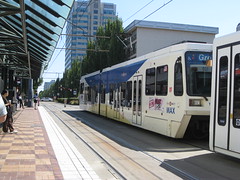
[Portland light rail near the convention center.]

Planning Organizations at Stake


Association of Metropolitan Planning Organizations

AMPO and APTA are jointly recommending to Congress that the reauthorization retain all exixting metropolitan planning organizations (MPOs), regardless of population size.
Removing the decision-making authority from the local level will reduce the voice of the local government, transit agencies, its citizens, and people in the region. Citizens elect their local public officials to reflect the unique nature of their region, and removing the MPO will only increase the distance between the average citizen and the policy-maker.
AMPO and APTA also oppose the 200,000-population threshold for all MPOs as eight states would potentially be left without one unless the Secretary grants approval that they possess the technical capacity to complete the planning requirements. Some that have served as local planning conveners since 1962 would be eliminated.

National Association of Counties
NACo is concerned about reauthorization proposals that fail to maintain planning organizations.
MPOs between 50,000-200,000 would face an uncertain future and are no longer guaranteed a role in the planning process; efforts to enhance the planning role for include rural regions under 50,000 were not successful; the Surface Transportation Program underwent some changes that may not be beneficial to local governments; and funding for the Transportation Enhancement program appears to be no longer mandatory.
[Portland's Amtrak station.]

Amalgamated Transit Union
ATU is advocating in favor of federal operating assistance for transit systems.
Now more than ever we must urge Members of Congress to do the right thing for our communities by voting yes on the amendment to adopt the original “100 Bus” language which also includes targeted and temporary operating assistance for the nation’s medium size and large transit systems which are also in the midst of a mobility crisis.

Other groups, such as Transportation for America, PolicyLink, and the League of American Bicyclists, among others, are advocating for improved transit funding and multi-modal street networks.

As we go to press, there are House members switching sides to back transit and the Senate is likely to put off a vote.
[San Luis Obispo Amtrak station.]

Local Stories

Two of the biggest logistical concerns for working parents are transportation and child care. One transit agency is doing both. To attract good employees who can work the nontraditional hours that transit and other industries demand, Prairie Transit in Spearfish, S.D., "opened its own state-licensed child care facility right in its new transit center." The article, Community care: Day care centers draw workers to towns, appeared in the Rapid City Journal.

Indianapolis, Ind. - APTA reports that IndyGo performed well during the Super Bowl festivities. The transit agency had a “Know Before You Go” campaign to alert riders to temporary route changes and offered free rides Feb. 2-5, funded by a federal Congestion Mitigation Air Quality grant.
Local fixed route ridership surpassed expectations throughout the entire detour period with a 39 percent increase over average ridership: a total of 325,212 rides over 10 days. IndyGo operated additional buses to accommodate the crowds on fixed route service, reaching a peak of 28 extra buses assisting routes on Feb. 4.

APTA's news also highlights another story, this from Cincinnati, where the Everybody Rides Metro Foundation, administered by Metro in Cincinnati, provided more than a million free rides in the past four years to low-income workers traveling to and from work, job training, and related activities. "Almost 100 agencies partner with the foundation, including Talbert House, Freestore Foodbank, St. Vincent de Paul, Lighthouse Youth Services, and Cincinnati Works."

Hi-Tech Town


Boston transit riders have hi-tech ways to get real-time information and engage in public participation. The Massachusetts Bay Transportation Authority is texting real-time information to bus riders. Just the stop identification number and the telephone number are all that is needed. And if you have a smartphone, life is even better because Boston boasts more than 40 apps for transit. Helps having lots of smart, techie college students around. The MBTA is also considering service cuts and fare increases. Like the wired town that it is, Boston's residents are commenting publicly - on twitter. That meeting is so last century. Both stories via the TransitWire.

Tuesday, February 7, 2012

Transit Users - What Influences Use; Events and Local Stories

Events

Easter Seals Project ACTION

Forming Partnerships with Transit - Online course - Feb. 13-Mar. 26. Designed for transit advocates interested in increasing their role in the design and implementation of community transportation services, the course includes four learning modules: Transportation planning, funding, becoming a transit supporter, and strategies.

Partnership for Mobility Management
2012 Mobility Management Conference - May 9-10, 2012, Long Beach, CA. To be held in conjunction with the Bus and Paratransit Conference (details below), this conference features sessions on performance measurement, forming partnerships with different organizations, non-emergency medical transportation and brokerages, customer focus, information technology, and integration of facilities. The Partnership is a collaborative effort of seven national organizations and approximately 300 individual mobility managers and mobility management professionals from around the country.

Community Transportation Association of America

EXPO conference - May 20-25, 2012, Baltimore, Md. This year's EXPO will feature tracks on mobility management, connectivity and livability, transportation operations, and management, as well as separate tracks on transportation for dialysis, veterans and employment. There will also be a two-day Job Access Conference that will focus on transportation partners, namely economic development, workforce development, employers and chambers of commerce; and highlight the many transportation options for students, job seekers, employees and businesses.

American Public Transportation Association
2012 Legislative Conference - March 11-13, 2012, Washington, DC.
Bus & Paratransit Conference - May 6-9, 2012, Long Beach, CA.
Rail Conference - June 3-6, 2012,Dallas, TX
Public Transportation & Universities Conference - June 16-19, 2012, Fargo, ND. This conference explores the unique needs of university communities and the population they serve, including the issues of universal access and land use development.

American Public Works Association
Sustainability in Public Works Conference - June 25-27, 2012, Pittsburgh, PA.

Local Stories


Children’s Health Fund
Instead of traveling to the doctor, a CHF mobile medical clinic goes to children and families. This entertaining video shows what the mobile clinics do and what that means for families.

At the other end of the age spectrum, a travel training program for older people fosters independence. This article, Program takes aim at seniors' bus fears, about a Wisconsin mobility manager who does travel training, and the older people he is training, personalizes the significance of the training and the confidence, and the mobility that using public transportation provides for those with transportation and mobility challenges. The article appeared in the GazetteXtra.com.

Transit Riders by Mode


Minetta Transportation Institute

Understanding Transit Ridership Demand for a Multi-Destination, Multimodal Transit Network in an American Metropolitan Area - Lessons for Increasing Choice Ridership While Maintaining Transit Dependent Ridership explores ridership patterns in the Atlanta area, specifically what bus and rail commuters have in common and what transit variables separate them. Though the report looks at the Atlanta area, the findings seem useful for thinking about transit possibilities and realities in other areas of the country. Here are a few excerpts. Many more details can be found in the report.

Bus riders were overwhelmingly transit-dependent riders, and rail riders included a disproportionate number of choice riders. By and large, rail riders tend to come from zones with high levels of vehicle access and bus riders from zones with low levels of vehicle access. The model results highlight important similarities as well as differences between the two rider groups. In terms of similarities, both bus and rail trips are produced in larger numbers in zones with higher populations and higher population densities, and attracted to destinations with larger numbers of jobs, but generally not areas with the highest densities of employment. Both bus and rail riders are also generally quite sensitive to in-vehicle travel time and transfer time.

In terms of differences between bus and rail riders, bus riders tend to come from zones with lower income, lower vehicle access (as noted above), and higher minority populations. While rail riders also disproportionately come from minority zones, they come from zones with high levels of vehicle access and the income variable is not significant, except in the cases of rail riders destined to more dispersed destinations, who tend to come from zones with lower incomes, but also relatively high levels of vehicle access. Bus riders do not place the same importance on out-of-vehicle travel time to transit as do rail riders ... Rail riders, on the other hand, do place a premium on out-of-vehicle travel time ... This is not surprising given the small number of rail stations and their spatial distribution relative to the patterns of population and employment in Atlanta.

TOD at Destination


The results for the land-use variables also reveal important differences between bus and rail riders as well as insights into the importance of transit-oriented development (TOD). Bus riders in Atlanta are not influenced by the presence of a transit-oriented development at either the origin or destination. The CBD does not emerge as a statistically significant destination for bus riders; indeed, lower density employment clusters emerge as important destinations for these riders. For rail riders, on the other hand, the CBD does emerge as an important travel destination, and two of Atlanta’s TODs (Midtown and North Avenue) emerge as important contributors to rail patronage, in excess of what would otherwise be predicted by the employment levels or densities of these zones.

...

Length of Wait Time Matters

The variable that had the greatest effect in determining transit ridership was the transit travel time between the origin zone and the destination zone. [T]ransit-dependent ridership, rather than being a fixed amount regardless of service quality, increases tremendously if the transit travel time between origin and destination is reduced.

...

What we see by looking at the parameters is a model that depicts more affluent, auto- owning riders using transit than does the bus model. The rail riders are willing to use rail transit to get to jobs throughout the region (not just jobs in the CBD), so long as they can walk to jobs once they get off the trains or can easily transfer to frequent buses that do not take long to reach jobs in the vicinity. CBD and TOD at the rail destination (though not at the rail origin) are highly important to potential rail riders.

...

In-vehicle travel time is relatively less important than out-of-vehicle travel time because trains are relatively fast, and their travel time is not an issue to passengers, in contrast to the depressing effect of slow buses, as shown earlier in the bus models. What really matters, however, are lengthy waits when transferring between trains and buses ... This conclusion is reinforced when we look at the tremendous impact that destination TODs have on multiplying rail ridership in comparison to the insignificant impact that origin TODs have on ridership. Where destination TODs exist, walking to the final destination is relatively short and attractive, and rail ridership to the TOD increases by 500% over what the model otherwise would predict for that zone.