There's an uptick in reauthoriztion talk due to the impending Sept. 30 deadline and whether the old transportation authorization, SAFETEA-LU, will continue to be extended as is - a "clean" extension. A further question is whether a short-term extension will be followed by a reauthorization.
National organizations are advocating for a reauthorization. Their priorities have generally remained the same in the last couple of years. This is what they are saying to the public and to their members.
American Association of State Highway and Transportation Officials
AASHTO supports President Obama's position to extend SAFETEA-LU to "as a prelude to completing a new reauthorization bill." AASHTO's reauthorization recommendations include doubling the use of transit by 2030, encouraging more efficient land use, streamlining transportation programs, and increasing investment in highways, transit and intercity passenger rail. On AASHTO's homepage, it is asking Congress to provide "[f]lexibility to enable states to get the most value for each dollar; [c]hanges in [the] law so we can deliver projects faster; [and f]inancial tools as a supplement to our dollars."

[Bike with bread in Hood River, Oregon.]
National Association of Regional Councils
NARC urges Congress to "pass a clean, long-term authorization extension of both the current federal-aid surface transportation programs (highways and transit) and the continued collection of federal fuel taxes." Economic stability and jobs are cited as the reasons for Congress to act now.
Smart Growth America is basically sending out the same message as NARC, with a warning that if Congress does not act "no federal funds for roads, bridge repair, or transportation options; thousands of American workers facing halts in work or layoffs; a loss of $1 billion in just 10 days."
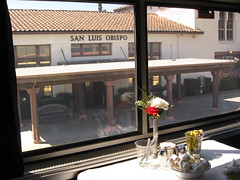
[San Luis Obispo Amtrak station in California. Photograph taken from the Coast Starlight train.]
Community Transportation Association of America
CTAA is noting the redefining of infrastructure to include transit vehicles and workers. Due to the consensus in Congress that we should not slight transportation infrastructure, CTAA is urging transit and transportation providers that "we must keep the infrastructure angle primary in our communications."
American Public Transportation Association
APTA released a public service television spot with Presidents Clinton and Reagon declaring the importance of transportation. The message requests that people tell Congress to pass a robust six-year transportation reauthorization. The ad presently appears on APTA's homepage. APTA is also talking about transportation investment as a means to preserve and create jobs.
Association of Metropolitan Planning Organizations
AMPO succinctly described the current House plans for a six-year reauthorization and the Senate two-year version, which has a $12 billion funding gap. AMPO also explains the mechanics of the Budget Control Act and the House plan to limit transportation spending to the amount of gas-tax receipts.
A summary of what is going on in Congress concerning reauthorization and appropriations appears in yesterday's edition of NRC Capitol Clips.
Thursday, September 8, 2011
Friday, September 2, 2011
Demand for Transit and Long-Distance Options
I am struck by the confluence of information floating across my screen about the more and more mainstream notion of transportation options in different settings, local, rural, urban, and regional.
National Association of Development Organizations
Exploring the Role of Regional Transportation Projects as Rural Economy Drivers is a NADO research report that looks at three positive experiences with transportation-led economic development projects. Funding sources are also discussed.
(1) Vermont: Construction in Brattleboro of a passenger intermodal transportation hub. The transportation hub, just blocks away from the Amtrak station, added to the downtown 300 parking spaces, bicycle racks, a parking enforcement office, street-level commercial space, and a connection to existing local and regional bus service. The results are fewer empty storefronts downtown, a new theater, and plans for renovating the Amtrak station and building a nearby mixed-use retail and multi- family residential project.
(2) Alabama: Creation of Baylinc, the first multi-county public transportation system in Southern Alabama. The report details the funding hurdles, importance of potential commuter service demand and effective partnerships with local leaders and transit systems. The result is the planning of other regional services, including ferry service and a guaranteed ride home component of commuter service. The lesson emphasized is not to give up on a good idea.
(3) Oregon: Recent projects of the Central Oregon Intergovernmental Council (COIC), with the support of regional partners, in opening a ride brokerage call center, preparing a coordinated regional public transportation plan, designing a bus system, building an intermodal transit hub, and starting local and regional bus service. That service is now serving 200,000 riders per year, with a shift from "a transit- dependent population (low-income, older adult and disabled customers) to a population that chooses public transit over other available transportation options ... helping boost the local economy." Although serving the wider public was not part of the plan, early-adopter human service agencies and transportation-challenged individuals convinced small communities and agencies to support public transit. There are now plans to partner with the business community and add pedestrian and bicycle connections. The advice of one participant is to "[c]reate a story of the problem and have data available to demonstrate a need for the proposed service. "
NADO also issued new reports about air quality projects (with one transit example), emergency planning and economic recovery after disasters.
Long-Distance Connectivity
American Bus Association
The ABA is promoting the $8.8 million that the Federal Transit Administration is offering for wheelchair lifts as part of its Over-the-Road Bus (OTRB) Accessibility Program. The ABA has a special grant information webpage with details and contacts for assisting with grant applications. The deadline is Sept. 12, 2011.
ABA mentions Who Rides Curbside Buses? A Passengers Survey of Discount Curbside Bus Services in Six Eastern and Midwestern Cities, a survey of passengers of intercity curbside bus service about what modes they are taking their business from and also examines the differences between travelers on these buses and on conventional carriers. "Curbside bus companies have attracted publicity for their steeply discounted fares, free wireless internet, and express services on routes that had seen little new service in decades." The 14-page report was prepared by the Chaddick Institute for Metropolitan Development at DePaul University.
The buses are generating trips in the two areas studied, East Coast and Midwest cities. Their fares undercut Amtrak's, are competitive with car travel, and offer free wifi. On the East Coast, where Amtrak's Northeast Corridor service is a popular option with frequent trains, the curbside buses are stealing business, though Amtrak is still showing ridership increases. In the Midwest, bus passengers are forgoing automobile travel add airplane trips.
Young Demographic
The age 18-25 age group represents a large segment of the curbside bus market and though I have seen many people outside this age group board those buses, including me, there is no question that it is mostly an under-30 crowd. Perhaps due to the nature of their travel and not being as concerned with time (or more concerned with free wifi at low cost), personal rather than business trips predominate. A huge difference with the conventional bus market is the over 90 percent use of portable electronic devices. The only greater percentage use is on the Acela, which costs a whole lot more, is the quickest option (rivaling the plane) and generally has much more expensively dressed travelers.
The ABA also reports that Megabus in the United Kingdom is experimenting with sleeper service, including one's "very own bed," on overnight service between Glasgow and London.
National Association of Development Organizations
Exploring the Role of Regional Transportation Projects as Rural Economy Drivers is a NADO research report that looks at three positive experiences with transportation-led economic development projects. Funding sources are also discussed.
(1) Vermont: Construction in Brattleboro of a passenger intermodal transportation hub. The transportation hub, just blocks away from the Amtrak station, added to the downtown 300 parking spaces, bicycle racks, a parking enforcement office, street-level commercial space, and a connection to existing local and regional bus service. The results are fewer empty storefronts downtown, a new theater, and plans for renovating the Amtrak station and building a nearby mixed-use retail and multi- family residential project.
(2) Alabama: Creation of Baylinc, the first multi-county public transportation system in Southern Alabama. The report details the funding hurdles, importance of potential commuter service demand and effective partnerships with local leaders and transit systems. The result is the planning of other regional services, including ferry service and a guaranteed ride home component of commuter service. The lesson emphasized is not to give up on a good idea.
(3) Oregon: Recent projects of the Central Oregon Intergovernmental Council (COIC), with the support of regional partners, in opening a ride brokerage call center, preparing a coordinated regional public transportation plan, designing a bus system, building an intermodal transit hub, and starting local and regional bus service. That service is now serving 200,000 riders per year, with a shift from "a transit- dependent population (low-income, older adult and disabled customers) to a population that chooses public transit over other available transportation options ... helping boost the local economy." Although serving the wider public was not part of the plan, early-adopter human service agencies and transportation-challenged individuals convinced small communities and agencies to support public transit. There are now plans to partner with the business community and add pedestrian and bicycle connections. The advice of one participant is to "[c]reate a story of the problem and have data available to demonstrate a need for the proposed service. "
NADO also issued new reports about air quality projects (with one transit example), emergency planning and economic recovery after disasters.
Long-Distance Connectivity
American Bus Association
The ABA is promoting the $8.8 million that the Federal Transit Administration is offering for wheelchair lifts as part of its Over-the-Road Bus (OTRB) Accessibility Program. The ABA has a special grant information webpage with details and contacts for assisting with grant applications. The deadline is Sept. 12, 2011.
ABA mentions Who Rides Curbside Buses? A Passengers Survey of Discount Curbside Bus Services in Six Eastern and Midwestern Cities, a survey of passengers of intercity curbside bus service about what modes they are taking their business from and also examines the differences between travelers on these buses and on conventional carriers. "Curbside bus companies have attracted publicity for their steeply discounted fares, free wireless internet, and express services on routes that had seen little new service in decades." The 14-page report was prepared by the Chaddick Institute for Metropolitan Development at DePaul University.
The buses are generating trips in the two areas studied, East Coast and Midwest cities. Their fares undercut Amtrak's, are competitive with car travel, and offer free wifi. On the East Coast, where Amtrak's Northeast Corridor service is a popular option with frequent trains, the curbside buses are stealing business, though Amtrak is still showing ridership increases. In the Midwest, bus passengers are forgoing automobile travel add airplane trips.
Young Demographic
The age 18-25 age group represents a large segment of the curbside bus market and though I have seen many people outside this age group board those buses, including me, there is no question that it is mostly an under-30 crowd. Perhaps due to the nature of their travel and not being as concerned with time (or more concerned with free wifi at low cost), personal rather than business trips predominate. A huge difference with the conventional bus market is the over 90 percent use of portable electronic devices. The only greater percentage use is on the Acela, which costs a whole lot more, is the quickest option (rivaling the plane) and generally has much more expensively dressed travelers.
The ABA also reports that Megabus in the United Kingdom is experimenting with sleeper service, including one's "very own bed," on overnight service between Glasgow and London.
Wednesday, August 31, 2011
Webinars - Performance Measurement, Creative Responses to Reduced Funding
Performing For Individual, Organizational and Collective Impact - webinar - Sept. 14, 2011 at 2 p.m. Eastern time. The Partnership for Mobility Management and the Community Transportation Association of America jointly present this webinar to explore the fundamentals of performance measurement. Hear how a results-based accountability framework is used to support quality of life. Learn about mobility management measures that gauge success of programs and outcomes for customers. Speakers include representatives of transit, transportation services and workforce agencies as well as a staff member of the Federal Transit Administration.
Creative Solutions to Reduced Funding for Public and Human Services Transportation - webinar - Sept. 20, 2011 at 2 p.m. Eastern time. The National Consortium on the Coordination of Human Services Transportation presents this colloquium via webinar to assist national organizations, states and communities during these fiscally challenging times. Speakers are representatives of communities that have taken different approaches to solving or alleviating the problem of cutbacks as well as a panel representing national organizations.
President Addresses Reauthorization
Department of Transportation
Secretary of Transportation Ray LaHood in his Fastlane blog applauds President Obama's request that Congress "pass a clean extension of key transportation programs as soon as possible." The President states that the jobs of thousands of construction workers and DOT employees are on the line. Politico is linking Obama’s remarks to a job-creation plan he’s expected to launch next week.
According to Politico, the President also calls this a good time to invest in transportation - while jobs are scarce, interest rates are low and infrastructure needs to be maintained. “We have to have a serious conversation about making real, lasting investments in infrastructure from better ports to a smarter electric grid to high speed rail,” he said. A Washington Post blog states that Obama will address jobs next week in a speech to a joint session of Congress.
The houses of Congress have different plans, a six-year reauthorization in the House and a two-year proposal in the Senate. Transportation funding will expire on Sept. 30. Click here for more general information about reauthorization and the speech from the Associated Press.
Secretary of Transportation Ray LaHood in his Fastlane blog applauds President Obama's request that Congress "pass a clean extension of key transportation programs as soon as possible." The President states that the jobs of thousands of construction workers and DOT employees are on the line. Politico is linking Obama’s remarks to a job-creation plan he’s expected to launch next week.
According to Politico, the President also calls this a good time to invest in transportation - while jobs are scarce, interest rates are low and infrastructure needs to be maintained. “We have to have a serious conversation about making real, lasting investments in infrastructure from better ports to a smarter electric grid to high speed rail,” he said. A Washington Post blog states that Obama will address jobs next week in a speech to a joint session of Congress.
The houses of Congress have different plans, a six-year reauthorization in the House and a two-year proposal in the Senate. Transportation funding will expire on Sept. 30. Click here for more general information about reauthorization and the speech from the Associated Press.
Tuesday, August 30, 2011
Caregiving Costs & FTA Policy on Access to Transit
AARP
AARP reports that transportation is a major part of caregiving for elderly relatives. Valuing the Invaluable: 2011 Update - The Economic Value of Family Caregiving in 2009, states:
Nearly four in ten (39 percent) Medicare beneficiaries report being accompanied to routine medical visits, typically by spouses or adult children. A recent analysis found that family and friends provide 1.4 billion trips per year for older relatives (age 70+) who do not drive. Adult children provide 33 percent of these trips.Taking time off to drive a parent or a spouse is not the only responsibility, though it might be one of the most time consuming. AARP also mentions the at-home medical care for people with long-term conditions as well as nursing-type care is performed after major surgeries and other critical procedures. Those people requiring the most care over long periods were individuals with chronic health conditions.
According to "more than one in three (36 percent) caregivers" due to budget cuts "government agencies and nonprofit organizations are now less able to provide services to their relative or friend" than prior to the recession. These include services such as transportation and delivered meals. This is borne out with area agencies on aging statistics in the report. Long-term effects for caregivers include a drain on financial resources and retirement savings, and negatively impacted employment prospects or advancement. Only California and New Jersey have legislation mandating paid family leave programs.
[Fish design bike rack in Long Beach, Calif.]
American Association of State Highway and Transportation Officials
AASHTO publicized the Federal Transit Administration's (FTA) issuance of a policy statement on the eligibility of pedestrian and bicycle improvements for funding under federal transit law - up to a radius of one-half mile for pedestrian improvements and all bicycle improvements located within three miles of a public transportation stop or station." The FTA declares a "de facto physical and functional relationship to public transportation." Funding for bicycle or pedestrian improvements at greater distances to public transportation may also be eligible for FTA funding where it is demonstrated that "the improvement is within the distance that people will travel by foot or by bicycle to use a particular stop or station." And that's just the FTA's introduction to the statement.
Details about funding are available in the NRC Technical Assistance News. The FTA policy statement appears in the Federal Register.
Monday, July 25, 2011
Events
Easter Seals Project ACTION
July 27 - Promising Practices and Solutions in Accessible Transportation: Environmental Barrier Analysis and Options for Remedy webinar.
This webinar will focus on common barriers and potential remedies for creating a barrier-free environment. Community assessment tool included that may be shared to train others on the importance of community involvement in removing barriers to accessibility.
Aug. 15 - Fundamentals of Travel Training Administration online course.
The course teaches about launching, operating and maintaining a travel training program. Learners may complete this course at their own pace while sharing experiences, ideas and knowledge with colleagues.
Autumn
Association of Metropolitan Planning Organizations
Oct. 25-28 - AMPO Annual Conference - Dallas, TX.
Expected presentations about climate change, complete streets, data collection, sustainable communities, small MPOs, promoting health through transportation, performance measures and social networking.
American Public Health Association
Oct. 29-Nov. 2 - Annual Meeting - Washington, D.C.
There are 1000 sessions on a wide range of public health topics, with many devoted to some aspect of the intersection with transportation, including public transit, walking and cycling, and mobility of people with disabilities.
July 27 - Promising Practices and Solutions in Accessible Transportation: Environmental Barrier Analysis and Options for Remedy webinar.
This webinar will focus on common barriers and potential remedies for creating a barrier-free environment. Community assessment tool included that may be shared to train others on the importance of community involvement in removing barriers to accessibility.
Aug. 15 - Fundamentals of Travel Training Administration online course.
The course teaches about launching, operating and maintaining a travel training program. Learners may complete this course at their own pace while sharing experiences, ideas and knowledge with colleagues.
Autumn
Association of Metropolitan Planning Organizations
Oct. 25-28 - AMPO Annual Conference - Dallas, TX.
Expected presentations about climate change, complete streets, data collection, sustainable communities, small MPOs, promoting health through transportation, performance measures and social networking.
American Public Health Association
Oct. 29-Nov. 2 - Annual Meeting - Washington, D.C.
There are 1000 sessions on a wide range of public health topics, with many devoted to some aspect of the intersection with transportation, including public transit, walking and cycling, and mobility of people with disabilities.
Wednesday, July 20, 2011
What's in the Deal for Transit and Community Programs?
I have yet to see specifics about transit or community transportation in articles about the proposed bipartisan debt-ceiling/deficit-reduction package. Instead of writing about missing details, I will take a page from the Daily Show - no, I won't attempt comedy - and look back at the bipartisan commission that is the source for the current proposal.
In late 2010, the chairs of the bipartisan National Commission on Fiscal Responsibility and Reform, former Clinton White House chief of staff Erskine Bowles and retired Sen. Alan Simpson (R-Wyo.), released detailed draft recommendations and a PowerPoint summary explaining their plan to significantly cut the federal budget and reduce the national debt.
Lots of Details
Their recommendations included freezing federal employee salaries and cutting the federal workforce, reducing the number of contract positions, and reducing the amounts spent on federal travel. Their plan would eliminate the Economic Development Administration and merge the Department of Commerce with the Small Business Administration. For transportation, there would be a 15-cent increase in the gas tax. There is much more. If you want details, refer to both the draft recommendations and the PowerPoint because they cover somewhat different topics.
This blog covered the responses from national organizations within the transportation world in November.
In December 2010, the Commission issued its report and in January 2011, the members of the Commission released their individual statements.
Transportation
The Commission report addresses transportation specifically.
News Will Be Out Soon
Well, we will all know soon whether the current Senate bipartisan proposal will take hold in the House. If it does, the transportation and infrastructure provisions will influence reauthorization whenever that happens, and specifically funding for transit, community transportation and zero-emission modes.
In late 2010, the chairs of the bipartisan National Commission on Fiscal Responsibility and Reform, former Clinton White House chief of staff Erskine Bowles and retired Sen. Alan Simpson (R-Wyo.), released detailed draft recommendations and a PowerPoint summary explaining their plan to significantly cut the federal budget and reduce the national debt.
Lots of Details
Their recommendations included freezing federal employee salaries and cutting the federal workforce, reducing the number of contract positions, and reducing the amounts spent on federal travel. Their plan would eliminate the Economic Development Administration and merge the Department of Commerce with the Small Business Administration. For transportation, there would be a 15-cent increase in the gas tax. There is much more. If you want details, refer to both the draft recommendations and the PowerPoint because they cover somewhat different topics.
This blog covered the responses from national organizations within the transportation world in November.
In December 2010, the Commission issued its report and in January 2011, the members of the Commission released their individual statements.
Transportation
The Commission report addresses transportation specifically.
Under current law, the Transportation Trust Fund has hybrid budget treatment in which contract authority is mandatory, while outlays are discretionary. This hybrid treatment results in less accountability and discipline for transportation spending and allows for budget gimmicks to circumvent budget limits to increase spending. The Commission plan reclassifies spending from the Transportation Trust Fund to make both contract authority and outlays mandatory, and then limits spending to actual revenues collected by the trust fund in the prior year once the gas tax is fully phased in. Shortfalls up until that point would be financed by the general fund.Transit, community transportation and other modes are not addressed. Nor were they mentioned in the President's deficit reduction speech in April 2011, covered here.
The Commission recommends gradually increasing the per gallon gas tax by 15 cents between 2013 and 2015. Congress must limit spending from trust funds to the level of dedicated revenues from the previous year. Before asking taxpayers to pay more for roads, rail, bridges, and infrastructure, we must ensure existing funds are not wasted. The Commission recommends significant reforms to control federal highway spending. Congress should limit trust fund spending to the most pressing infrastructure needs rather than forcing states to fund low-priority projects. It should also end the practice of highway authorization earmarks such as the infamous Bridge to Nowhere.
News Will Be Out Soon
Well, we will all know soon whether the current Senate bipartisan proposal will take hold in the House. If it does, the transportation and infrastructure provisions will influence reauthorization whenever that happens, and specifically funding for transit, community transportation and zero-emission modes.
Subscribe to:
Posts (Atom)
